

Imagine a bright red, fresh tuna fillet displayed in the supermarket, but to produce it, not a single fish is caught, not a drop of seawater is used, and it contains absolutely no mercury or microplastics. This isn't science fiction; it's a reality right on our doorstep.
The era of "cell-cultured seafood" is knocking on the door, with a predicted boom between 2026 and 2028. The question for the traditional aquaculture industry is whether today's ponds and cages will soon be replaced by bioreactors, and where will farmers stand in this new value chain?
From the laboratory to the dinner table
More than a decade ago, when the first burger containing cultured meat was introduced in 2013 at a price of up to $330,000, the whole world laughed and said it was just a luxury toy for the scientific community, never to reach the dinner table of the average person.
But by 2025, that laughter will have faded as production technology makes rapid advances. According to the report "Cultivated Meat: Out of the Lab, into the Frying Pan" by global consulting firm McKinsey & Company, the cost of producing cultured meat is decreasing exponentially according to Moore's Law. McKinsey analyzes that with the current pace of development, the break-even point between cultured and natural meat in the premium segment will be reached around 2030.
Legally, the biggest hurdles have also been removed as the Singapore Food Authority (SFA) and the US Food and Drug Administration (FDA) officially granted commercial approval for cultured meat. In Singapore, the startup Shiok Meats has made a big splash by introducing lobster and prawns grown entirely from stem cells, with a taste and texture indistinguishable from real prawns but produced in a sterile environment like a surgical room.
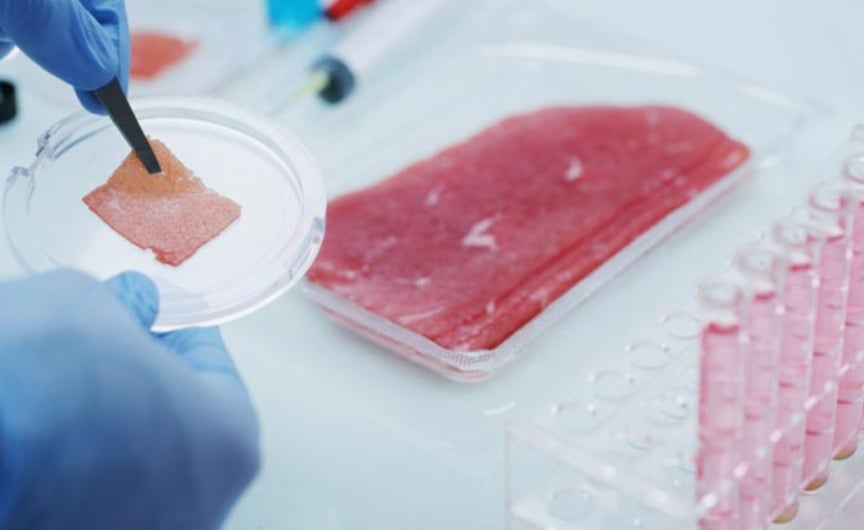
A sample of tuna sashimi created using cell culture technology. Photo: MH.
However, the market will not suddenly shift to using 100% artificial meat. According to The Good Food Institute's (GFI) Industry Status Report, the period 2026-2028 will see a boom in "hybrid" products. These are clever combinations of plant-based protein frameworks from soy, wheat, or young jackfruit with cultured fish fat cells.
GFI points out that this strategy solves two difficult problems simultaneously. First is cost; using mostly plant-based ingredients helps reduce costs to a level that is immediately competitive with wild-caught seafood.
Secondly, there's the flavor aspect. The weakness of current imitation seafood products is the lack of the richness and characteristic fishy smell of seafood. However, by adding just 10-20% cultured real fish fat cells, the hybrid product will perfectly recreate this culinary experience.
The race to dominate the supply chain.
The emergence of cell culture technology poses a real threat to traditional logistics supply chains. Currently, to get a piece of Norwegian salmon in Hanoi , the fish has to be flown thousands of kilometers, leaving a huge carbon footprint. But with cell technology, factories will use bioreactor systems shaped like giant stainless steel industrial brewing pots, located right in industrial zones on the outskirts of Hanoi, Ho Chi Minh City, or any major city.
A report in the journal Nature Food highlights the "weapon" of this model: absolute safety. While the World Health Organization (WHO) continuously warns about the levels of heavy metal contamination in ocean tuna, fish raised in stainless steel tanks are completely free of mercury and microplastics. Furthermore, this model ensures absolute food security as the production process runs continuously 24/7, completely immune to storms, rough seas, droughts, and water pollution.
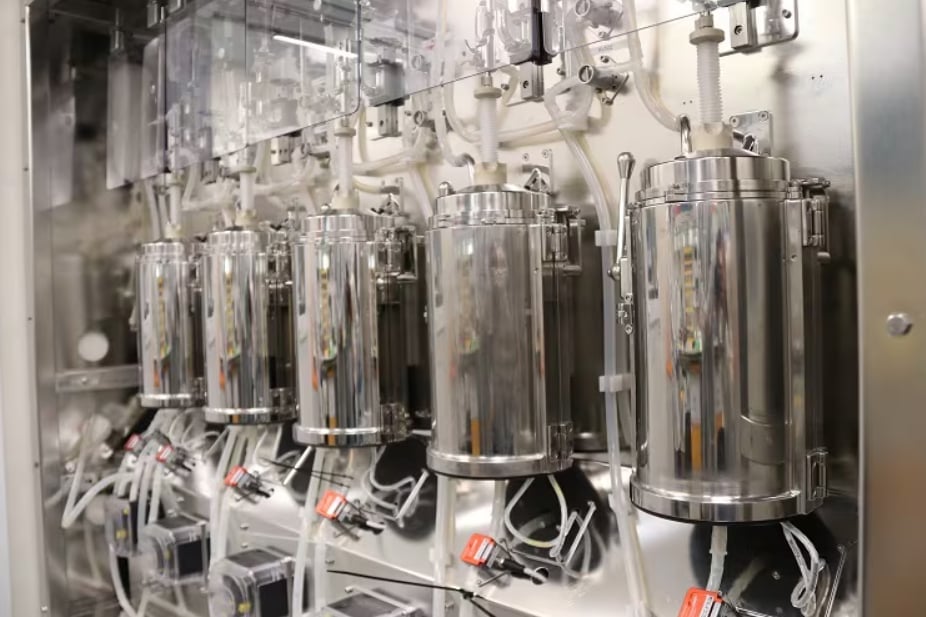
A system of stainless steel bioreactors, where meat and seafood cells are cultured in a sterile environment, replaces traditional ponds. Photo: Ever After Foods.
Recognizing this enormous potential, leading businesses in Vietnam have not stayed out of the game. A prime example is Vinh Hoan Corporation, often dubbed the "Queen of Pangasius" in Vietnam, which has quietly joined the game early on. According to its published financial information, Vinh Hoan has continuously invested in leading Asian food technology startups such as Shiok Meats from Singapore and Avant Meats from Hong Kong.
This move demonstrates the strategic vision of large businesses as they choose to walk on two legs: maintaining traditional pangasius farming areas in the Mekong Delta to serve the current market, while also holding onto core technologies of the future to avoid being left behind when the market reverses.
Farmers won't be marginalized if they know how to adapt.
Faced with this technological "tsunami," many fear that farmers will lose their livelihoods. However, the answer lies in adaptation and role transformation. Cells in a bioreactor don't grow naturally; they require enormous amounts of energy to develop.
Their food consists of a nutrient solution containing glucose for energy and amino acids for muscle building. This nutrient source actually comes from familiar crops in Vietnamese agriculture such as sugarcane, cassava, corn, and various types of beans.
This is a golden opportunity for Vietnam to transition from a traditional agricultural model to "molecular agriculture." Instead of raising catfish amidst disease outbreaks and environmental risks, farmers can switch to cultivating cassava, sugarcane, and soybeans that meet international standards to supply raw materials for artificial meat processing plants.
According to Allied Market Research, the global market for cell-cultured food will reach $2.7 billion by 2030. This is a huge raw material market that Vietnamese agriculture can absolutely capture if properly prepared.
Thus, the "waterless seafood" revolution was not created to eliminate farmers, but rather to restructure the food production industry. In the near future, the market will become clearly polarized, with wild seafood becoming a luxury item for connoisseurs, while cultured seafood and hybrid products will fill the mass market segment.
Vietnamese agriculture needs to quickly adapt and restructure to become a kitchen that provides energy for both of these ecosystems. Instead of fearing that machines will replace humans, the sustainable wealth-building mindset in the new era is to start growing what machines need.
Source: https://nongnghiepmoitruong.vn/nuoi-ca-tom-trong-lo-phan-ung-sinh-hoc--co-hoi-cho-startup-viet-d794347.html
![[Photo] Admire the coral "masterpiece" amidst the million-year-old heritage of Dak Lak province.](https://vphoto.vietnam.vn/thumb/1200x675/vietnam/resource/IMAGE/2026/05/31/1780221235105_anh-man-hinh-2026-05-31-luc-16-53-27.png)


![[Photo] Solemn bathing ceremony and Buddha procession in Hue](https://vphoto.vietnam.vn/thumb/1200x675/vietnam/resource/IMAGE/2026/05/31/1780228263543_1-jpg.webp)










![[Video] Sunset at Lap An Lagoon – Where the sun sets over the fishing nets](https://vphoto.vietnam.vn/thumb/340x192/vietnam/resource/IMAGE/2026/05/31/1780192137701_beach-landscape-sea-water-nature-grass-745871-pxhere-com.jpeg)
![The Essence of Viet Bac Villages: [Part 3] The Precious Fragrance of Nghinh Tuong](https://vphoto.vietnam.vn/thumb/402x226/vietnam/resource/IMAGE/2026/05/29/1780020600366_5237-tinh-tuy-ban-lang-viet-bac-bai-3-chuyen-o-nghinh-tuong-050626_700.jpeg)
![The Quintessence of Northern Vietnam's Villages: [Part 2] The Famous Cassava Noodles of Kunming](https://vphoto.vietnam.vn/thumb/402x226/vietnam/resource/IMAGE/2026/05/28/1779937455892_3929-3144-mien-dong-15-nongnghiep-023138.jpeg)
![The Essence of the Village: [Part 1] Wine on the mountain, tea in the clouds - Bang Phuc](https://vphoto.vietnam.vn/thumb/402x226/vietnam/resource/IMAGE/2026/05/27/1779841729178_3821-1jpg-nongnghiep-103814.jpeg)
































![[Photo] Admire the coral "masterpiece" amidst the million-year-old heritage of Dak Lak province.](https://vphoto.vietnam.vn/thumb/402x226/vietnam/resource/IMAGE/2026/05/31/1780221235105_anh-man-hinh-2026-05-31-luc-16-53-27.png)




























Comment (0)