

In the days leading up to the Lunar New Year of the Year of the Snake, Tra Que vegetable village was bustling and lively.
The joy of being honored by the United Nations Tourism Organization (UN Tourism) as the "Best Tourist Village of 2024" continues to spread throughout this suburban area of the World Heritage site - the ancient town of Hoi An (Quang Nam).
Counting money is exhausting!
I first visited Tra Que (Cam Ha, Hoi An) in 2003, right when Hoi An launched a tourist tour called "Tra Que Vegetable Village" with many new and unique activities. Spending half a day there, my feeling, as someone who grew up in the countryside, was "nothing special," because the rows upon rows of cabbage, lettuce, basil, mint, coriander, and other herbs were just like any other vegetable garden in Quang Nam province – nothing special! Even the dish called Tam Huu (locals call it "shrimp with a fragrant sauce"), which the people of Tra Que promoted as a specialty, I patiently waited to try, and found it... quite ordinary. It was just a small shrimp stir-fried, sandwiched between slices of boiled pork, with basil and green onions tied around it, and dipped in fish sauce...
"Oh, it's normal, so why isn't it normal?" Foreign tourists started flocking in – Americans, French, Russians, Japanese, Koreans… – you name it. Groups of 16-seater, 30-seater, and 50-seater vans lined the village from beginning to end, packed with people. Everyone was excited to play the role of "A Day as a Farmer." On one side, they tilled the soil, prepared the beds, fertilized, sowed seeds, and watered the plants… On the other side, they pulled up cabbage, picked vegetables, and bundled onions… They even went to local homes and homestays (which weren't many at the time) to try making Tam Huu dishes and enjoy them on the spot. Laughter and chatter filled the air from morning till afternoon along the Co Co River. In the early days of ecotourism, the local residents were unfamiliar with many things, not yet accustomed to serving groups of tourists who loved community-based tours, so they had to learn as they went. And international tourists coming to Tra Que didn't just "play farmers" and eat vegetables; they tried everything the village sold. Services and trade flourished as a result. Foreign currency, therefore, began flowing into the pockets of farmers...
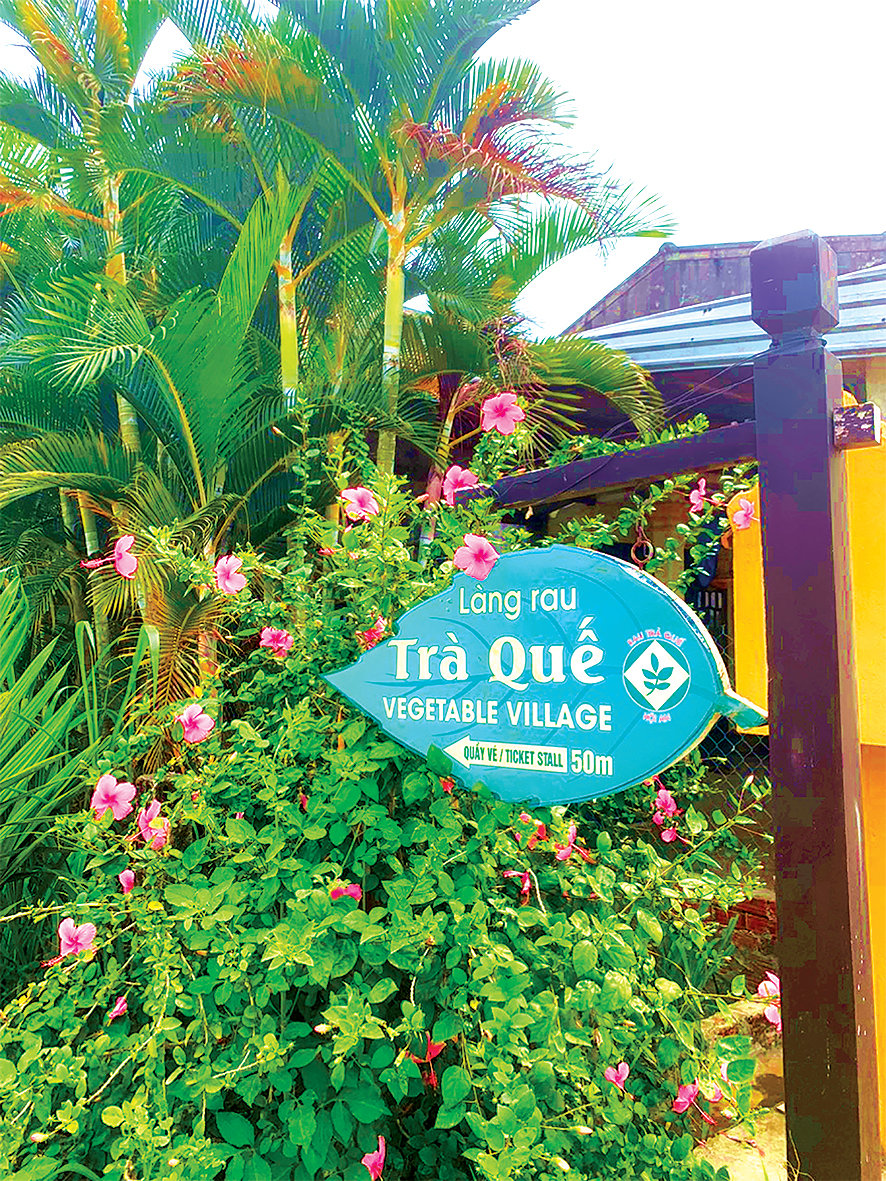
FROM ANONYMOUS TO FAMOUS
Hoi An has many strengths in heritage tourism and traditional craft villages – this is undeniable. Another advantage is that they are very good at marketing their local brand using natural methods. The case of Tra Que is a prime example.
Meeting 9 stringent criteria
During a visit to Quang Nam to present the certificate in early December 2024, Ms. Zoritsa Urosevic, Deputy Secretary-General of UN Tourism, praised: The title "Best Tourism Village of 2024" was awarded to Tra Que vegetable village based on nine stringent criteria, including: cultural and natural resources; conservation and promotion of cultural resources; economic , social and environmental sustainability; tourism development linked to the value chain; tourism governance; infrastructure and connectivity; and criteria related to health, security and safety.
Tra Que vegetable village is the only representative from Vietnam to be awarded this certification in 2024 and is the third village in our country to be honored by UN Tourism, after Thai Hai village (Thai Nguyen) in 2022 and Tan Hoa village (Quang Binh) in 2023.
Following in the footsteps of the Đại Việt migrants conquering the South, this traditional village was formed in the 17th century. Trà Quế is said to have been given its name by King Gia Long (another name is Nhự Quế).
For a long time, Tra Que was just a small, unnoticed village, whose inhabitants lived by fishing. Then, the locals realized that their land was fertile thanks to the alluvial deposits from the lower Thu Bon River and the sediment from the De Voong River, making it ideal for growing fragrant vegetables. So they switched to specializing in vegetable cultivation, a practice they continue to this day.
The authorities and residents of Hoi An over the generations have done a great deal to create the best tourist village - Tra Que - that it is today.
Since 2019, the People's Committee of Hoi An City has issued Decision No. 1766/QD-UBND approving the plan for developing community tourism in Tra Que vegetable village.
On December 13, 2021, the People's Committee of Hoi An City issued Project No. 3603/DA-UBND on "Developing Hoi An Tourism until 2025, with a vision to 2030," and on July 6, 2022, further issued Plan No. 1838/KH-UBND on "Developing Green Tourism in Hoi An until 2025." Accordingly, the government is committed to the "green future" of Tra Que: preserving the unique traditional farming methods, using only seaweed from Tra Que lagoon and decomposed organic fertilizers for cultivation; absolutely no mechanization, chemical fertilizers, or pesticides... Through tourism activities, the cultural values (beliefs, festivals, etc.) of the village are preserved and promoted.
Thanks to tireless efforts, in April 2022, the Tra Que vegetable farming craft was recognized by the Ministry of Culture, Sports and Tourism and included in the list of National Intangible Cultural Heritage, under the category of folk knowledge and traditional crafts. Following this, in 2023, Hoi An officially became a member of UNESCO's Global Creative Cities Network in the field of folk crafts and arts. Thanks to this springboard, the Tra Que vegetable village's dossier was soon recognized by UN Tourism as the "Best Tourist Village of 2024," announced in November of the same year.
Now, among the 4 million tourists who visit and stay in Hoi An each year, how many haven't fallen in love with Tra Que tea?! Each tourist is also an "ambassador," taking this brand further and spreading its reach wider.
This humble dish has made its way to restaurants and eateries throughout Hoi An, Da Nang, Tam Ky, then "on the plane" to Ho Chi Minh City, and followed Vietnamese expatriates to many countries. Tra Que vegetables have naturally become an international brand! Diners who try Tra Que vegetables are hooked. This variety is fresh, green, and clean, with tiny, thin leaves and small stems, yet it has an incredibly fragrant aroma! Customers love it, so restaurants have to cater to their preferences, and thus it has become an irreplaceable choice. "Good wine needs no bush," Tra Que vegetables have risen to the status of a renowned specialty without spending much on marketing!
ECO-CITY WITHIN REACH
I asked Mr. Nguyen Van Son, Chairman of the People's Committee of Hoi An City: That's the theory, but what about the "reward" - what do the local people get?
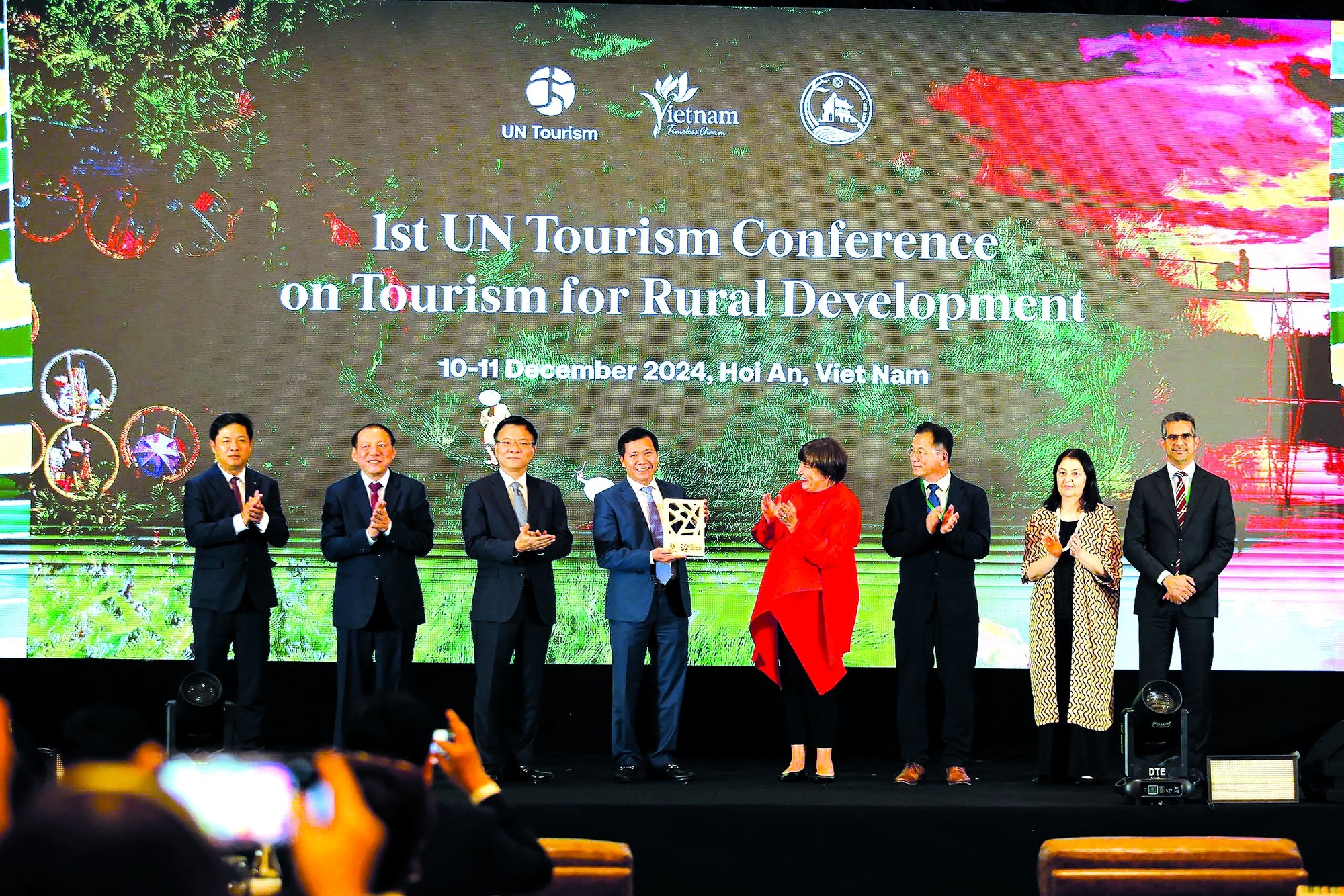
Mr. Nguyen Van Son, Chairman of the People's Committee of Hoi An City, representing the local government, received the "Best Tourist Village of 2024" award for Tra Que vegetable village from Ms. Zoritsa Urosevic, Deputy Secretary-General of UN Tourism, on the evening of December 10, 2024. Photo: TRAN THUONG
"The community benefits greatly!" Here's the impressive answer: Firstly, with 202 households comprising 326 direct laborers cultivating 55 types of vegetables on 18 hectares, harvesting approximately 800 tons of safe, high-quality vegetables meeting VietGAP standards annually, tourism in Tra Que is creating jobs and increasing income for residents. Currently, the average income of residents reaches 56.11 million VND/person/year; the average revenue from the production and consumption of clean vegetables by the 202 households in the village reaches approximately 12 billion VND/year.
Secondly: Realizing the goal of developing green tourism. With traditional farming methods, the residents of Tra Que craft village are moving towards green consumption, green tourism, and sustainable tourism, in line with Hoi An City's policy of building an ecological city. The organic vegetable products from the craft village brought to market are guaranteed to be safe for public health. The "From garden to table" model is increasingly favored by international tourists because it meets the requirements for food safety and environmental protection. Instead of going to restaurants to enjoy delicious dishes, in Tra Que, tourists are taken to visit the gardens, learn about the process of growing and caring for clean vegetables, processing and enjoying many vegetable dishes, drinks, and some local specialties such as Quang noodles, Cao Lau, and banh xeo... amidst lush green nature.
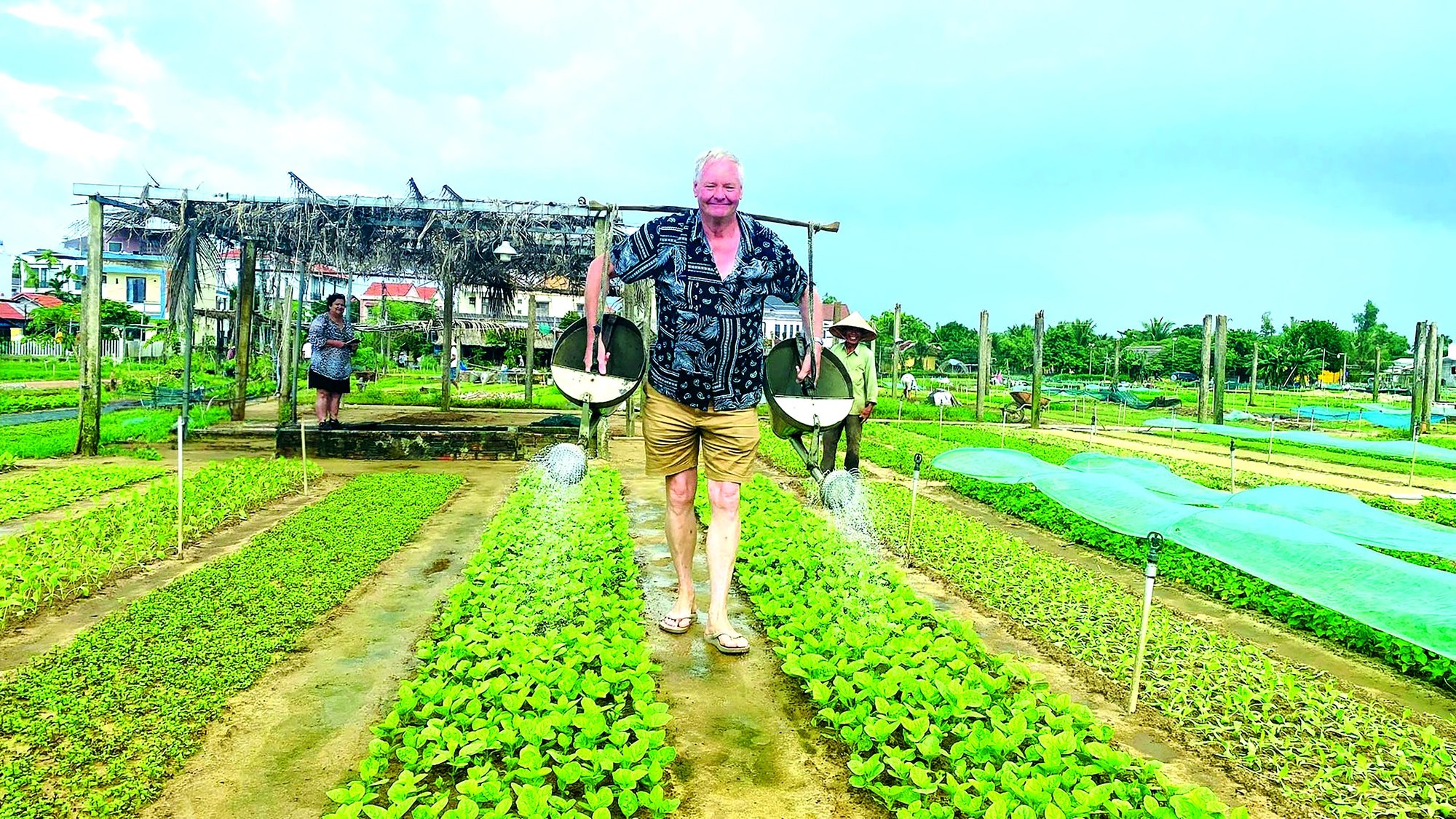
Foreign tourists experience life in Tra Que vegetable village.
As Tet approaches, the number of tourists visiting Tra Que increases. The whole village is bustling day and night with the spring vegetable harvest. With more and more successful green tourism models like Tra Que, Hoi An will soon become an eco-city.
Source: https://nld.com.vn/phai-long-tra-que-196250114092026817.htm
![[Photo] Capturing the moment the tide recedes at Yen Binh Son rapids - a million-year-old scenic spot in Quang Ngai.](https://vphoto.vietnam.vn/thumb/1200x675/vietnam/resource/IMAGE/2026/05/19/1779175463885_yen9-1199-jpg.webp)
![[Photo] National Assembly Chairman Tran Thanh Man attends the groundbreaking ceremony for the National Highway 1A spatial axis project.](https://vphoto.vietnam.vn/thumb/1200x675/vietnam/resource/IMAGE/2026/05/19/1779161360398_ndo_br_bnd-1412-jpg.webp)












































![[Photo] General Secretary and President To Lam receives Indian Defense Minister Rajnath Singh](https://vphoto.vietnam.vn/thumb/402x226/vietnam/resource/IMAGE/2026/05/19/1779184046302_anh-man-hinh-2026-05-19-luc-16-46-58.png)
















Comment (0)