

From "white gold" to prolonged difficulties
Once considered the "white gold" of the hilly region of Quang Tri , rubber trees have experienced many ups and downs along with the market. At times, persistently low latex prices caused hardship for many households, shrinking rubber plantation areas, and forcing many to switch crops to maintain their livelihoods. But now, as rubber latex prices are gradually recovering, people's confidence in this key crop is slowly being rekindled.
The Cua area is home to a large concentration of rubber trees in Cam Lo commune. These days, the atmosphere is bustling as people begin a new harvesting season. From early morning, households are present in their plantations to tap, collect, and prepare latex for sale to traders. The improved price of latex not only brings better income but also motivates people to continue cultivating this crop, which has helped many families improve their lives.
 |
| Mr. Vo Van Tan is delighted that rubber prices have risen again - Photo: LT |
Having been involved with rubber trees for over 15 years, Mr. Vo Van Tan in Nghia Phong village, Cam Lo commune, said that during the peak period in 2010, the price of rubber latex fluctuated from 45,000 to 50,000 VND/kg. At that time, rubber trees truly became a crop that brought high economic efficiency to the people. Thanks to the stable income from more than 4 hectares of rubber trees, Mr. Tan's family was able to support their children's education and cover living expenses. Not only his family, but many other households in Cam Lo also boldly expanded their rubber tree cultivation area, hoping for the economic potential of rubber trees.
However, heavy reliance on the market also exposes rubber growers to many risks. Since 2016, the price of latex has plummeted to only about 5,000-6,000 VND/kg, much lower than the investment and labor costs. The prolonged decline in income has caused significant hardship for farmers. In addition to market fluctuations, many rubber plantations have suffered heavy damage from successive storms and heavy rains. Thousands of hectares of rubber trees have been broken or uprooted, with many plantations taking years to recover, and some areas even having to be completely cleared.
Mr. Vo Van Tan further shared that, due to the impact of fluctuating prices and natural disasters, his family's rubber plantation area has shrunk from over 4 hectares to only about 2.5 hectares. During that difficult period, many households in Cam Lo commune switched to planting acacia, pepper, or fruit trees to alleviate economic pressure.
New hope as rubber prices recover.
This year, the rebound in rubber latex prices is creating a sense of optimism among growers. According to locals, the current price ranges from 24,000 to 28,000 VND/kg, an increase of about 8,000-10,000 VND/kg compared to the same period last year. Although it hasn't reached the peak levels of the "golden age," this is considered a positive sign after many difficult years.
With the remaining rubber plantation area, Mr. Vo Van Tan's family harvests about 70kg of solidified latex each day, bringing in nearly 2 million VND in income. This income helps the family cover living expenses and invest in caring for the plantation.
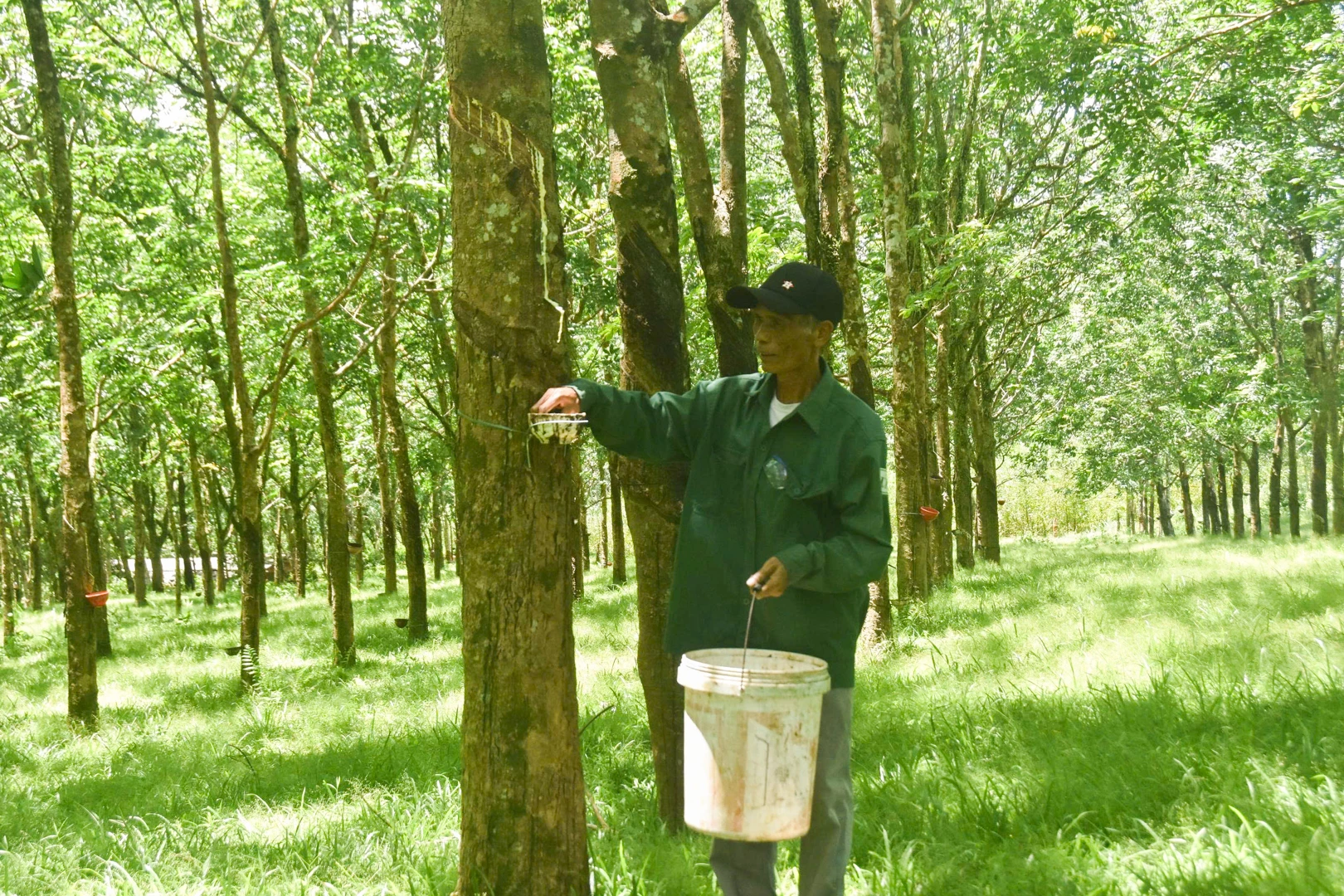 |
| The Cua region currently has about 2,700 hectares of rubber trees, providing a stable source of income for the local people - Photo: LT |
According to local residents, the encouraging news now lies not only in the increase in rubber prices but also in the change in production mindset. While many households previously considered cutting down their rubber trees, they are now focusing more on caring for and restoring existing plantations to maintain long-term production.
Mr. Nguyen Van Hoang, from Son Thanh village, Cam Lo commune, said that from May to November each year is the time when people enter the rubber tapping season. Currently, people hope for stable prices so they can feel secure in continuing to cultivate rubber trees.
According to Nguyen Thanh Cong, Head of the Economic Department of Cam Lo Commune People's Committee, the commune currently has approximately 2,700 hectares of rubber trees. This remains one of the locality's main crops, contributing to job creation and increased income for the people. Therefore, we encourage farmers to continue taking good care of their existing plantations, while closely monitoring market developments to ensure appropriate and sustainable growth.
Not only in Cam Lo commune, but also in Con Tien commune, people are urgently clearing undergrowth and preparing tools for the new harvesting season. The atmosphere of labor in the rubber-growing areas shows the hope for a more favorable harvest after many difficult years.
According to Mr. Cai Viet Chi from An Nha village, Con Tien commune, this year the rubber tapping season is shorter, so most of the trees are still green. At this time, we are taking advantage of the favorable weather to open the tapping gates, preparing for the new tapping season.
According to Ms. Tran Thi Oanh, Chairwoman of the People's Committee of Con Tien commune, the entire commune currently has more than 2,472 hectares of rubber trees in the harvesting stage. Rubber trees not only provide employment for rural laborers but also become an important source of income, helping many families stabilize their lives and develop their economy.
The rebound in rubber prices is raising hopes for rubber farmers. Despite remaining challenges and risks from the market and weather, the positive price recovery is boosting confidence, encouraging people to maintain their main crop, aiming for sustainable agricultural development and improving their livelihoods in the hilly areas of Quang Tri province.
Le Truong
Source: https://baoquangtri.vn/kinh-te/202605/phankhoi-vigia-mucao-sutang-trolai-c1b6053/


![[Image] Hanoi's urban life under the challenge of a "scorching hot" environment](https://vphoto.vietnam.vn/thumb/1200x675/vietnam/resource/IMAGE/2026/05/25/1779706979265_nang-nong-t5-2026-minh-duy-7-4636-jpg.webp)
![[Image] Close-up view of the interchange connecting the two expressways and Long Thanh Airport.](https://vphoto.vietnam.vn/thumb/1200x675/vietnam/resource/IMAGE/2026/05/25/1779703378210_ndo_br_z7863716673926-224453a31600126cce10622af6290afd-4549-jpg.webp)































































Comment (0)