

According to Sci-News, the family Liassophlebiidae is part of the superorder Odonatoptera, one of the oldest lineages of winged insects on Earth, possibly dating back to the Carboniferous period.
They flourished during the Triassic period and, more remarkably, survived the Triassic-Jurassic extinction event, approximately 200 million years ago, one of the major extinction events in the Phanerozoic eon, which wiped out at least half of the species on the planet.
The specimen's age also approximates that of the mass extinction event and is the oldest specimen of the Liassophlebiidae family ever found, suggesting the deep-rooted origins of this family before its diverse rise in the Jurassic period.
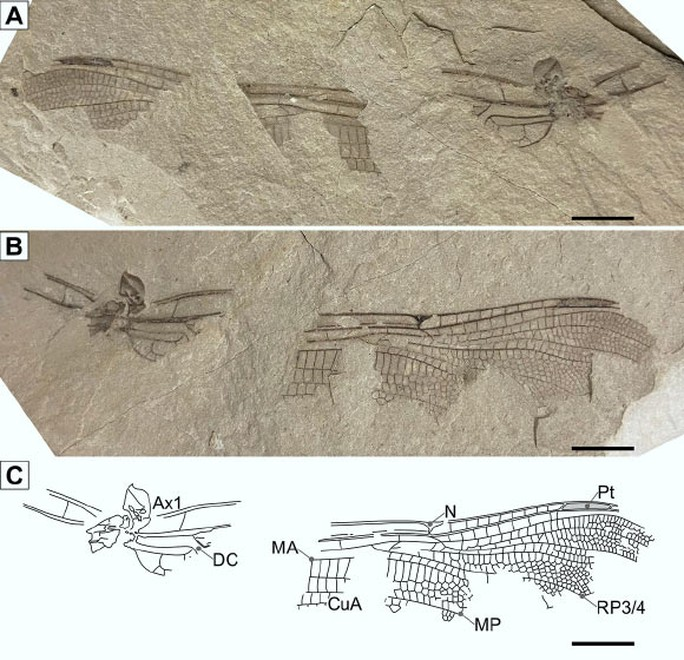
Fossilized dragonfly wings have recently been unearthed in England. (Image: HISTORICAL BIOLOGY)
According to paleontologist Emily Swapy of the Open University (UK), the new specimen includes an incomplete forewing measuring 4.2 cm long and 1 cm wide.
Fossil slabs collected from the Bowdens quarry in Somerset, in the lower part of the White Lias Formation, have revealed many valuable specimens.
This wing section is preserved in astonishing detail, a rarity for specimens of this age.
With a specific age of 202 million years, this ancient dragonfly was born at the end of the Triassic period, meaning it and its lineage represent a group that directly confronted mass extinction, surviving and then thriving, filling ecological niches as soon as the environment became more favorable.
Even more astonishing, the images recreated by scientists show that this dragonfly, over 200 million years old, has an appearance identical to modern dragonflies.
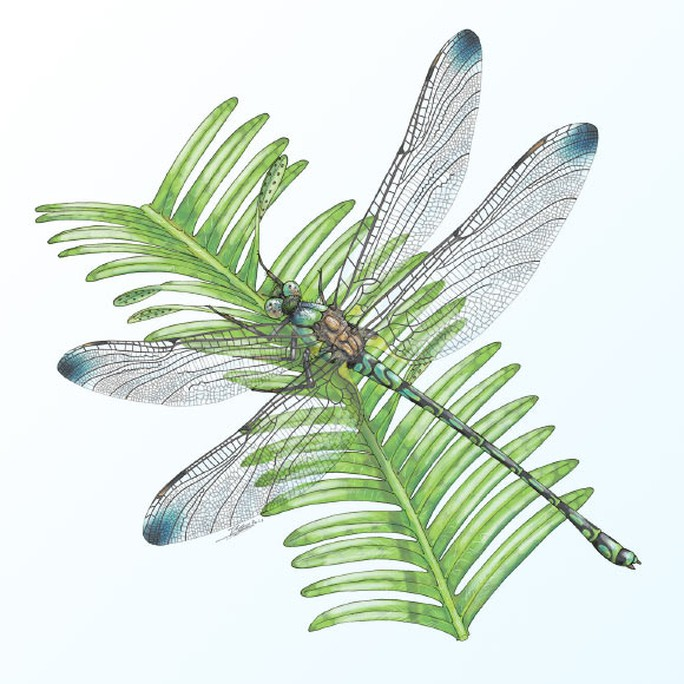
A portrait of a dragonfly from the Triassic period. (Image: HISTORICAL BIOLOGY)
This discovery is a crucial piece in completing the "family tree" of dragonflies, and also contributes to the larger picture of how insects have thrived on Earth and become the most numerous group of organisms today.
(Source: Nguoi Lao Dong Newspaper)
Source


























![[Image] Close-up of the newly discovered "sacred road" at My Son Sanctuary](/_next/image?url=https%3A%2F%2Fvphoto.vietnam.vn%2Fthumb%2F1200x675%2Fvietnam%2Fresource%2FIMAGE%2F2025%2F12%2F13%2F1765587881240_ndo_br_ms5-jpg.webp&w=3840&q=75)




























































Comment (0)