

Fossils discovered on Barro Colorado Island reveal that Panama once had a giant mangrove forest with trees 25-40 meters tall, buried by volcanic mud 23 million years ago.
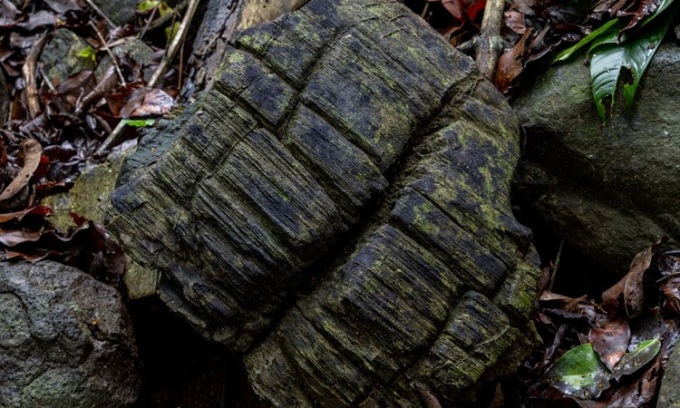
A fossilized wood specimen from Barro Island, Colorado. Photo: Christian Ziegler
An ancient mangrove forest with trees reaching up to 40 meters in height has been discovered more than 20 million years after volcanic mudflows covered the area now located in Panama, according to research published in the journal Palaeogeography, Palaeoclimatology, Palaeoecology . Researchers first found the fossils in 2018 during a geological expedition on Barro Colorado Island (BCI). The island is located in Panama's artificial Lake Gatun, through which thousands of ships pass each year when navigating the Panama Canal.
BCI was once a hilly region that was partially flooded in 1913 when engineers built a dam on the Chagres River to create a canal, and became a nature reserve in 1923. Today, the rainforests of BCI are among the most studied in the world .
"We never imagined there would be petrified wood forests in BCI, even though countless scientists have surveyed the island over the past decade, and no one has ever mentioned them," said study co-author Carlos Jaramillo, a geologist at the Smithsonian Tropical Research Institute in Panama. "The fossils are very difficult to distinguish from decaying trees in the forest because they look like rotting logs."
Despite their shape, the mangrove fossils are remarkably well-preserved, according to Jaramillo. This is because a volcanic eruption buried the tree trunks about 23 million years ago at the beginning of the Miocene epoch (5.3 - 23 million years ago), slowing down the decomposition process and preserving the forest over time.
"Fossilized wood specimens, also known as petrified wood, contain a wealth of information," said research team leader Camila Martínez Aguillón, a paleontologist at EAFIT University in Colombia. The cellular structure, mineralized through geological processes and preserved intact, provides researchers with a rare opportunity to learn about the past.
The research team examined 121 fossilized wood specimens exposed in a small stream on the island and found that 50 specimens belonged to a previously unknown species of tree, called Sonneratioxylon barrocoloradoensis . The newly discovered fossilized tree resembles the mangrove tree found in Southeast Asia, Australia, New Zealand, and several surrounding islands, as well as in many parts of Africa.
While the canopies of most living mangrove trees reach 13 m, S. barrocoloradoensis grew to 25-40 m. This ancient species likely evolved similar survival strategies to modern mangroves, preferring brackish water over high-salinity seawater. The forests grew on the edge of the narrow peninsula connecting central Panama to North America before the Isthmus of Panama formed, approximately 3-23 million years ago.
An Khang (According to Live Science )
Source link




![[Photo] Standing Committee member of the Party Central Committee Tran Cam Tu working with the Central Inspection Committee](https://vphoto.vietnam.vn/thumb/1200x675/vietnam/resource/IMAGE/2026/05/28/1779969579668_ndo_br_bnd-2495-jpg.webp)












![[GALLERY] A "billion-dollar" game that hasn't even been released yet is already driving gamers crazy.](https://vphoto.vietnam.vn/thumb/402x226/vietnam/resource/IMAGE/2026/05/28/1779977371733_goi-3-png.webp)


















































































Comment (0)