

Gene editing - a breakthrough in breeding bananas resistant to Panama disease.
According to Dr. Mary Grace B. Saldajeno, an expert at Dole Corporation, given the severity of Panama disease in bananas, Dole is focusing on cultivation practices involving the use of resistant banana varieties. These varieties are created through various methods such as somatic variation, natural selection, accelerated breeding, or induced mutation.

According to Dr. Mary Grace B. Saldajeno, Dole Corporation is focusing on farming practices involving the use of banana varieties resistant to Panama disease. Photo: Phuc Lap.
Sharing insights on global trends in developing disease-resistant banana varieties, Dr. Mary Grace B. Saldajeno stated that several parallel approaches exist. Among them, somatic variation is a method already implemented in practical production, although the level of disease resistance is currently only moderate.
In addition, methods such as traditional breeding, natural selection, gamma irradiation-induced mutation, accelerated breeding, and gene editing are being researched, tested, and are gradually completing the approval procedures according to regulatory requirements in many countries.
Notably, gene editing is considered a breakthrough in plant breeding. This technology allows for targeted manipulation of DNA sequences or gene activity without introducing foreign genes into plants, aiming to improve nutritional value, flavor, disease resistance, and adaptability to climate change. Compared to traditional genetic modification technology, gene editing has a faster development rate and higher acceptance in many markets.
However, according to Dr. Mary Grace B. Saldajeno, current disease-resistant banana varieties still have many limitations; most only offer resistance, not complete immunity, and the effectiveness of disease resistance largely depends on specific conditions such as pathogen density, climate, and soil characteristics.
Furthermore, market acceptance remains a significant challenge because farmers and exporters need banana varieties that are not only disease-resistant but also meet requirements for flavor, ripeness, and transportability within the supply chain. In addition, differences in legal frameworks and public perception of genetically modified bananas between countries also create certain barriers.
Finally, experts note that the sustainability of disease resistance remains a major question mark. Pathogens can continue to adapt, and reliance on a single gene or strategy always carries the risk of long-term disruption, requiring a holistic and flexible approach to breeding and cultivation practices.
Experience in handling the TR4 strain in the Philippines
Dr. Chih-Ping Chao, former Director of the Taiwan Banana Institute, shared that over 10,000 hectares of Cavendish bananas in the Philippines that had been abandoned due to Panama wilt disease strain Tropical Race 4 (TR4) have been brought back into production by switching to the Formosana variety.

Dr. Chih-Ping Chao stated that the Philippines has decided to restore banana plantations affected by Panama disease using resistant varieties. Photo: Phuc Lap.
In the Philippines, TR4 was first recorded on Cavendish bananas in 2000, spreading rapidly to lowlands and by 2013 rendering thousands of hectares uncultivable, with smallholder farmers being the most severely affected.
Instead of continuing to expand into new areas to compensate for lost yields, the Philippines decided to restore the infected areas using resistant varieties.
The Formosana variety (GCTCV-218) was developed from a somatic mutation (a change in genetic or morphological characteristics occurring in the somatic cells of a plant, often associated with tissue culture and exhibiting genetic stability) by Cavendish, and was developed by the Taiwan Banana Research Institute (TBRI).
Data shows that GCTCV-218 and GCTCV-219 have very low rates of TR4 infection in commercial plots that were heavily infected. Between 2012 and 2015, many GCTCV-219 plots were almost completely free of infection, while popular Cavendish varieties like Grand Naine had infection rates as high as 87% under the same conditions. Although yields and some agronomic indicators did not meet those of susceptible varieties, the new varieties are considered capable of restoring production, especially in areas where crop rotation is not feasible.
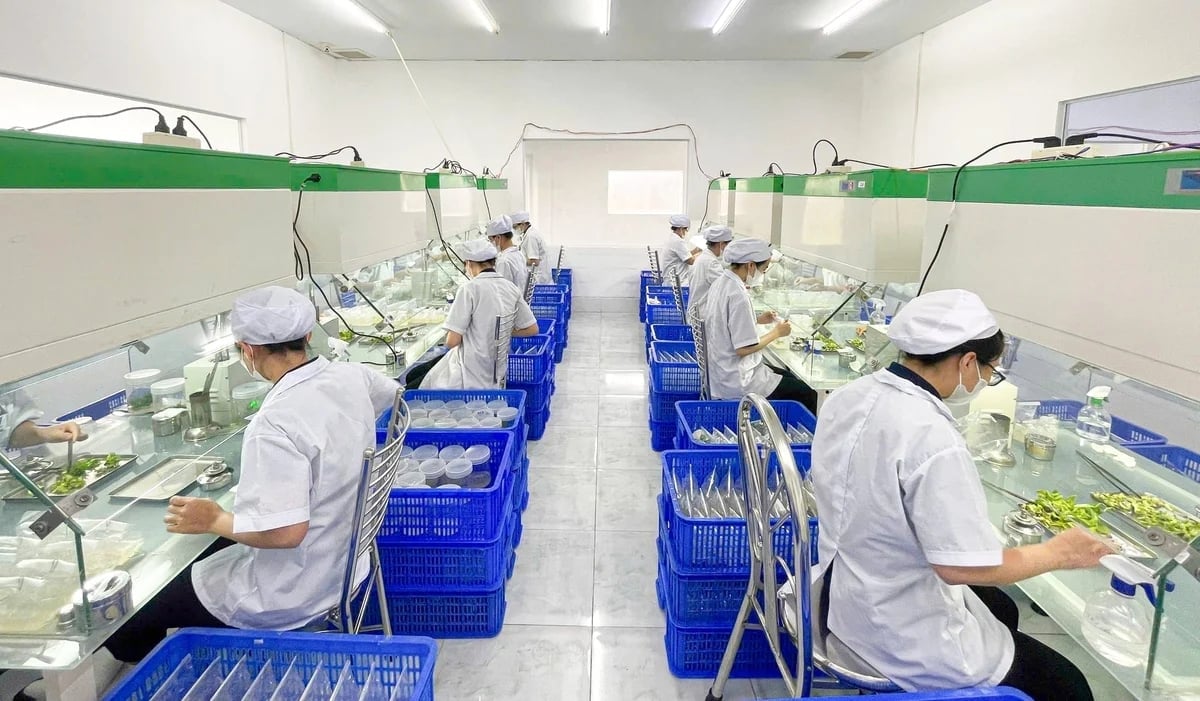
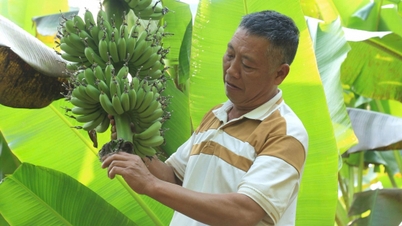
Research and breeding of the UNI 126 banana variety at Vietnam Seed Biotechnology Joint Stock Company. Photo: PH.
By 2025, the total area of Cavendish bananas infected with TR4 that have been restored using the Formosana variety in the Philippines has exceeded 10,000 hectares. This result was achieved in part thanks to plant health management measures. First, biological control and techniques for destroying diseased plants at "hot spots," combined with post-harvest plant tissue treatment to limit the source of infection, were implemented. Measures to prevent bacterial re-infection were also applied, such as biological barriers, vehicle disinfection, and surface drainage.
Another key point is the variety. Using tissue-cultured varieties helps cut the most common route of TR4 infection, which is through uncontrolled planting material. Scientists also recommend that growers consider crop rotation of bananas with rice or taro to lower fungal density in the soil, soil improvement with organic matter, or mulching and intercropping to limit erosion and runoff spread.
Compared to the Philippines, Vietnam faces similar challenges, but on a smaller and more dispersed scale. While the domestic banana industry is growing, its high reliance on vulnerable species like Cavendish bananas poses a significant long-term risk.
Domestic studies have selected several lines with medium resistance, such as GL3-5 from Williams' somatic variant, which were evaluated as meeting agronomic and quality requirements after trials in the North.
The UNI 126 banana variety from U&I Agricultural Joint Stock Company (Unifarm) is assessed to have a resistance rate of over 95% against Panama disease TR4, with a yield of 50-65 tons/ha/season. Currently, this banana variety has been expanded to over 1,500 hectares at Unifarm and its affiliated units.
Unifarm identifies UNI 126 as a superior, disease-resistant banana variety, playing a key role in the sustainable development strategy of the banana industry, aiming to bring Vietnam's banana export value to $1 billion and become a global leader by 2030.
Speaking at the forum "Solutions for controlling banana wilt disease" held on December 13th, international experts and leading scientists expressed their interest in and high regard for UNI 126, considering it one of the banana varieties with the best resistance to Panama disease in the world today.
Source: https://nongnghiepmoitruong.vn/gioi-khoa-hoc-quoc-te-danh-gia-cao-giong-chuoi-uni-126-cua-viet-nam-d789229.html













![Anticipating future trends: [Part 1] New livelihoods from floating tank frog farming model](https://vphoto.vietnam.vn/thumb/402x226/vietnam/resource/IMAGE/2025/12/13/1765607984017_dsc06888-210118_726-133559.jpeg)































































Comment (0)