

Raising frogs in floating tanks opens up new livelihood opportunities.
In recent years, passing through Loc Trung hamlet, Loc Ninh commune, Tay Ninh province, one can easily spot villagers hunched over rows of floating tanks lined with HDPE tarpaulin, the sound of frogs snapping at food mingling with the laughter of the frog farmers. A few years ago, this area was almost exclusively known for rice and cassava, but now, frog farming is quietly becoming a new direction for many farming households.
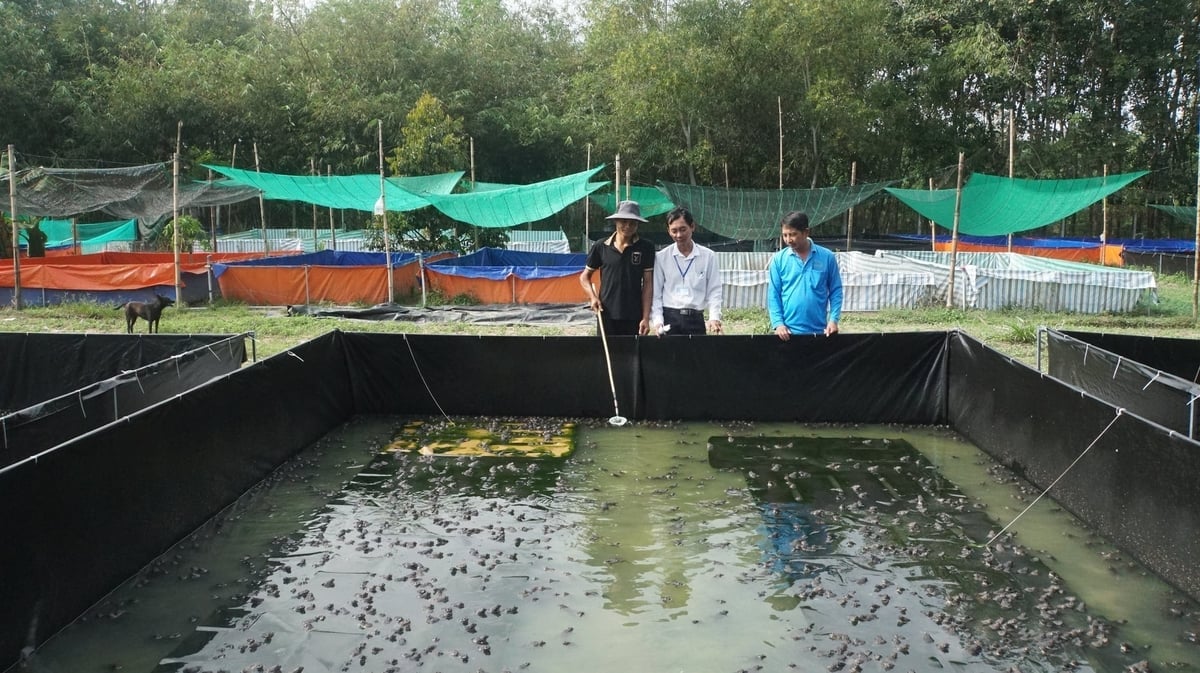
New livelihoods from floating tank frog farming model in Loc Trung hamlet, Loc Ninh commune. Photo: Tran Trung.
Following Mr. Nguyen Ba Quoc, Head of Loc Trung Hamlet, we visited the floating frog farming model of Mr. Tran Van Dung, one of the first farmers to raise frogs. In a small yard of about 1000 square meters, more than 20 cages were neatly arranged. Mr. Dung recounted that he started with only 3 experimental cages, but realizing that frogs were easy to raise and had low costs, he boldly expanded. "I have little land, and rice farming never yields much profit. Seeing that frogs are easy to raise and have a stable market, I decided to try it. Each farming cycle only takes 3 months, and the turnover is much faster than farming," Mr. Dung said with a smile.
That smile wasn't just a joy for his family. Many households around here have found similar approaches: those with yards build raised ponds lined with HDPE tarpaulin, while those without land utilize abandoned barns and sheds for raising frogs. The countryside, once bustling only during the planting season, now has a new sound: the growing croaking of frogs thanks to the diligent efforts of the farmers.
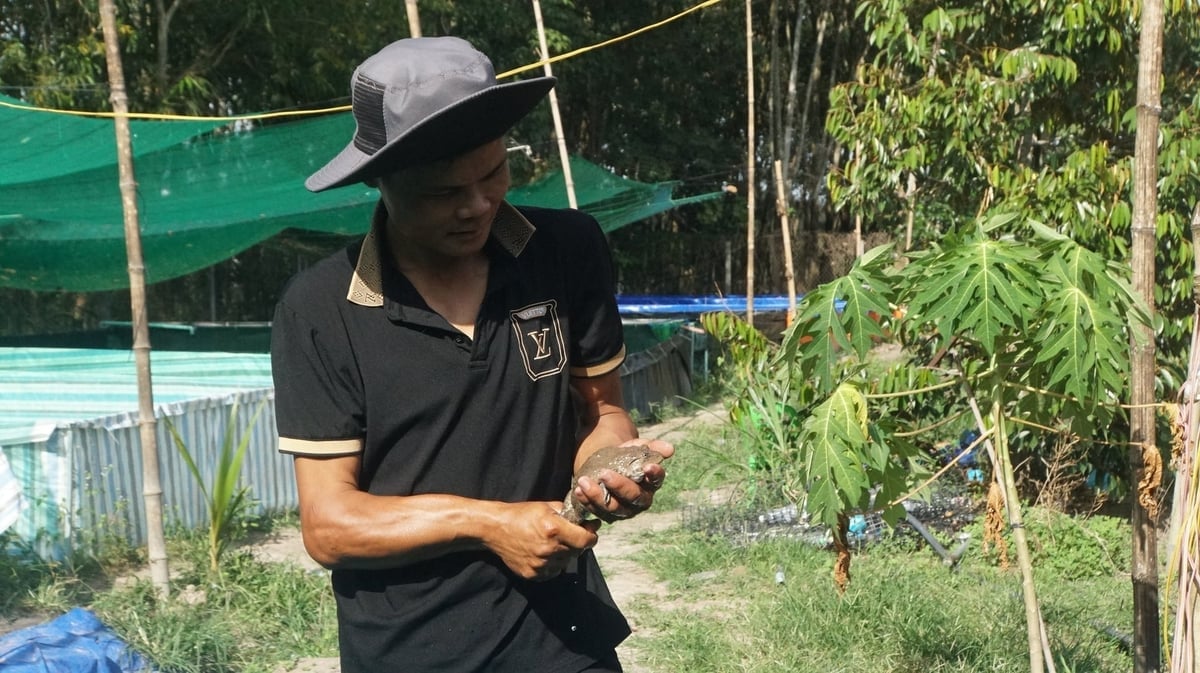
Mr. Tran Van Dung is delighted with the results of his work. Photo: Tran Trung.
According to Mr. Nguyen Ba Quoc, Head of Loc Trung Hamlet, livestock farming has evolved from spontaneous practices to more advanced techniques in recent years, thanks to the efforts of the commune and the Agricultural Extension Center. However, getting information to farmers is not easy, so the commune has experimented with "bringing classes to people's homes."
“Besides technical support, promoting communication, providing on-site guidance, and organizing demonstration models right in the hamlet are considered key solutions to help people grasp the correct process and avoid spontaneous farming that causes environmental pollution. From the initial households, the entire hamlet now has 20-25 households raising frogs, with some large households having up to 70 cages and others small ones having only a few. Each person has their own method, but the economic efficiency has improved significantly,” Mr. Quoc emphasized.
Information on how to get rich from frog farming.
A key highlight is the increasingly innovative way information is conveyed to the people . Gone are the days of gathering dozens of people in auditoriums; now, agricultural extension officers select successful farming households as model farms and invite farmers to see firsthand. While observing the ponds, farmers can ask questions and receive answers on the spot. Everything from feeding methods, disease treatment, water changes, to common mistakes is visually demonstrated right at the production site. This hands-on approach helps farmers learn much faster than simply listening to lectures.
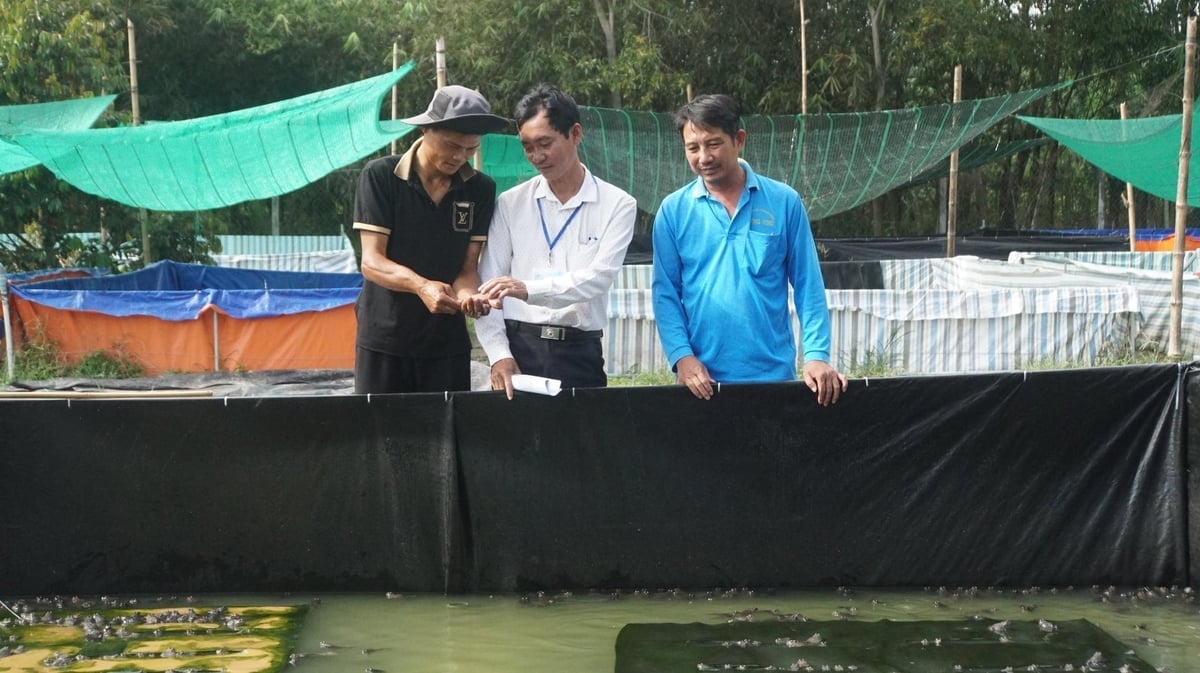
Commune and village officials, along with agricultural extension workers, work alongside farmers. Photo: Tran Trung.
Another approach being considered is the establishment of a frog farming cooperative. By joining the cooperative, households could collectively purchase froglings to reduce costs, share market outlets, learn techniques from each other, and have easier access to government support. "If each person has dozens of cages and operates independently, it will be difficult for anyone to sign a sales contract," Mr. Quoc explained.
If a cooperative is formed, the hamlet will also have the conditions to plan a concentrated farming area, install a common wastewater treatment tank, and limit environmental impact. This is a necessary direction to ensure that frog farming does not become a fragmented, trend-driven occupation but a stable, systematic livelihood.
Currently, traders are regularly coming to buy the produce, but the small volume prevents farmers from negotiating good prices. If the model continues to expand, the opportunity to connect with businesses that will guarantee the purchase of the produce is entirely feasible.
In the coming time, the hamlet will coordinate with the commune to finalize concise technical documents to distribute to each household; at the same time, they will select 2-3 of the most effective models to film illustrative videos to be posted on local social media. "Filming with a phone is fine, as long as people see real people and real situations, they will learn quickly," Mr. Quoc said with a smile.
From humble beginnings, the frog farming model in Loc Trung is opening up a more stable livelihood for the people. Its effectiveness is clear, the risks are low, and it's suitable for households with limited land. Timely communication, regular technical guidance, and a focus on replicating the model will help people reduce their dependence on a few unstable crops, building a small but flexible and sustainable agricultural system.
Amidst the crystal-clear pools and the croaking of frogs each afternoon, the people of Loc Trung are continuing their story of escaping poverty in their own way – persistent, natural, and simple, just like their homeland.
Source: https://nongnghiepmoitruong.vn/di-truoc-don-dau-bai-1-sinh-ke-moi-tu-mo-hinh-nuoi-ech-be-noi-d789065.html


![[Photo] Prime Minister Pham Minh Chinh attends the Conference summarizing and implementing tasks of the judicial sector.](/_next/image?url=https%3A%2F%2Fvphoto.vietnam.vn%2Fthumb%2F1200x675%2Fvietnam%2Fresource%2FIMAGE%2F2025%2F12%2F13%2F1765616082148_dsc-5565-jpg.webp&w=3840&q=75)








![Looking back at the peak month of combating IUU: [Part 3] Synchronizing fisheries infrastructure](https://vphoto.vietnam.vn/thumb/402x226/vietnam/resource/IMAGE/2025/12/13/1765608279533_2109-b32-133759_237.jpeg)






![Major policy decisions for agricultural development in Thanh Hoa: [Part 3] The vast forest waters awaken the entire land.](https://vphoto.vietnam.vn/thumb/402x226/vietnam/resource/IMAGE/2025/12/13/1765583676489_z7282526539020_1ee647dc8468da9b9f2428712b435ae7-nongnghiep-184805.jpeg)





























































Comment (0)