

At the forum "Digital Transformation in Agriculture: Seizing Opportunities, Adapting to the Future" held recently in Hanoi, Dr. Le Duc Thinh, Director of the Department of Cooperative Economics and Rural Development ( Ministry of Agriculture and Environment ), shared many important international experiences in the process of implementing digital transformation in the agricultural sector.
In China, the national digital platform for agriculture has been deployed down to the cooperative and farm level, integrated with local-level management systems.
In Thailand, the TraceThai electronic traceability system is mandatory for exported agricultural products, tracing their origin from farm to market.
"Meanwhile, Vietnam still lacks a synchronized digital traceability system, which is slowing us down in the integration process," Mr. Thinh emphasized.

Dr. Le Duc Thinh, Director of the Department of Cooperative Economics and Rural Development (Ministry of Agriculture and Environment), shared many important international experiences in the process of implementing digital transformation in agriculture. Photo: Hong Tham .
In Europe, digital agriculture extends beyond production management to include carbon trading, carbon credit quantification, and regional policy allocation. This demonstrates their established institutional framework, infrastructure, and data platforms for the comprehensive operation of the digital agricultural ecosystem.
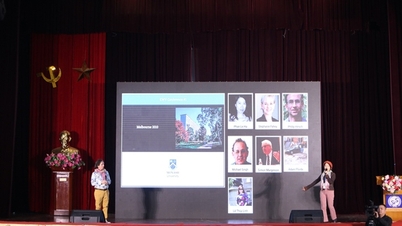
Ms. Le Thi Thu Hien, Head Representative of Agriterra in Vietnam, shared the experience of the Netherlands in building a digital data system to serve cooperative management and market linkages. Ms. Hien emphasized: "Data is the foundation of transparent management and accurate decision-making."
According to research by Wageningen University (Netherlands, 2017), the application of smart data helps increase productivity by 10-20%, while reducing production costs by approximately 15%. Therefore, data is not only a management tool but also a strategic asset for cooperatives.
In the Netherlands – a country with a population of only about 18 million but the world's second-largest exporter of agricultural products – cooperatives are seen as symbols of cooperation and innovation. Their operating philosophy is based on mutually beneficial collaboration, data sharing throughout the value chain, and ensuring that the data belongs to the cooperative members.

Ms. Le Thi Thu Hien, Head Representative of Agriterra in Vietnam, said: “Data is the foundation of transparent governance and accurate decision-making.” Photo: Hong Tham .
Three pillars of digital transformation in Dutch cooperatives have been identified: reshaping the market through a digital ecosystem; optimizing the value chain through smart production; and data-driven governance and digital services. This lays the groundwork for smart agriculture, helping to reduce resource waste and improve product traceability.
To further illustrate the experience of digital transformation in cooperatives in the Netherlands, Ms. Hien cited several typical cases.
Specifically, the world's largest flower cooperative, Royal FloraHolland (established in 1912), has over 3,000 members/flower growers and achieved a revenue of 5.35 billion Euros in 2024.
Over the past period, Royal FloraHolland Cooperative has built the Floriday digital platform, connecting more than 5,500 growers and 2,500 buyers globally, integrating farm management, warehousing, and logistics systems. As a result, the supply chain is shortened, more transparent, intermediary costs are reduced, and markets are expanded to more than 60 countries.
FrieslandCampina, a cooperative established in 1871, has over 14,000 members in the Netherlands, Belgium, and Germany. In 2024, the cooperative's revenue reached €13 billion, becoming a model for a modern and sustainable agricultural value chain.
FrieslandCampina's smart farms utilize IoT technology and sensor systems to monitor the health and productivity of dairy cows in real time, while the smart factories are fully automated with robots and state-of-the-art production data analysis systems.
As a result, the farm can accurately trace the origin from pasture to glass of milk, ensuring consistent quality while optimizing costs, reducing errors, and improving production efficiency.
Rabobank, the largest cooperative bank in the Netherlands, has implemented the FarmData360 platform, integrating financial, climate, and production data to more accurately assess credit risk. As a result, the non-performing loan ratio decreased from 1.8% to 1.2%, while administrative workload was reduced by 40%…

Royal FloraHolland, the world's largest flower cooperative, built the Floriday digital platform, connecting more than 5,500 growers and 2,500 buyers globally. Photo: Royalfloraholland .
Drawing on the experience of the Netherlands and the practices of Vietnam, the Head of Agriterra's Representative Office in Vietnam proposed several directions. At the macro level, it is necessary to build common, transparent digital platforms for each major commodity sector, connecting multiple stakeholders, ensuring security and transparency. It is crucial to ensure farmers and cooperatives have control over their data. Decision-making should be based on data analysis. Investment in human resources and a digital culture is essential. Support for cooperatives includes infrastructure, capital, technology, and consulting.
At the cooperative level, the digital transformation strategy needs to be linked to the cooperative's development strategy and market needs, with the consensus of the board of directors, management board, and members. Leaders should be pioneers and heads of the digital transformation team. Start with the smallest, most urgent issues, and don't try to digitize everything at once. Technology needs to be simple, suitable for farmers, and capable of multi-stakeholder connectivity. Continuous training and guidance are essential, emphasizing learning by doing and fostering creativity in instruction.
“We believe that through international sharing and cooperation, Vietnam can fully develop modern, transparent, data- and technology-driven cooperative models, contributing to green transformation and sustainable agriculture,” the Head of Agriterra in Vietnam confidently stated.
Source: https://nongnghiepmoitruong.vn/kinh-nghiem-chuyen-doi-so-tu-nhung-quoc-gia-dan-dau-d781471.html






![Passion fruit 'capital' faces sustainability challenge: [Part 3] Building supply chain linkages](https://vphoto.vietnam.vn/thumb/402x226/vietnam/resource/IMAGE/2025/12/12/1765517075835_1232-akk00534-130606_948.jpeg)








![[Photo] Prime Minister Pham Minh Chinh holds a phone call with the CEO of Russia's Rosatom Corporation.](/_next/image?url=https%3A%2F%2Fvphoto.vietnam.vn%2Fthumb%2F1200x675%2Fvietnam%2Fresource%2FIMAGE%2F2025%2F12%2F11%2F1765464552365_dsc-5295-jpg.webp&w=3840&q=75)









































Comment (0)