

According to Dr. Phung The Hai, Director of the Central Livestock Breeding Center (Institute of Animal Husbandry), most dairy cows in Vietnam are currently imported. When brought to Vietnam, a country with a hot and humid environment and large temperature fluctuations, many cows experience reduced productivity and higher disease rates compared to their country of origin. This makes breeding difficult and has not yet resulted in the formation of a stable local gene pool.
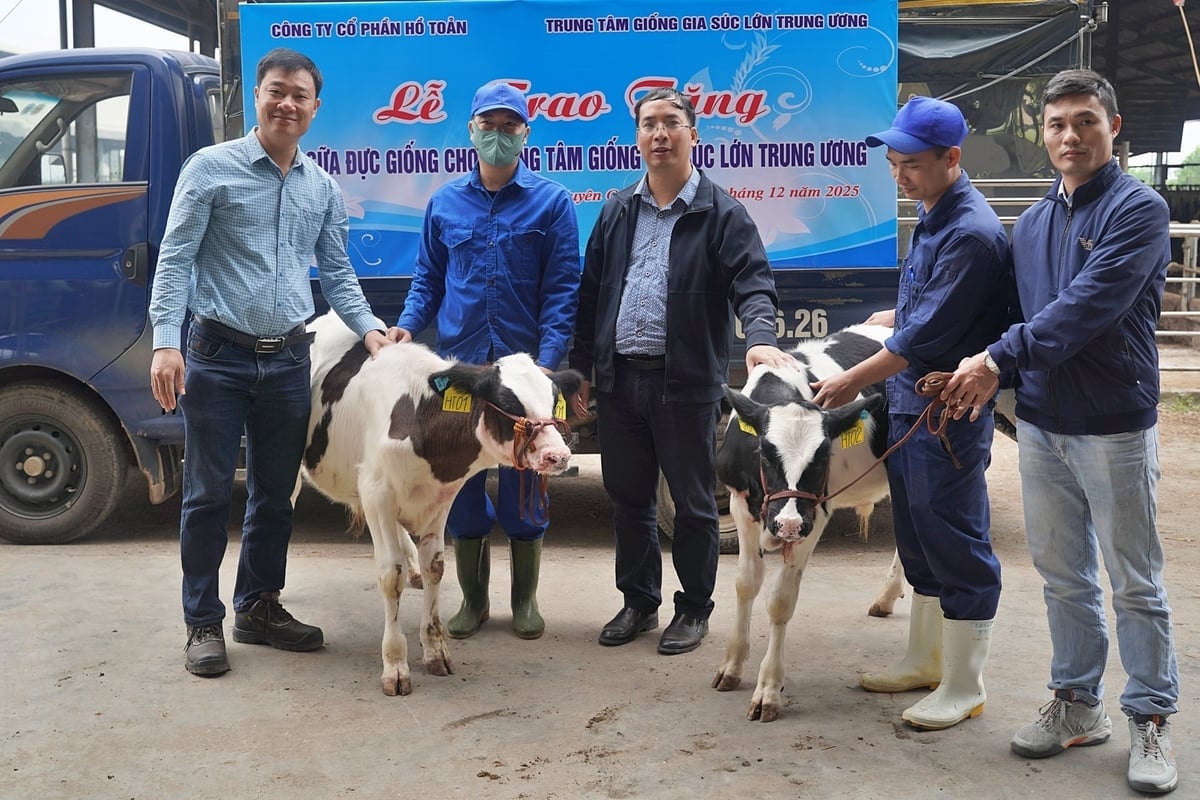
Two dairy cows of purebred origin were donated by Ho Toan Company. Photo: Bao Thang.
What makes the two Holstein Friesian (HF) male dairy cows donated on December 11th special is that they were conceived and raised right here in Vietnam, even though they are purebred. Being pregnant and giving birth in native conditions helps the calves adapt better to the humid tropical climate.
"The gestation process in the water creates a 'transition generation,' helping the offspring better adapt to the temperature, humidity, and nutritional conditions in Vietnam," Mr. Hai said. This rare breeding stock is selected from the farm's high-yielding mother cows and inseminated using high-quality semen.
Currently, finding a purebred cow with a good breeding history and productivity, adapted to Vietnamese conditions, is very costly and time-consuming. Therefore, individuals that meet all three criteria—good genes, born in Vietnam, and stable adaptation—become especially important.
General Director Luong Duy Toan shared that the company is applying a genetic management program focused on sex-selective semen selection for heifers, prioritizing male semen from countries with developed breeding systems such as the United States, Israel, and Canada.
Such pedigree management helps create a consistent and stable source of high-quality calves, allowing farmers to access controlled breeding stock when the company transfers the technology.
The overall industry context further highlights this issue. Many farmers have reduced their herds due to low purchase prices, in some cases nearly equaling the production cost. Investing nearly 100 million VND in a cow yields a profit of only about 7 million VND per year, making maintaining the herd unattractive. As farmers reduce their herds, the demand for breeding stock increases, while sources of well-adapted breeding stock become scarce.
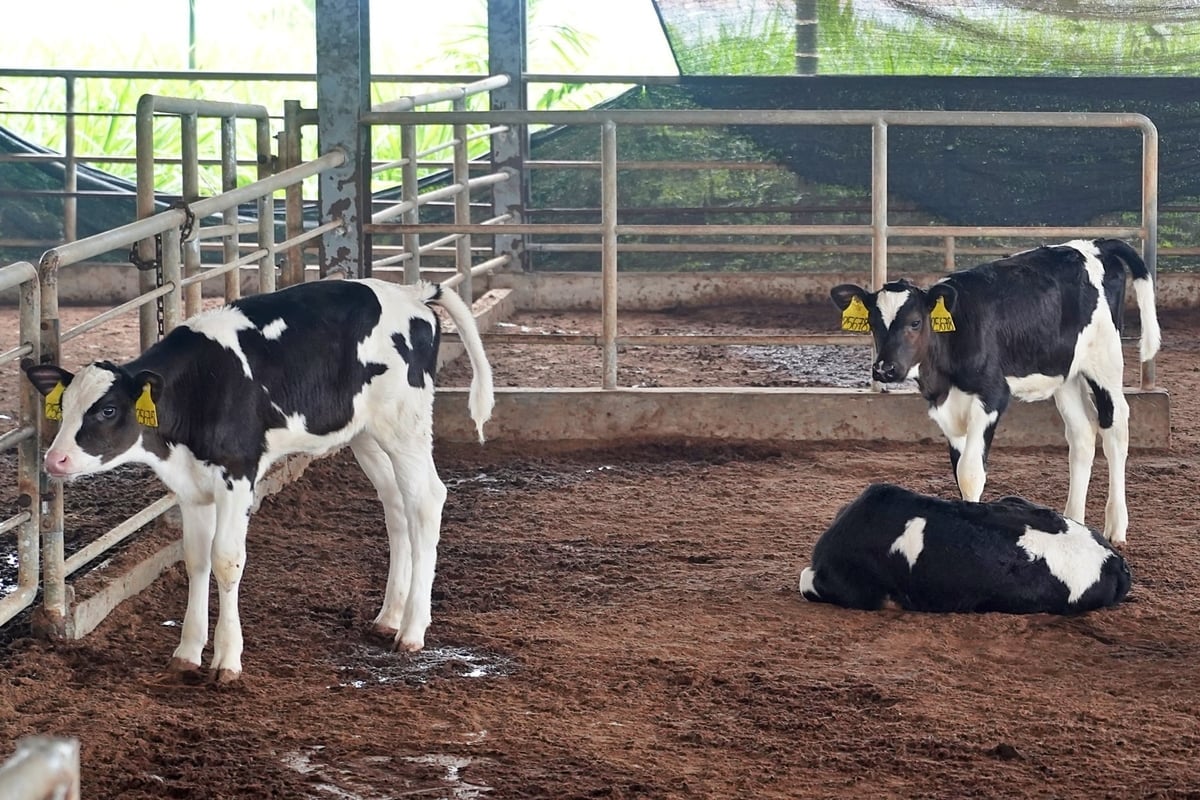
A calf in the farm of Ho Toan Company. Photo: Bao Thang.
The head of the Central Livestock Breeding Center said that the two individuals will be evaluated according to a strict procedure, from health and growth to milk yield. If they meet the standards, they will be used for commercial semen production.
Establishing a purebred, domestically adapted breeding stock is a crucial link in improving the quality of Vietnam's dairy cattle herd. Each standard semen sample can produce hundreds or thousands of calves, creating a significant ripple effect. This forms the basis for creating a generation of dairy cows suitable for Vietnamese conditions, helping farmers reduce risks and increase productivity in the long term.
The donation took place at the same time that the delegation of media agencies working with Ho Toan Joint Stock Company was conducting a press and environmental awareness campaign.
The delegation included Mr. Le Xuan Dung, Deputy Editor-in-Chief of the Agriculture and Environment Newspaper; Mr. To Duc Huy, Chief of Office; and Mr. Nguyen Viet Hung, Deputy Head of Office in charge of the Northern Midlands and Mountainous Region Office. The trip aimed to record exemplary models, including the efforts of production facilities in sharing good genetic resources with research institutions and farmers.
Based on the on-site inspection, the delegation highly appreciated the company's technology for controlling the farming environment and nutrition. In particular, the average milk yield was approximately 38.6 kg/cow/day, higher than the average of many farms nationwide. The barn system is designed with a cooling technology that operates continuously 24/7 according to the THI index, helping cows reduce heat stress in hot and humid conditions.
The waste treatment system is designed to ensure the environmental quality of the area surrounding the farm, as evidenced by the fact that many areas near the farm can be used for growing vegetables. This is an important factor when large production facilities need to maintain veterinary hygiene and limit cross-contamination among the cattle herd.
Source: https://nongnghiepmoitruong.vn/trung-tam-giong-gia-suc-lon-trung-uong-nhan-2-bo-sua-giong-thuan-chung-d788891.html

![[Photo] Closing Ceremony of the 10th Session of the 15th National Assembly](/_next/image?url=https%3A%2F%2Fvphoto.vietnam.vn%2Fthumb%2F1200x675%2Fvietnam%2Fresource%2FIMAGE%2F2025%2F12%2F11%2F1765448959967_image-1437-jpg.webp&w=3840&q=75)



![[Photo] Prime Minister Pham Minh Chinh holds a phone call with the CEO of Russia's Rosatom Corporation.](/_next/image?url=https%3A%2F%2Fvphoto.vietnam.vn%2Fthumb%2F1200x675%2Fvietnam%2Fresource%2FIMAGE%2F2025%2F12%2F11%2F1765464552365_dsc-5295-jpg.webp&w=3840&q=75)































![[OFFICIAL] MISA GROUP ANNOUNCES ITS PIONEERING BRAND POSITIONING IN BUILDING AGENTIC AI FOR BUSINESSES, HOUSEHOLDS, AND THE GOVERNMENT](https://vphoto.vietnam.vn/thumb/402x226/vietnam/resource/IMAGE/2025/12/11/1765444754256_agentic-ai_postfb-scaled.png)









































Comment (0)