

Recently, in Hoa Long commune, the Center for Research and Transfer of Agricultural Technological Advances (Southern Vietnam Academy of Agricultural Sciences) collaborated with the National Agricultural Extension Center and the Dong Thap Provincial Agricultural Services Center to organize a workshop on "Building a model for applying mechanized services to collect rice straw as raw material for mushroom production, animal feed, and organic fertilizer" in 2025.

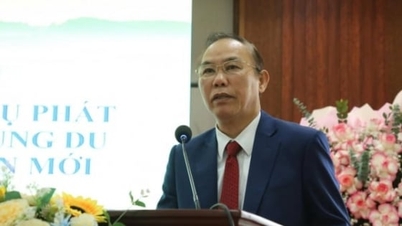
At the workshop, experts assessed that the model has helped farmers in Dong Thap change their practices in handling straw after harvest. Photo: Minh Sang.
At the workshop, experts presented an overview of the project, the implementation model, and the initial results of applying mechanization in straw collection in several provinces of the Mekong Delta. Delegates also exchanged practical experiences, assessed the effectiveness, advantages, and difficulties in the implementation process, and outlined directions for replicating the model in the future.
According to experts, the model has helped farmers in Dong Thap change their post-harvest straw disposal practices, from burning to collecting and selling or treating it with microbial preparations right in the fields. As a result, farmers' income from rice production has increased by about 15% compared to traditional farming methods.
In addition to its economic benefits, the model significantly reduces the burning of straw, which causes environmental pollution, limits greenhouse gas emissions, and improves biodiversity and the quality of arable land.

The mechanized straw collection model in Dong Thap helps increase farmers' income. Photo: Minh Sang.
Utilizing rice straw to produce mushrooms, animal feed, and organic fertilizer helps return organic matter to the soil, increase fertility, and reduce reliance on chemical fertilizers and pesticides. This is considered a suitable approach in the context of the agricultural sector's push towards circular, green, and sustainable production models.
The mechanized straw collection model not only transforms abundant agricultural by-products into valuable resources but also contributes to increasing the value of rice grains, improving farmers' livelihoods, and promoting sustainable agricultural development in the Mekong Delta.
Source: https://nongnghiepmoitruong.vn/co-gioi-hoa-thu-gom-rom-ra-nguoi-trong-lua-tang-15-thu-nhap-d789011.html






























































Comment (0)