

The formula for success, as seen from Nafoods.
After years of rapid growth, Gia Lai, the "capital" of passion fruit cultivation, has gradually stabilized. Farmers are no longer expanding their acreage but are shifting to safer farming practices, intercropping passion fruit in coffee plantations to reduce risks. However, given the complex nature of pest and disease outbreaks, farmers' confidence in passion fruit cultivation is showing signs of decline.

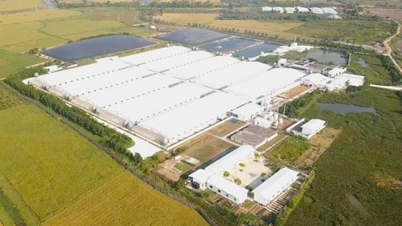
Nafoods is developing passion fruit orchards that meet export standards. Photo: Tuan Anh.
While many passion fruit orchards are plagued by disease, some regions still exhibit successful growth models, yielding stable results thanks to participation in value chain production linkages. Nafoods Group Joint Stock Company is one of the pioneering enterprises implementing this linkage model in Gia Lai.
![Passion fruit capital faces the challenge of sustainability: [Part 1] Regaining stability](https://vstatic.vietnam.vn/vietnam/resource/IMAGE/2025/12/10/1765385639543_1322-z7304406080505_7f5b16cdbceddbe34392d83300f8dfba-120956_263.jpeg) Passion fruit capital faces the challenge of sustainability: [Part 1] Regaining stability
Passion fruit capital faces the challenge of sustainability: [Part 1] Regaining stabilityNafoods has invested in a passion fruit seedling production facility with a modern technological line and a quality control laboratory before releasing seedlings to the market. They directly supply seedlings to affiliated units, cooperatives, and farmers. In addition, the company provides technical advice from seed selection and care to harvesting, processing, and export.
To date, Nafoods has partnered with approximately 50 cooperatives and over 5,000 farming households to develop passion fruit cultivation areas, covering more than 5,000 hectares. Looking ahead to 2030, the company aims to expand its raw material area to over 10,000 hectares in key provinces in the Central Highlands such as Gia Lai, Dak Lak , and Lam Dong.
Previously, passion fruit production relied primarily on traditional methods. However, awareness has gradually shifted as farmers understand that investing in quality is a sustainable path to increased income. Recognizing this trend, Nafoods collaborates with farmers to develop and implement standardized technical processes, helping to reduce risks from natural disasters and pests, improve productivity and quality, and ensure traceability, meeting the increasingly stringent requirements of export markets.
Currently, Nafoods has established a passion fruit ecosystem in Gia Lai, with the key element being high-tech, disease-free seedlings that are traceable to each individual plant using a QR code. This solution increases resistance, reduces the use of pesticides, brings economic benefits to growers, and meets strict export standards. Simultaneously, Nafoods' technical team regularly monitors the growing areas, coordinating with cooperatives and distributors to provide timely technical support.

Nafoods' passion fruit variety consistently delivers high quality and abundant fruit. Photo: Tuan Anh.
![Passion fruit 'capital' faces sustainability challenge: [Part 2] Overcoming numerous obstacles](https://vstatic.vietnam.vn/vietnam/resource/IMAGE/2025/12/12/1765517078692_2842-z7302761988134_dc134a17bfdb79e6bbec47c9721f34b7-122812_180.jpeg) Passion fruit 'capital' faces sustainability challenge: [Part 2] Overcoming numerous obstacles
Passion fruit 'capital' faces sustainability challenge: [Part 2] Overcoming numerous obstaclesIn the Gia Lai growing region, Nafoods Tay Nguyen Factory plays a crucial role as a stable consumption hub, committing to purchasing at competitive prices, helping farmers feel secure in investing and committing to passion fruit cultivation in the long term. The technical team also directly advises on cultivation processes, warns of pest and disease risks, and guides harvesting techniques to optimize production efficiency.
In the context of export markets such as Europe, the US, and China increasingly tightening requirements on quality and pesticide residue levels, good control of growing areas within the supply chain will help diversify passion fruit output, stabilize prices, and thereby create a foundation for people to confidently and sustainably commit to this crop.
Mr. Nguyen Manh Hung, General Director of Nafoods Group, stated that to maintain stable and sustainable export operations, Nafoods will continue to improve its traceability capabilities, strictly adhere to residue standards required by each market, and refine its quality management system in accordance with international practices.
Simultaneously, the company has identified the need to promote deep processing and diversify value-added products, from dried and freeze-dried passion fruit to passion fruit seed oil for use in pharmaceuticals, cosmetics, and food. This is a key direction to enhance competitiveness and increase profit margins in the global market.
Rebuilding the industry towards sustainability.
Having many years of experience in linking with and purchasing passion fruit from farmers, Ms. Nguyen Thi Huyen, Director of Gia Lai Bio-Agriculture Joint Stock Company, said that to develop the passion fruit industry sustainably, it is necessary to coordinate with three parties: the State, businesses, and farmers.

To develop a sustainable passion fruit industry, coordination among three parties is necessary: the government, businesses, and farmers. Photo: Tuan Anh.
Accordingly, the Department of Agriculture and Environment needs to advise the Gia Lai Provincial People's Committee on a comprehensive plan for passion fruit cultivation areas to ensure that the raw material supply is not swayed by market trends. At the same time, it is necessary to improve people's knowledge about the production process, from seed selection and proper cultivation techniques to controlling pesticide residue levels.
On the other hand, priority should be given to businesses involved in deep processing, building sufficiently large factories and cold storage facilities, and purchasing all the produce from farmers during the peak passion fruit harvest season. “Most importantly, farmers must make a profit. When prices fall, businesses must apply clear price guarantees and purchase all the produce. Businesses must have a team of highly skilled technicians working closely with farmers, controlling the entire supply chain from ensuring the seedlings are of the correct origin and free from disease to the point of purchase,” Ms. Huyen shared.
To ensure the sustainable development of the passion fruit industry in the future, Mr. Tran Xuan Khai, Head of the Gia Lai Department of Crop Production and Plant Protection, stated that the Gia Lai agricultural sector's viewpoint is to always accompany and provide the highest level of support to businesses, cooperatives, and people in production development.
In recent times, Gia Lai's agricultural sector has intensified its efforts in disseminating information and promoting production linkages with product consumption, focusing on consolidating, innovating, and developing cooperative economics, with a focus on improving the operational efficiency of cooperatives.

A supply chain linkage is necessary for the sustainable development of the passion fruit industry. Photo: Tuan Anh.
Simultaneously, Gia Lai aims to establish concentrated, intensive passion fruit production areas based on market demand through economic contracts and value chain linkages. Special attention is also being paid to building and perfecting the documentation for these growing areas, meeting the technical barriers of export markets.
On the other hand, Gia Lai's agricultural sector is also closely coordinating with local authorities, departments, and businesses to strengthen propaganda and gradually change people's production mindset, limiting development based on trends.
"Instead of chasing after expanding the cultivated area, we are focusing on reorganizing production according to a plan, concentrating on linkages and standardizing processes from cultivation and harvesting to preservation, processing, and consumption in order to improve quality, added value, and economic efficiency," Mr. Khai shared.
Mr. Khai stated that to reduce losses for passion fruit crops and enhance processing capacity, Gia Lai's agricultural sector will support businesses in investing in the construction of preliminary processing, handling, packaging, and preservation facilities in large-scale concentrated growing areas. Simultaneously, they will encourage investment, technological innovation, and product diversification towards high value-added products, better meeting the demands of both domestic and export markets.
On December 12th, the Agriculture and Environment Newspaper, in collaboration with the Department of Crop Production and Plant Protection and the Gia Lai Department of Agriculture and Environment, organized the forum "Sustainable Development of the Passion Fruit Industry through a Supply Chain".
The forum aims to comprehensively assess the current state of passion fruit production, processing, consumption, and export in Vietnam, while also discussing difficulties and challenges such as climate change, diseases, fragmented production, and limitations in processing and preservation. Based on this, it will propose solutions for developing standardized raw material areas, applying science and technology, expanding markets, and building a sustainable brand for Vietnamese passion fruit.
We invite interested readers to participate in the online forum at the following link: https://zoom.us/j/99827748852?pwd=4a3BqsLZIIJB2iq9aRolaaU4k49yY8.1
Meeting ID: 998 2774 8852 Password: CL1212
Or follow the Forum live on the online newspaper: nongnghiepmoitruong.vn
Source: https://nongnghiepmoitruong.vn/thu-phu-chanh-leo-truoc-bai-toan-ben-vung-bai-3-xay-dung-lien-ket-chuoi-d788211.html














![[Photo] Prime Minister Pham Minh Chinh holds a phone call with the CEO of Russia's Rosatom Corporation.](/_next/image?url=https%3A%2F%2Fvphoto.vietnam.vn%2Fthumb%2F1200x675%2Fvietnam%2Fresource%2FIMAGE%2F2025%2F12%2F11%2F1765464552365_dsc-5295-jpg.webp&w=3840&q=75)











































Comment (0)