

Slow progress
Coastal forests play a protective role against storms, tidal surges, and erosion, but the progress of restoration is not meeting expectations. While forest protection efforts have reached over 281,000 hectares, equivalent to 102% of the plan, the area of new planting and supplementary planting remains low. Provinces have planted 6,442 hectares of new forest and 5,185 hectares of supplementary planting and restoration. In addition, there are more than 7,900 hectares of regeneration and 329 million scattered trees.
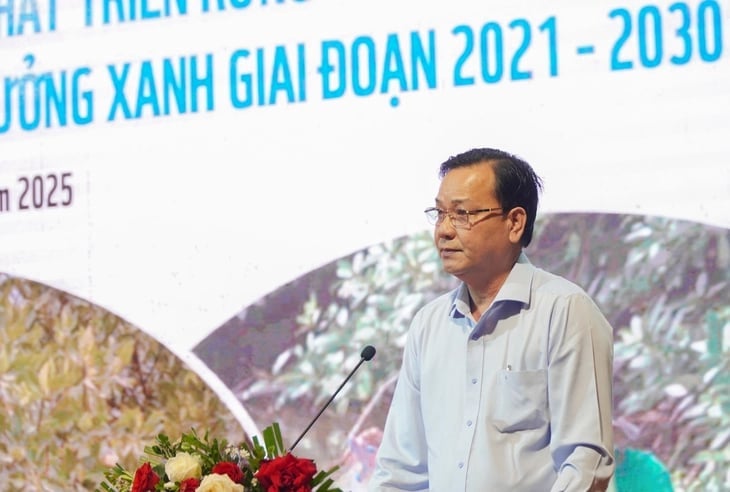
Mr. Phan Minh Chi, Deputy Director of the Department of Agriculture and Environment of Ca Mau province. Photo: Thanh Huyen.
The completion rates vary greatly among localities. Quang Ninh achieved 111.4% of the plan, Hue City 110.8%, and Ca Mau 93.3%. However, Nghe An only reached 9%, Lam Dong 17.5%, Khanh Hoa 20.8%, Ho Chi Minh City 30.2%; and Quang Ngai did not plant any new areas. Implementation depends heavily on site conditions, the degree of erosion, and the availability of coastal land.
During the 2021-2025 period, 147 projects were implemented with a total capital of VND 2,631.6 billion, reaching 88.5% of the plan. ODA accounted for 28%, capital from organizations and businesses accounted for 36.2%, local budgets 21%, and central government budgets 14.8%. Many coastal livelihood models were implemented, attracting more than 2,200 households in Ninh Binh, Thanh Hoa, Da Nang , Ca Mau, and several other provinces to participate in mangrove shrimp farming, honey bee farming, and ecological aquaculture.
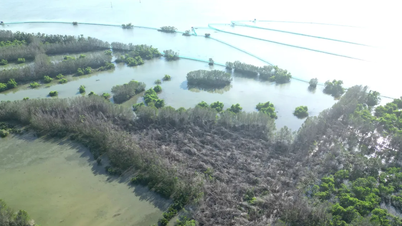
According to the Ministry of Agriculture and Environment, the slow progress in reforestation stems from harsh natural conditions. Coastal provinces are constantly affected by storms, low pressure systems, strong tides, and river mouth erosion. Many planting areas are fragmented or deeply flooded seasonally.
In some areas, reforestation is only possible after sedimentation and beach creation, increasing costs. Mangrove forests are affected by large waves, barnacles, crustaceans, and pollution from industry and aquaculture. Furthermore, the conversion of forest land for industry, tourism, and aquaculture reduces the area suitable for reforestation.

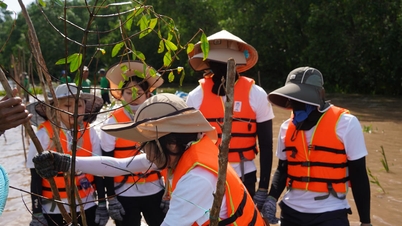
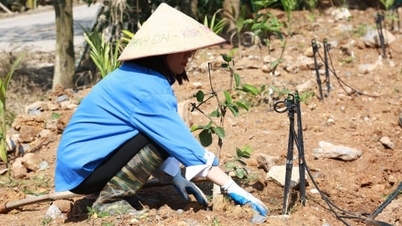
Forestry officials cooperate in reforestation efforts in Ca Mau province. Photo: Thanh Phong.
At a recent conference summarizing the first five years of implementing the Project on Protecting and Developing Coastal Forests to Respond to Climate Change and Promote Green Growth in the period 2021-2030, many localities raised difficulties in the implementation process.
Mr. Le Sy Duong, Deputy Head of the Forestry and Forest Protection Department of Ninh Binh province, said that the province has more than 3,600 hectares of coastal forest but faces difficulties in land and forest allocation, leading to inadequacies in forest management and development. He suggested strengthening the dissemination of forestry laws and reviewing the planning of coastal forest land, clarifying the boundaries of forest land, aquaculture land, national defense land, and residential land to avoid overlap.
In Vinh Long, the forest rangers reported that the pest situation in mangrove forests is becoming increasingly complex, especially in areas outside the sea dike. The province proposed that the Ministry provide technical guidance on treatment and prioritize investment in projects to create new land and create beaches combined with reforestation to expand and stabilize the area.
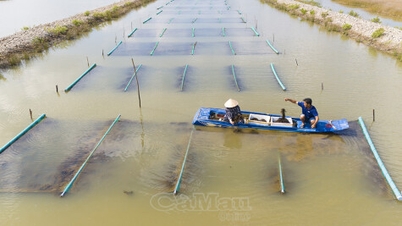
Representatives from the Ca Mau Department of Agriculture and Environment emphasized that mangrove forests and mangrove shrimp farming are two closely linked elements. Accordingly, forests create habitats and ecological shrimp farming generates economic value, helping communities become more committed to forest protection. The province hopes to receive technical support and resources to further expand sustainable livelihood models linked to forests.
On the international side, WWF-Vietnam stated that it will strengthen support for provinces in the 2025-2030 period, with priority given to Ca Mau. The organization affirmed its readiness to collaborate in coastal forest conservation, climate finance mobilization, and promoting the future forest carbon market.
It is urgent to increase coastal forest cover.
According to the report, the project aims to restore and develop 23,374 hectares of forest during the 2026-2030 period. However, the plans submitted by the provinces only reached 6,602 hectares, equivalent to 28% of the need, including 5,088 hectares of new planting and 1,514 hectares of supplementary planting. Mangrove forests alone account for 3,236 hectares.
Deputy Director of the Department of Forestry and Forest Protection, Trieu Van Luc, requested that localities review and update their plans and submit reports in the first quarter of 2026 to ensure compliance with the national forestry plan and sufficient land for reforestation.
He emphasized that localities must fully implement the Forestry Law, conduct site surveys before project planning, and select appropriate species and planting seasons to improve forest survival rates. The conversion of coastal forest land to other purposes needs to be strictly controlled, and encroachment should be severely punished. Integrated forest-agriculture-fishery models should be replicated to increase land use efficiency and improve livelihoods.
The Deputy Director also proposed strengthening inspections, applying digital technology in forest management, and promoting forest allocation and forest protection contracts in accordance with regulations. At the same time, he committed to coordinating with localities to review the 2026-2030 plan, provide guidance on technical standards, and compile reports for the Ministry and the Prime Minister.
"The coordination between local authorities and international organizations will help achieve the remaining goals of the Project, increase forest cover, protect the coastline, and meet climate commitments," Mr. Luc said.
Source: https://nongnghiepmoitruong.vn/trong-rung-ven-bien-dat-58-ke-hoach-sau-5-nam-d788395.html


![[Photo] General Secretary and President To Lam presides over the meeting to approve the draft report on the results of the second inspection by the Politburo of the Standing Committee of the Hanoi City Party Committee.](https://vphoto.vietnam.vn/thumb/1200x675/vietnam/resource/IMAGE/2026/05/26/1779789811432_a2-bnd-4430-9620-jpg.webp)










































































Comment (0)