

In recent years, the dairy cattle development project in Vinh Long province has opened up new avenues for farmers, especially rural youth. Beyond providing breeding stock, the project also focuses on dissemination of information, training, and technology transfer, helping people gradually access scientific knowledge, change their production mindset, and ultimately increase their income and improve their living standards.
Mr. Tran Van Cuong, born in 1986, Deputy Head of Thanh My Hamlet, Quoi Dien Commune, Vinh Long Province, boldly started his own business and achieved success with this model. Previously, his family mainly raised yellow cattle and goats for meat, earning only a moderate income and facing many risks due to dependence on market prices. When informed about the dairy cattle development project by the local authorities, Mr. Cuong proactively sought information and participated in training sessions organized by relevant agencies.
In July 2020, when participating in the project, Mr. Cuong received support in the form of 6 dairy cows. This was not only material support but also an opportunity for him to access comprehensive and systematic information on safe and efficient dairy farming practices. Thanks to applying the correct techniques, he has now developed his herd to 21 cows, including 8 that are currently producing milk, providing a stable income for his family.
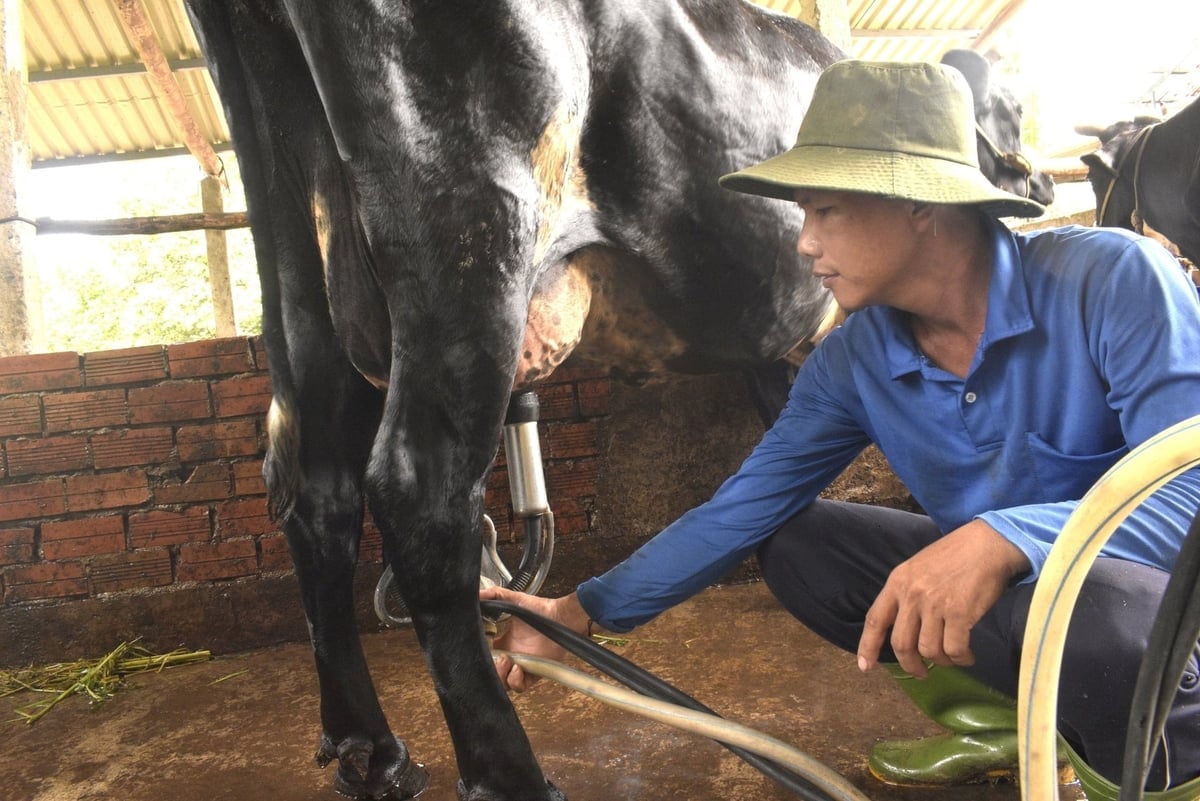
Mr. Tran Van Cuong is milking a cow. Photo: Minh Dam.
Speaking to reporters, Mr. Tran Van Cuong said that raising dairy cows yields much higher economic returns than raising yellow cattle. On average, a dairy cow generates an income of about 60 million VND per year, while yellow cattle only reach about 20 million VND. The cost of raising dairy cows is slightly higher due to the need for more feed, but the overall feed sources such as grass and straw remain similar. "If well cared for, the income from dairy cows can be three times that of yellow cattle," he affirmed.
According to Mr. Cuong, to succeed with this model, farmers must equip themselves with basic veterinary knowledge, especially in vaccinating against various diseases, mainly mastitis. Previously, people had limited access to this knowledge, mainly relying on experience in farming. Thanks to training courses, guidance materials, and timely information support from technical staff, farmers have improved their understanding and proactively prevented diseases. "With farming experience, when cows encounter problems, they can handle them promptly," he shared.
To achieve his current success, Mr. Cuong has overcome many difficulties. Previously, he raised yellow cattle and goats for meat, earning a decent income. But when he learned about the dairy farming project, he decided to give it a try. With his accumulated capital, he invested in barns, bought more feed, and proactively learned. Not only did he participate in the project's training courses, but he also researched online and consulted experiences from many other successful models.
Thanks to this, his dairy herd thrived. From the initial 6 cows, he expanded his herd by 5 and acquired 10 more from other households that lacked the resources to raise them. To date, he has a total of 21 dairy cows.
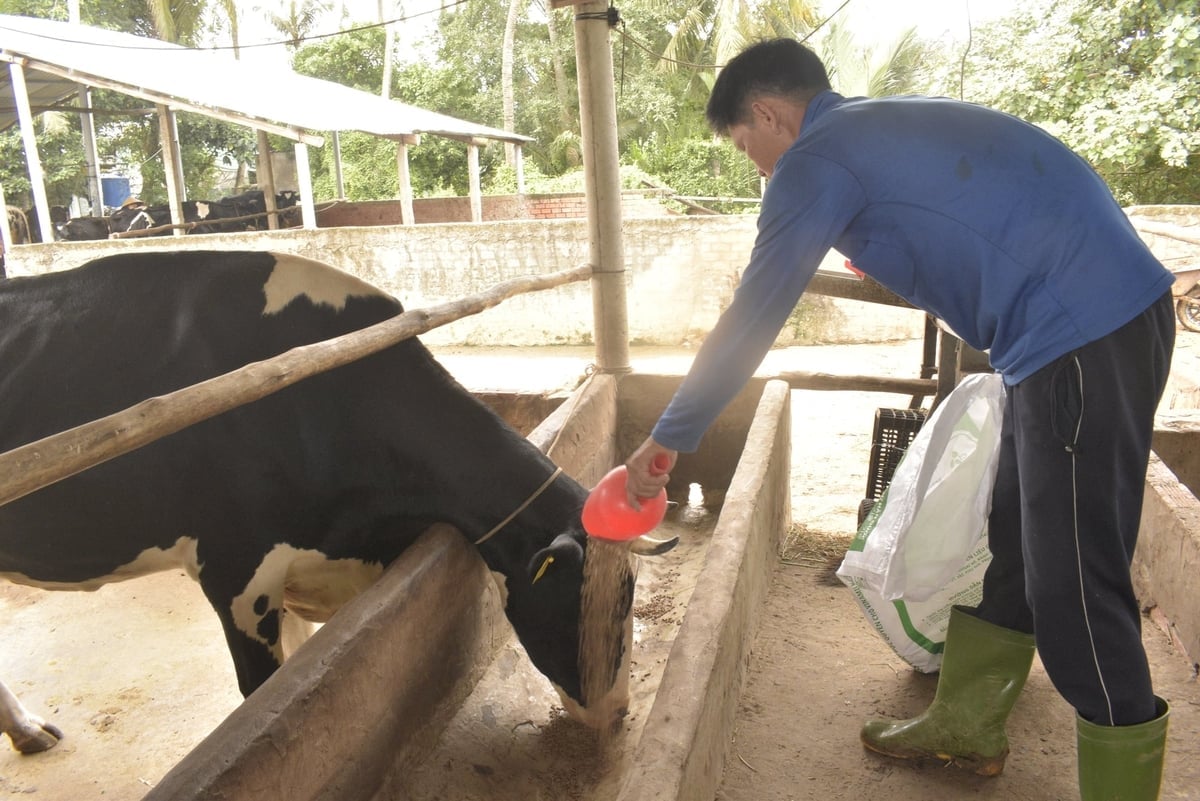
Feeding cows extra bran to increase milk production. Photo: Minh Đảm.
Every day, at 5 a.m. and 3 p.m., he regularly harvests the milk. On average, he collects 120 kg of milk per day, with some cows yielding up to 27 kg/day. All the milk is sold to the Vinamilk transfer station in Ba Tri at an average price of 15,700 VND/kg.
Thus, each month, from milk alone, Mr. Cuong earns about 50 million VND, and after deducting expenses, he has a profit of about 25 million VND. He reinvests this profit to care for the cows that are not yet producing milk and to raise an additional 14 beef cows. Even so, he still manages to save 15 million VND each month for his family's living expenses.
According to Mr. Phan Van Le, Deputy Head of the Economic Department of Quoi Dien Commune, Mr. Tran Van Cuong is a successful young producer with a dairy farming model in the locality.
Mr. Phan Van Le added that currently, there are 9 households in the commune participating in the dairy farming model with a total herd of about 90 cows, which has been implemented for 3 years. Compared to raising beef cattle, the income of dairy farming households has increased significantly, and the lives of the people are more stable.
According to Mr. Le, Quoi Dien is a commune located in a freshwater area with a large area of grassland, making it very favorable for livestock development. "In the coming time, the locality will continue to plan, guide, and encourage people to expand their livestock herds, including dairy cows, beef cattle, goats, and poultry," he emphasized.
It is evident that the dairy farming model not only brings economic benefits but also plays a significant role in rural poverty reduction. Through the provision of knowledge, skills, market information, and support policies, people have gradually raised their awareness, proactively developed their livelihoods, and moved towards the goal of sustainable poverty reduction.
Source: https://nongnghiepmoitruong.vn/thanh-nien-quoi-dien-doi-doi-nho-tiep-can-thong-tin-nuoi-bo-sua-d786235.html


![[Photo] Prime Minister Pham Minh Chinh attends the Conference summarizing and implementing tasks of the judicial sector.](/_next/image?url=https%3A%2F%2Fvphoto.vietnam.vn%2Fthumb%2F1200x675%2Fvietnam%2Fresource%2FIMAGE%2F2025%2F12%2F13%2F1765616082148_dsc-5565-jpg.webp&w=3840&q=75)






![Looking back at the peak month of combating IUU: [Part 3] Synchronizing fisheries infrastructure](https://vphoto.vietnam.vn/thumb/402x226/vietnam/resource/IMAGE/2025/12/13/1765608279533_2109-b32-133759_237.jpeg)





![Anticipating future trends: [Part 1] New livelihoods from floating tank frog farming model](https://vphoto.vietnam.vn/thumb/402x226/vietnam/resource/IMAGE/2025/12/13/1765607984017_dsc06888-210118_726-133559.jpeg)
![Major policy decisions for agricultural development in Thanh Hoa: [Part 3] The vast forest waters awaken the entire land.](https://vphoto.vietnam.vn/thumb/402x226/vietnam/resource/IMAGE/2025/12/13/1765583676489_z7282526539020_1ee647dc8468da9b9f2428712b435ae7-nongnghiep-184805.jpeg)

















































Comment (0)