

To achieve this goal , the Department of Agriculture and Environment advised the People's Committee of Thai Nguyen province to issue a Decision approving the implementation plan for projects, programs, and plans related to emission reduction, such as: the Organic Agriculture Development Project; the Soil Health Improvement Project; the National Climate Change Strategy; the Project on the Development of Production and Use of Biological Plant Protection Products; and the Project on the Development of Production and Use of Organic Fertilizers.

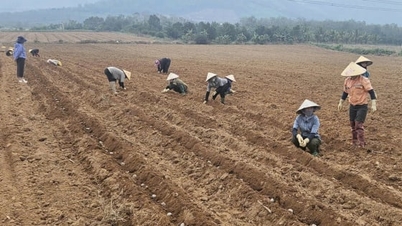
Organic farming and emission reduction are the goals that the agricultural sector in Thai Nguyen province is striving for. Photo: Ngoc Tu.
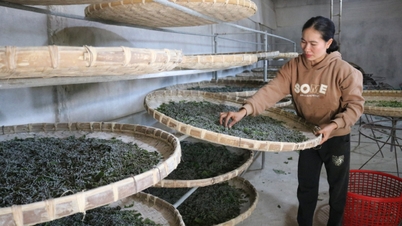
Regarding technical solutions, Thai Nguyen province focuses on organic and circular agriculture. To date, the area of tea plantations certified under good agricultural practices and equivalent standards has reached 6,440 hectares. The entire province has nearly 1,100 hectares of fruit trees and 200 hectares of vegetables certified for safe production according to VietGAP standards. The area of high-quality rice, specialty rice, and rice grown using VietGAP or organic standards is approximately over 42,000 hectares.
Simultaneously, Thai Nguyen province encourages the conversion of inefficient paddy land to high-yield dryland crops, combining rice cultivation with aquaculture. By 2025, the area of converted rice land will reach 970 hectares, including 890 hectares for annual crops, 43.3 hectares for perennial crops, and 35 hectares for rice cultivation combined with aquaculture.
From now until 2035, Thai Nguyen province will build and develop the "Low Emission" label for agricultural products, establish at least two models of low-emission agricultural production for tea and ginger, and pilot 15 or more models of cultivation capable of generating carbon credits, meeting the requirements of international organizations, according to the plan of the Ministry of Agriculture and Environment.

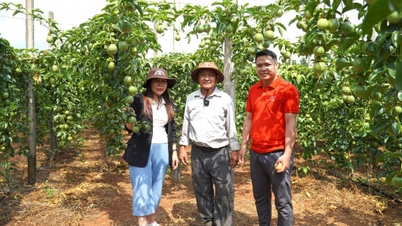
Organic custard apple orchards in Vo Nhai commune, Thai Nguyen province. Photo: Ngoc Tu.
In addition, the relevant sector will also issue technical guidelines for reducing emissions in production applicable to key crops, and build a database of emissions in crop production that is synchronously connected with the national registration system.
Mr. Trieu Duc Van, Deputy Director of the Department of Agriculture and Environment of Thai Nguyen province, said: The Department will continue to develop and advise on the issuance of an action plan to implement the project "Reduced Emission Production in the Crop Production Sector giai đoạn 2025-2035, vision 2050". The goal is that by 2035, the crop production sector in the province will contribute to reducing at least 15% of total greenhouse gas emissions (CO2td) compared to 2020, as per the project of the Ministry of Agriculture and Environment.

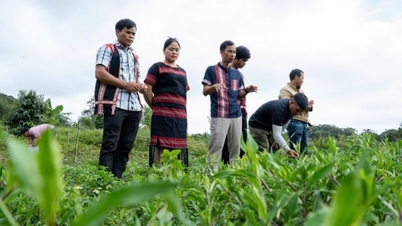
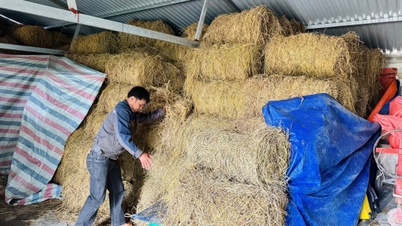
Small-scale farming, which makes it difficult to apply scientific and technological advancements, is a barrier to implementing emission-reduction farming practices in Thai Nguyen. Photo: Ngoc Tu.
Despite achieving initial results and having a specific roadmap, Thai Nguyen province's green agriculture journey also faces several significant challenges. While safe production models are certified annually, the area and scale remain small. Commercial agricultural production has shown initial positive results, but the transformation of crop structure is slow, the scale is small and fragmented, and concentrated production areas have not yet been formed, resulting in limited output.
Most post-harvest agricultural products, especially organic products, are not closely linked to processing and consumption, making it difficult to access support mechanisms and policies. These difficulties need to be addressed to facilitate the transition from traditional farming to low-emission farming in Thai Nguyen in the coming years.
Source: https://nongnghiepmoitruong.vn/nong-nghiep-thai-nguyen-huong-den-giam-phat-thai-d789182.html




![[Image] Vietnam's colorful journey of innovation](/_next/image?url=https%3A%2F%2Fvphoto.vietnam.vn%2Fthumb%2F1200x675%2Fvietnam%2Fresource%2FIMAGE%2F2025%2F12%2F14%2F1765703036409_image-1.jpeg&w=3840&q=75)








![Anticipating future trends: [Part 1] New livelihoods from floating tank frog farming model](https://vphoto.vietnam.vn/thumb/402x226/vietnam/resource/IMAGE/2025/12/13/1765607984017_dsc06888-210118_726-133559.jpeg)
![Major policy decisions for agricultural development in Thanh Hoa: [Part 3] The vast forest waters awaken the entire land.](https://vphoto.vietnam.vn/thumb/402x226/vietnam/resource/IMAGE/2025/12/13/1765583676489_z7282526539020_1ee647dc8468da9b9f2428712b435ae7-nongnghiep-184805.jpeg)

































![[Image] Vietnam's colorful journey of innovation](https://vphoto.vietnam.vn/thumb/402x226/vietnam/resource/IMAGE/2025/12/14/1765703036409_image-1.jpeg)





















Comment (0)