

Reduce costs, reduce emissions.
In 2025, the Department of Crop Production and Plant Protection of Thai Nguyen province, in coordination with Net Zero Carbon Company and the People's Committee of Hop Thanh commune, will implement a smart rice cultivation model using alternating wet and dry methods to reduce methane emissions, aiming to build agricultural carbon credits on a scale of 12 hectares.
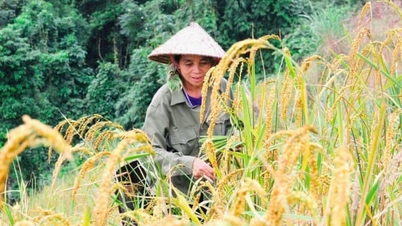
Participating farmers cultivate rice using the alternating wet and dry irrigation (AWD) technique and the improved rice cultivation method (SRI). They transplant young seedlings with two leaves, planting sparsely, with one tiller per plant, alternating water drainage, and applying fertilizer early and at the right time. Rice growers proactively investigate and calculate the timing of pesticide application for pest and disease control and implement integrated crop health management (IPHM) on rice plants.
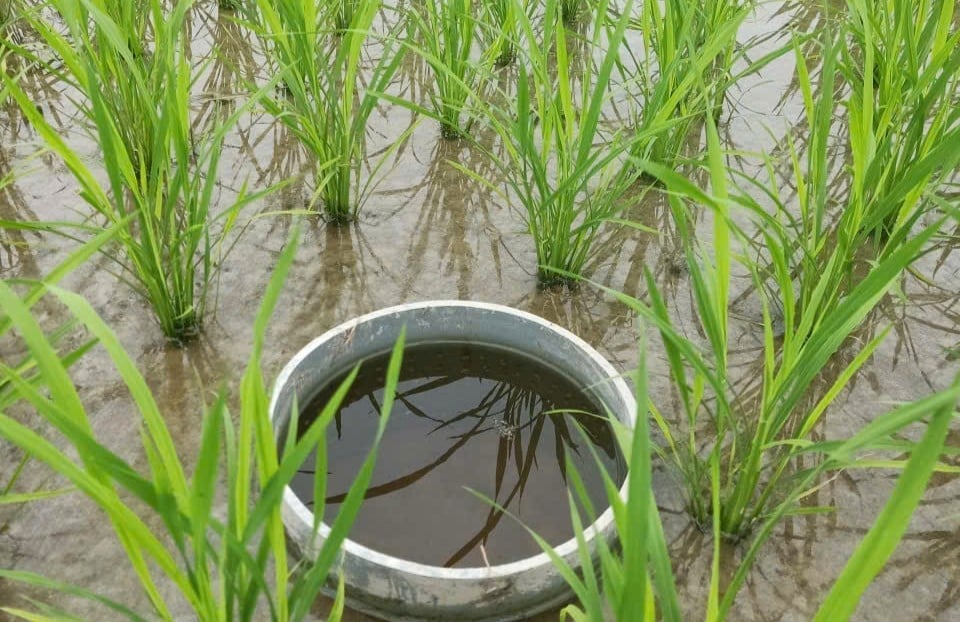
Water metering devices are installed on rice fields implementing smart farming and emission reduction models in Hop Thanh commune, Thai Nguyen province. Photo: Ngoc Tu.
Unlike traditional farming methods that maintain continuous flooding, the AWD technique only keeps the field flooded four times (4, 22, 40, and 64 days after transplanting), then drains the water naturally and allows the field to dry. Draining and drying the field provides oxygen to the roots, promoting better respiration and nutrient absorption, and enabling the rice roots to penetrate deeper into the soil to search for water and nutrients.
Drying the rice paddies helps the rice plant's root system develop strongly and spread widely, making the plant more resistant to adverse conditions such as drought, flooding, or strong winds. The application of alternating wet and dry irrigation (AWD) helps reduce methane (CH4) emissions, a potent greenhouse gas, due to the decomposition of organic matter under anaerobic (oxygen-deficient) conditions in continuously flooded rice paddies.
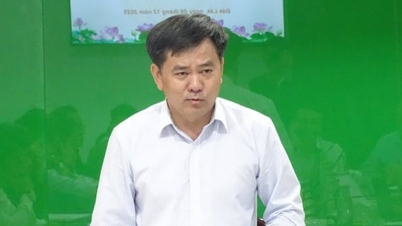
Mr. Hoang Thanh Binh, Deputy Head of the Crop Production and Plant Protection Department of Thai Nguyen province, said: The smart rice cultivation model with alternating wet and dry periods demonstrates superior agronomic indicators. At all stages of rice plant growth, indicators such as roots, stems, leaves, and the number of tillers in the model fields developed better than in the control fields cultivated using traditional methods. Rice yield when applying this emission-reducing cultivation method is 15% higher than conventional cultivation.
“Seed costs have decreased by 50%, nitrogen fertilizer by 20%, pesticide costs by 30%, and irrigation water costs by an estimated 40%. Due to higher yields and reduced costs, the profits of smart rice farmers have increased compared to conventional farming. In addition, farmers also benefit from the recycling of rice straw used as organic fertilizer on-site and from transactions related to emission reduction reports,” Mr. Binh added.
According to the research conducted by the implementing unit, 12 hectares of rice cultivation with reduced emissions in Hop Thanh commune reduced carbon emissions by more than 44.5 tons, averaging a reduction of over 3.7 tons of carbon per hectare. With the achieved effectiveness, the smart rice cultivation model with alternating wet and dry cycles, reducing methane emissions, aims to build an agricultural carbon credit, aligning with the development orientation of low-emission crop production, adapting to climate change, increasing income, improving sustainable livelihoods, and gradually forming an ecological agriculture.
Add policies to support the people.
In the coming period, Thai Nguyen's agricultural sector will continue to expand the program to other areas with suitable production conditions, evaluate its effectiveness, and use it as a basis for replication throughout the entire province.
Based on practical experience, Mr. Hoang Thanh Binh, Deputy Head of the Crop Production and Plant Protection Department of Thai Nguyen province, suggested the need to develop more policies to support farmers with microbial products for processing agricultural by-products, cultivating native microorganisms, and providing various types of bio-fertilizers, microbial fertilizers, and macro and micronutrients for plant fertilization. The province should direct the application of single-variety fields, ensuring uniformity in planting times and cultivation practices to achieve higher efficiency.
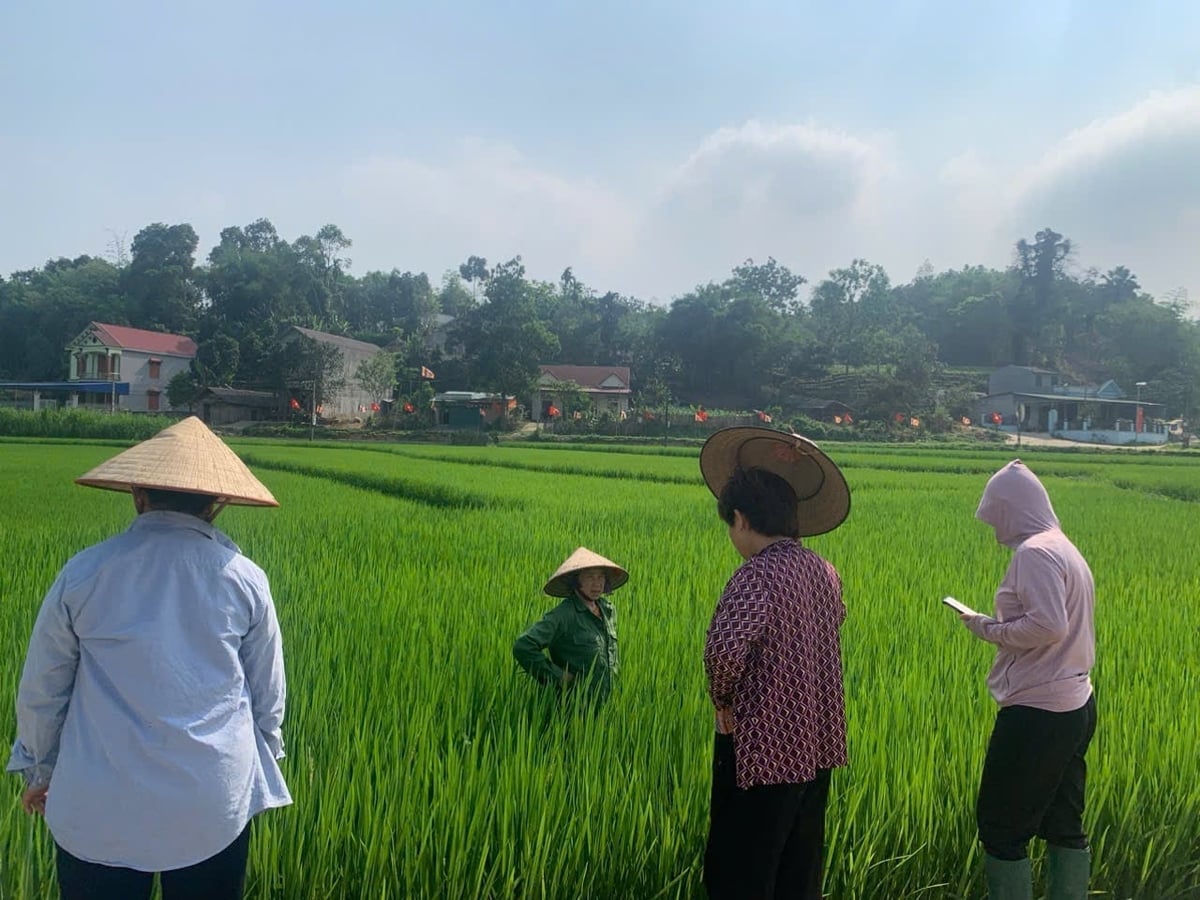
Professional staff and local people inspect a smart rice farming model that reduces emissions in Hop Thanh commune. Photo: Ngoc Tu.
The pilot implementation also revealed several difficulties. Implementing irrigation and drainage systems on small, fragmented farming areas is challenging. Regulating water using alternating wet and dry cycles requires precision and synchronization according to the farming schedule, which is difficult for fields with small-scale irrigation and drainage systems, and for low-lying fields with poor drainage.
In addition, differences in awareness, access to information, traditional farming practices, and people's reluctance to change also lead to the inconsistent application of farming methods, making it difficult to implement them on a large scale in a short period of time.
Source: https://nongnghiepmoitruong.vn/giam-hon-37-tan-cac-bon-1ha-nho-trong-lua-thong-minh-d789170.html

![[Image] Vietnam's colorful journey of innovation](/_next/image?url=https%3A%2F%2Fvphoto.vietnam.vn%2Fthumb%2F1200x675%2Fvietnam%2Fresource%2FIMAGE%2F2025%2F12%2F14%2F1765703036409_image-1.jpeg&w=3840&q=75)











![Anticipating future trends: [Part 1] New livelihoods from floating tank frog farming model](https://vphoto.vietnam.vn/thumb/402x226/vietnam/resource/IMAGE/2025/12/13/1765607984017_dsc06888-210118_726-133559.jpeg)
![Major policy decisions for agricultural development in Thanh Hoa: [Part 3] The vast forest waters awaken the entire land.](https://vphoto.vietnam.vn/thumb/402x226/vietnam/resource/IMAGE/2025/12/13/1765583676489_z7282526539020_1ee647dc8468da9b9f2428712b435ae7-nongnghiep-184805.jpeg)







































![[Image] Vietnam's colorful journey of innovation](https://vphoto.vietnam.vn/thumb/402x226/vietnam/resource/IMAGE/2025/12/14/1765703036409_image-1.jpeg)






















Comment (0)