

Crops adapting to climate change
The eastern part of Gia Lai (formerly Binh Dinh province) is located in the South Central Coastal region and is directly affected by climate change. Due to the impact of climate change, the area of agricultural land affected by salinization in eastern Gia Lai is increasing. According to statistics, the saline-affected land area in eastern Gia Lai is 12,759 hectares; of which, moderately and slightly saline-affected land is 9,618 hectares, accounting for 1.6% of the natural land area and 75.4% of the total saline-affected land area.
According to Dr. Pham Vu Bao, Deputy Director of the Southern Central Coastal Agricultural Science and Technology Institute (ASISOV), this type of land is being cultivated by farmers in coastal areas to diversify crops and improve economic efficiency per unit of cultivated land. Peanuts are one of the crops chosen by farmers. However, before the availability of salt-tolerant peanut varieties, many farmers were still struggling with old varieties that yielded low productivity and limited quality. This is where scientific information and technical training become decisive factors in helping farmers change their farming methods.
Eastern Gia Lai is one of the provinces with the largest peanut cultivation area in the South Central Coast region. While in 2015 this area had 8,713 hectares of peanut cultivation, this increased to 9,842 hectares in 2020 and currently exceeds 10,000 hectares. According to plan, the peanut cultivation area in eastern Gia Lai will increase to 16,000 hectares in the coming years. Peanut cultivation in eastern Gia Lai is concentrated in the districts of Phu Cat, Phu My, and Tay Son (formerly Binh Dinh province); peanuts are mainly grown on alluvial soil, gray soil, degraded gray soil, and sandy soil in coastal areas.
Recognizing the urgent need of farmers for peanut varieties adapted to saline soil, since 2014, ASISOV has conducted research and developed the salt-tolerant and wilt-resistant peanut variety LDH.09. Dr. Pham Vu Bao, Deputy Director of ASISOV, stated: The LDH.09 peanut variety was created from the single-cross hybrid combination ICG20x9205-H1 and selected using pedigree methods. The LDH.09 variety is suitable for production in slightly to moderately saline soils, has moderate resistance to wilt disease; high yield and large pods, creating an advantage when participating in the supply chain of fresh peanuts for domestic consumption.
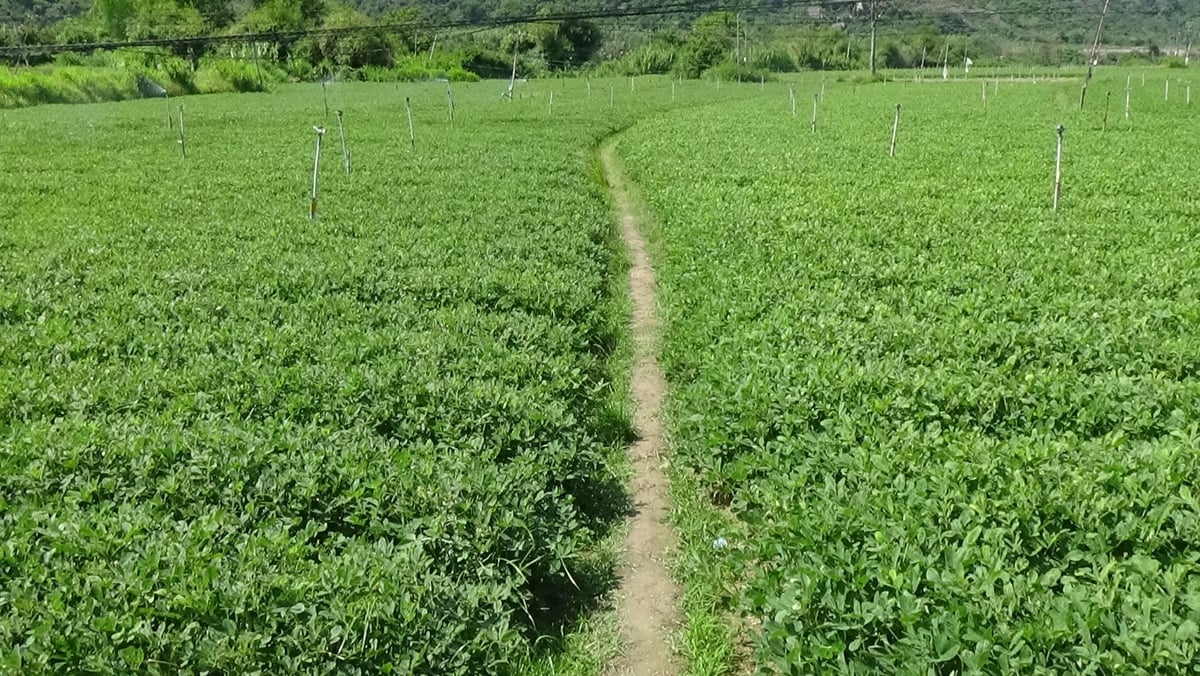
The LDH.09 peanut variety offers coastal farmers a chance to escape poverty. Photo: Vu Dinh Thung.
In particular, alongside research on new varieties, ASISOV has implemented numerous information transfer and technical training programs on cultivation techniques for farmers in coastal areas. From disseminating information about new peanut varieties, guiding farmers on seed selection, soil improvement, proper fertilization procedures, to pest and disease control methods, farmers have gradually acquired the knowledge to effectively apply the LDH.09 peanut variety to production. According to Dr. Pham Vu Bao, this process is not just about providing scientific information, but also a tool to help farmers escape poverty by improving economic efficiency and reducing cultivation risks.
The LDH.09 peanut variety was tested in the South Central Coastal region from 2014, and was recognized as a trial variety in 2017. In 2019, the former Ministry of Agriculture and Rural Development (now the Ministry of Agriculture and Environment) approved the project "Trial production of LDH.09 peanut variety in the South Central Coastal region". Subsequently, ASISOV conducted trial production in the provinces of Binh Dinh, Quang Ngai, Khanh Hoa, and Quang Nam (formerly), and in 2021, the Department of Crop Production accepted its self-declaration for circulation as a new variety.
“The LDH.09 peanut variety has completed a new breeding process that meets the criteria of climate-smart agriculture (CSA), including: enhancing productivity and sustainable efficiency, minimizing greenhouse gas emissions, and adapting to climate change,” shared Dr. Pham Vu Bao.
Peanut varieties help farmers reduce poverty.
The LDH.09 peanut variety has given farmers in the coastal area of Cat Hai commune (Phu Cat district, former Binh Dinh province), now Cat Tien commune (Gia Lai province), an opportunity to escape poverty and have a stable life.
According to Mr. Nguyen Van Hung, Secretary of the Party Committee of Cat Tien commune (Gia Lai province), before 2002, although the former Cat Hai commune was a purely agricultural area, there was only one small reservoir in Tan Thang village that could only irrigate about 40 hectares of rice; another reservoir in Vinh Hoi village was even smaller, only irrigating about 10 hectares. Hundreds of hectares of remaining rice-growing land relied on rainwater. Therefore, farmers in this locality could only grow one winter-spring rice crop per year, with very low yields, not exceeding 45 quintals/hectare, leaving people with insufficient rice to eat.
Since 2003, thanks to receiving information about crop diversification, farmers in Cat Hai have boldly switched to growing peanuts. The area planted with peanuts quickly increased to nearly 400 hectares, with an average yield of 36 quintals/hectare, contributing to increased income and stable livelihoods.
According to Dr. Pham Vu Bao, the LDH.09 peanut variety adapts well to saline soil in coastal agricultural areas, yielding 14-18% higher productivity compared to traditional peanut varieties; LDH.09 peanuts have large pods, making them suitable for participation in the fresh peanut supply chain, and are resistant to bacterial wilt, thus reducing the number of pesticide applications.
At the same time, thanks to training sessions and guidance on farming techniques, farmers have learned how to apply new varieties according to standard procedures, from soil improvement, fertilization, care to harvesting. Scientific information has become a "weapon" to improve economic efficiency and reduce risks, while also changing people's perceptions of smart agriculture.
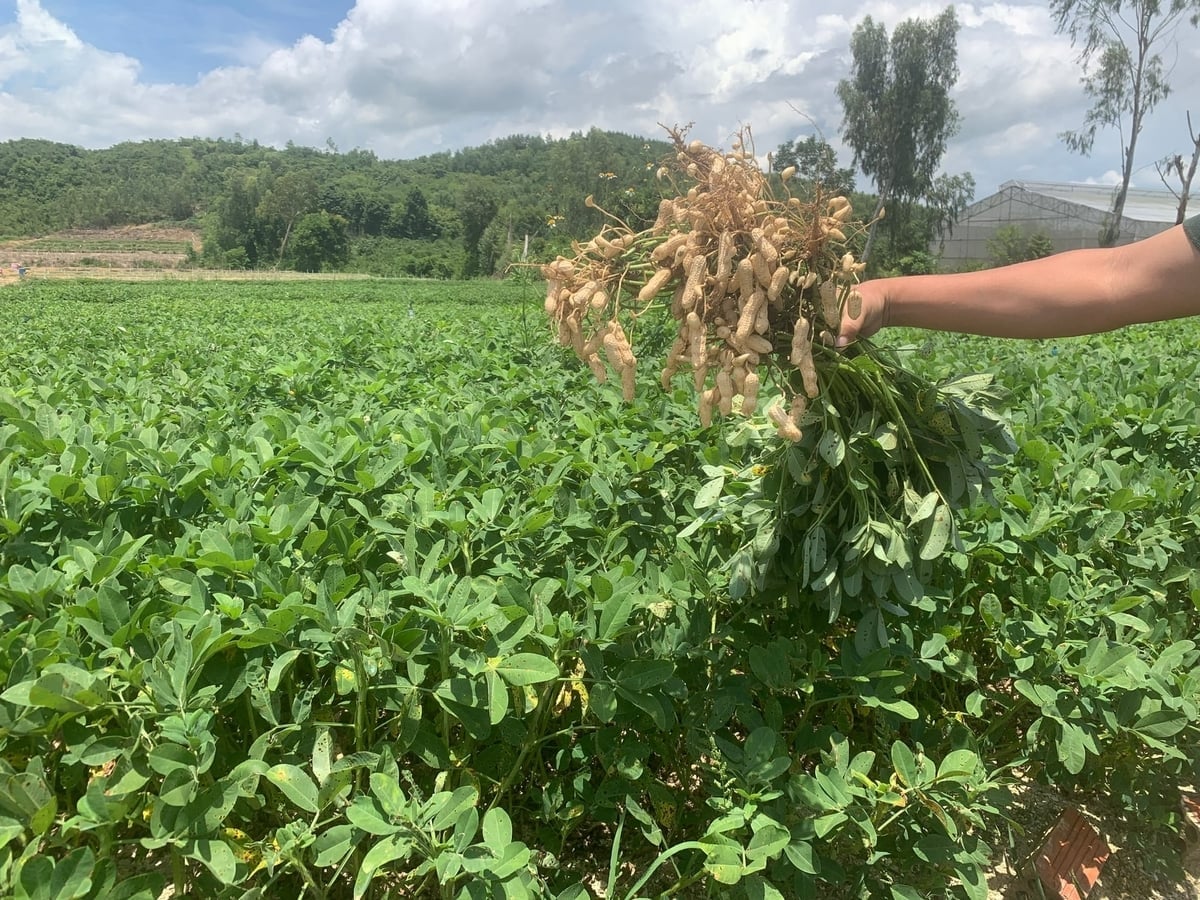
The LDH.09 peanut variety is salt-tolerant, high-yielding, resistant to bacterial wilt, and has large pods, making it advantageous for participation in the fresh peanut supply chain for domestic consumption. Photo: Vu Dinh Thung.
According to Dr. Bao, thanks to its adaptability, the LDH.09 peanut variety is used for cultivation on saline-affected land, converting from one rice crop per year to two peanut crops per year or two peanut crops plus one onion crop per year. This increases land utilization efficiency by 2-3 times, resulting in an additional profit of over 80 million VND/ha/year. Currently, the area for producing the LDH09 peanut variety in the South Central Coastal region reaches approximately 800 ha/year, bringing in an additional profit of about 64 billion VND/year.
"Besides economic benefits, producing the new peanut variety LDH.09 with an integrated farming process on low-yield rice land in saline areas also contributes to protecting the agricultural environment through rational farming methods," shared Dr. Pham Vu Bao, Deputy Director of ASSOV.
It can be said that the LDH.09 peanut variety and the accompanying technology transfer process have helped farmers in the coastal areas of Gia Lai province access information, improve their agricultural knowledge, and apply it in practice, thereby increasing their income, enhancing their production capacity, and achieving sustainable poverty alleviation.
Source: https://nongnghiepmoitruong.vn/giong-lac-chiu-man-giup-nong-dan-ven-bien-giam-ngheo-d788964.html













![Anticipating future trends: [Part 1] New livelihoods from floating tank frog farming model](https://vphoto.vietnam.vn/thumb/402x226/vietnam/resource/IMAGE/2025/12/13/1765607984017_dsc06888-210118_726-133559.jpeg)



















































Comment (0)