



Meritorious Artist Luong Thiem Phu (far left) participates in performing the zither and singing Then songs.
The flame of the craft burns in the hearts of the artisans.
We arrived at Chien Thang village (Dien Xa commune) on a cold afternoon, following a recommendation from the commune's leaders. When we were about 20 meters from the house of the Meritorious Artist Nong Thi Hang, we could hear the clear and warm sound of Then singing, making us want to stop and listen.
The small, simple house is filled with the familiar sounds of the Tay ethnic group. Inside, the distinguished artisan Nong Thi Hang (79 years old) is patiently instructing several young people on how to sing each verse of the ancient then folk song. She corrects each note, each rhythm, her voice gentle but full of determination.
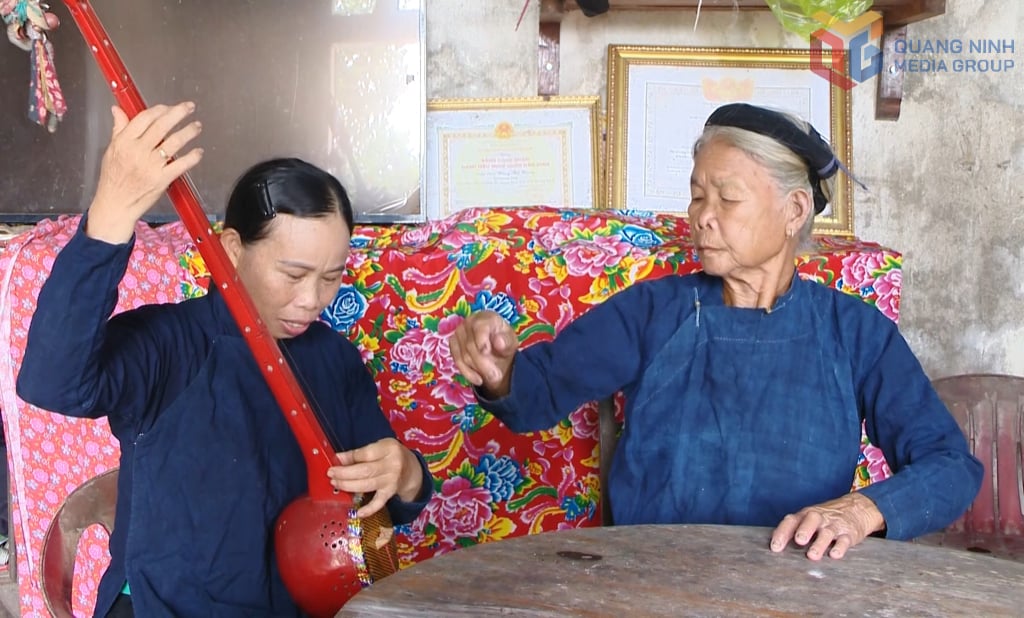
Distinguished artisan Nong Thi Hang teaches the zither and then singing to people in her village.
Meritorious Artist Nong Thi Hang poured a cup of hot tea for her guest, then slowly recounted her journey with then music. She was born into a family in Lang Son with four generations dedicated to then music. “From a young age, I heard my grandparents and parents perform then music to pray for peace. Gradually, I learned and fell in love with it without even realizing it,” shared Meritorious Artist Nong Thi Hang. At the age of 20, she moved to Tien Yen with her husband and continued practicing then rituals, earning the trust of the local people who invited her to perform then music whenever they needed prayers for blessings, peace, or a good harvest.
For Mrs. Hang, then is a prayer to ancestors, a plea for a bountiful harvest and family peace. Then singing is also a way for people to express their feelings, praise their homeland, and teach their children to live kindly and respectfully. In the past, then songs were also a way for young men and women to express their feelings and get to know each other during festivals.
The biggest concern of Meritorious Artisan Nong Thi Hang is the gradual decline of the Tay language and then singing as young people use their mother tongue less in communication. "I fear that one day no one will understand all the ancient then songs," she said, her voice becoming somber. Therefore, Meritorious Artisan Nong Thi Hang diligently transcribed then songs from memory and then opened free evening classes. The classes are simple, sometimes held at the village cultural center, sometimes at her own home, but there are students every evening.
To date, Meritorious Artisan Nong Thi Hang has taught hundreds of people. Many of her students have performed in local and provincial cultural events, and some have even established clubs for singing Then and playing the Tinh instrument to continue spreading their passion.
Ms. Nong Thi Mai (from Dien Xa commune) - a student of Meritorious Artisan Nong Thi Hang, shared: "I have loved then singing since I was little, but it was thanks to Ms. Hang that I fully understood the beauty of each song. Ms. Hang is very patient; she meticulously guided me through every word and every breath, which enabled me to perform in front of an audience and then open a class to teach the children in the village."
Years have passed, but the flame of the traditional craft in the heart of Meritorious Artisan Nong Thi Hang has never died out. "As long as anyone wants to learn, I will still teach," Ms. Hang said with a smile, her eyes shining with simple yet warm joy.
Leaving Dien Xa commune, we continued on to Binh Lieu - a mountainous area in the northeastern part of the province. Chang Na village (Binh Lieu commune) is home to the distinguished artisan Luong Thiem Phu, considered one of the very few artisans who still preserve the traditional techniques of making the Tinh lute.
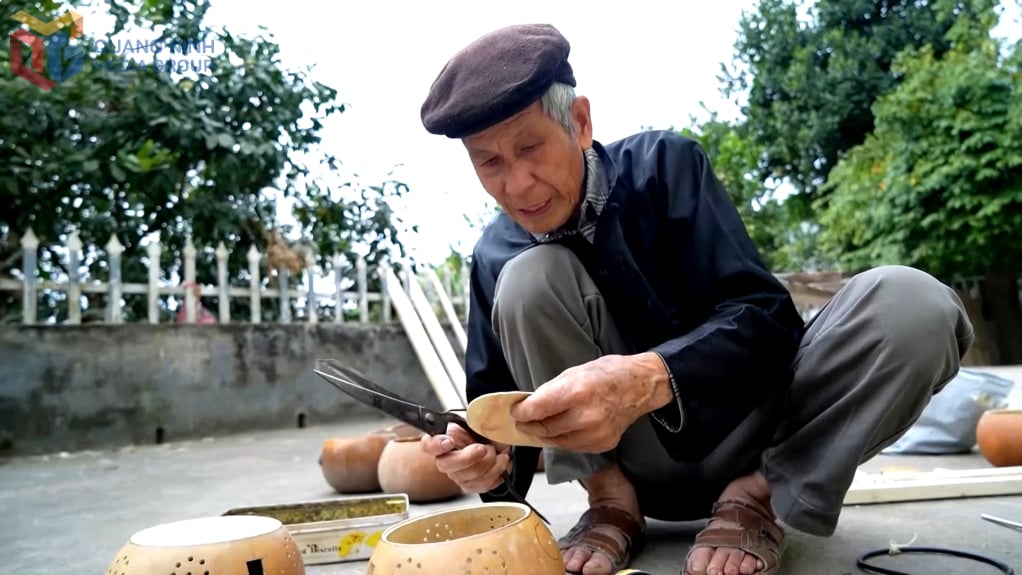
Distinguished artisan Luong Thiem Phu meticulously crafts the zither.
In the spacious courtyard in front of his house, with the still-fresh-smelling sound of the zithers, 86-year-old Meritorious Artisan Luong Thiem Phu meticulously carves the necks of his instruments. His hands are still strong, yet skillful, as if untouched by the ravages of time. Meritorious Artisan Luong Thiem Phu recounts that since childhood he has been fascinated by the sounds of the then and zithers in the village festivals. “Seeing the older children playing and singing, I loved it. So I taught myself and made my own instruments to play,” Mr. Phu said.
In the early years, Master Craftsman Luong Thiem Phu made many zithers, but the sound wasn't resonant enough and the shape wasn't beautiful. He would make one, then revise it, and then make a new one. "Sometimes I would spend half a month working on just one zither over and over again," Master Craftsman Luong Thiem Phu recalled. Through persistent experimentation, Master Craftsman Luong Thiem Phu finally succeeded in making a zither that met the proper standards.
The Tày people's zither looks simple, but it's very difficult to craft. From selecting the wood to choosing the gourd, the most important part of the instrument, every step must be taken with great care. The gourd used for the instrument must be mature, round, beautiful, and free from blemishes or deformities. After harvesting, it must be soaked in water for nearly ten days to remove the pulp, then washed clean, dried, and finally cut horizontally to create a flat surface for gluing the wood. Even a small mistake can cause the instrument to lose its resonance. All these steps are done by hand by the Meritorious Artisan Luong Thiem Phu: from sawing, planing, and chiseling, to the steps of applying the bronze-brown paint to the gourd to create the distinctive color of the Binh Lieu zither.
Despite his advanced age, driven by his love for Then singing and the Tinh lute, Meritorious Artisan Luong Thiem Phu meticulously crafts each Tinh lute every day. Each completed piece brings him joy and happiness. People from the region and beyond still seek him out to order lutes, knowing that only his lutes retain the distinctive sound of the Tay people in this area.
The sound of the Tinh lute has been intertwined with the spiritual life of the Tay people of Binh Lieu for generations. From festivals and weddings to community activities, wherever the Tinh lute is played, the Then folk songs resonate with heartfelt emotion. However, currently only two artisans can make the lute in the traditional way. This means that preservation must not only focus on preserving Then folk songs, but also on preserving the craft of making the Tinh lute, the very soul of their ethnic music .
We left Chang Na with the gentle sound of the zither still echoing behind us, like a message from the old artisans to the younger generation: "Preserving the sound of the zither is preserving our roots."
"Living treasures" of silk weaving singing - singing and dancing at the temple gate.
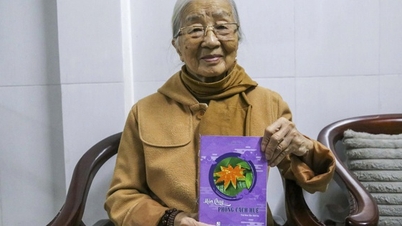
Our final destination was Dam Ha commune, considered the cradle of the art of "hat nha to" (singing and dancing at the communal house gate). Here, we find a person regarded as a "living treasure" of this unique art form: People's Artist Dang Thi Tu, who is now 104 years old.
On the way to the home of People's Artist Dang Thi Tu in Trai Giua village, we were told many stories by Ms. Dang Minh Hai, Deputy Secretary of the Dam Ha Commune Youth Union. She said: "Ms. Tu knows nearly 40 songs with 9 different styles of traditional Vietnamese folk singing. She teaches many young generations; almost everyone who loves traditional folk singing in Quang Ninh has learned from her at least once."
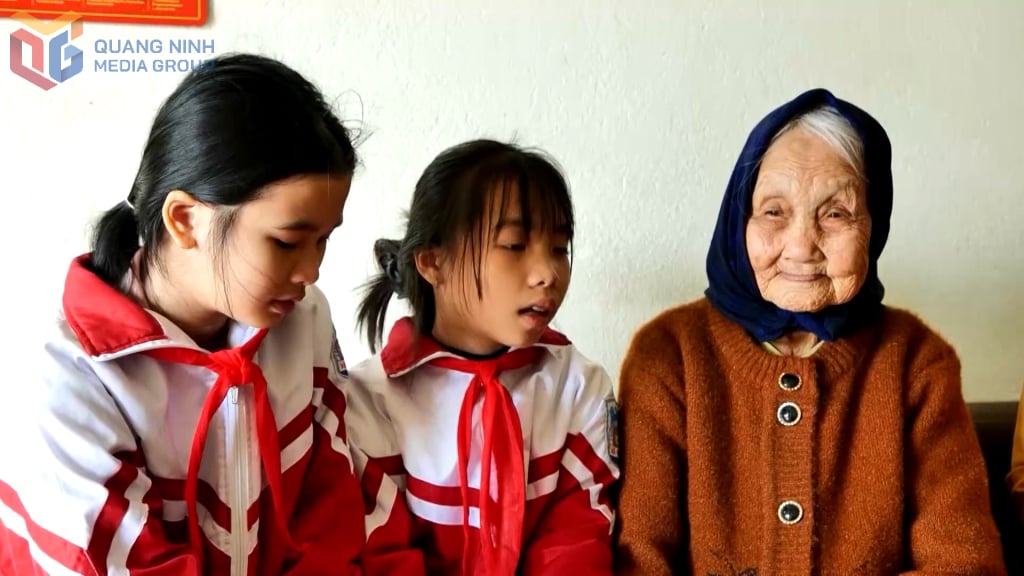
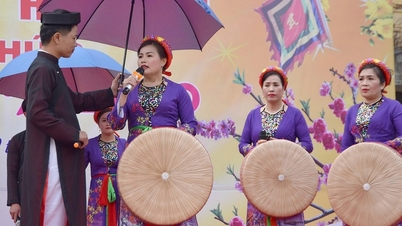
People's Artist Dang Thi Tu (Dam Ha commune) teaches children in the village to sing the "Nha To" folk song.
Upon meeting, People's Artist Dang Thi Tu, though her voice was weak, still had bright eyes and a surprisingly resilient singing voice. The elderly artist recounted that she had been deeply immersed in the sounds of temple singing since childhood. At just 16 years old, she performed at village temple festivals and was later invited to perform in many places throughout the province.
In 2019, Mr. Tu was honored to receive the title of People's Artisan from the President of Vietnam - a well-deserved reward for his lifetime of dedication.
When asked about the techniques of "Nha To" singing, People's Artist Dang Thi Tu shared that "Nha To" singing has many styles, including "huynh," "giai," "phu," "xa lam," "ham," "vong," "het nhac," "tha," and "thap nhi tu ieu." The temple gate dances include lantern dances, flower dances, incense offering dances, and sacrificial dances. Each style and melody has its own rules, and they are not easy to perform. "The singer must know how to pronounce the words clearly and distinctly. The rhythm must be firm and crisp, matching the lyrics. If you don't understand the lyrics, you will never be able to sing with soul," Ms. Tu said.
Those who studied under People's Artisan Dang Thi Tu all acknowledge that she not only passed on the techniques but also the "spirit" of silk weaving—the solemnity, softness, and emotion of the craft.
Despite being over a hundred years old, People's Artist Dang Thi Tu still dedicates her time to mentoring young people. Whenever she sings, the atmosphere seems to quiet down, transporting listeners back to the traditional village festival – where the sounds of clappers and stringed instruments blend with her simple yet profound singing.
In recent years, to preserve this heritage, the Youth Union of Dam Ha commune has established a traditional silk-singing club in schools with 60 students. The classes are taught by individuals who previously studied under People's Artist Dang Thi Tu. Thanks to this, the traditional silk-singing, traditionally performed by the elderly, now resonates clearly in the voices of young children. This is a welcome sign for a performing art form facing the risk of extinction.
People's Artist Dang Thi Tu often said, "As long as there are learners, there will be silk weaving." And her presence is the most vivid proof of that spirit – she has preserved and passed on the soul of silk weaving singing and dancing – the singing and dancing at Dam Ha communal house – for over a hundred years.
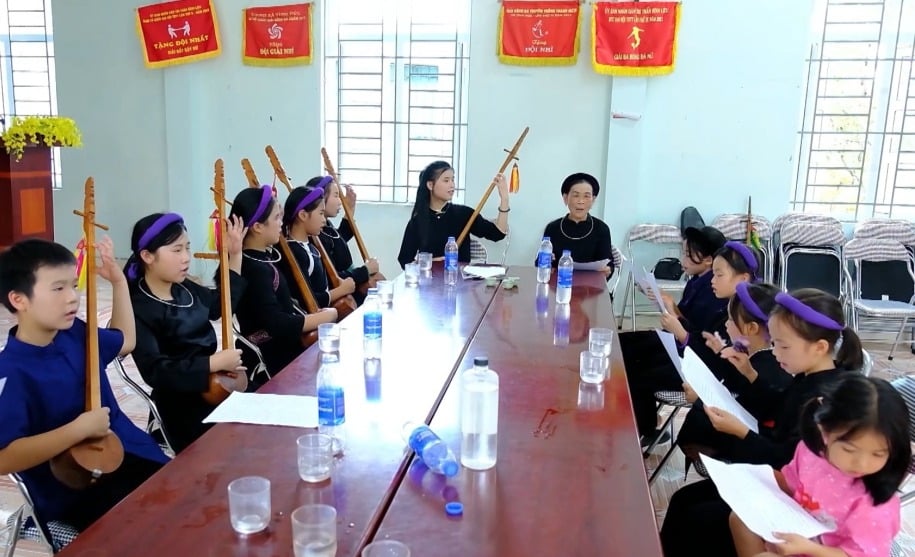
A class on singing then and playing the zither in Na Lang village (Binh Lieu commune).
Quang Ninh is developing rapidly today, but amidst this development, artisans like Mrs. Hang, Mr. Phu, and Mr. Tu... are quietly preserving and passing on traditional culture. Currently, the province has 36 Outstanding Artisans and 2 People's Artisans, each with their own craft and method, but all sharing a deep devotion to the nation's heritage.
They don't speak grandiose words. Their work is simply transcribing folk songs, teaching children how to play the instrument, embroidering traditional costumes, and instructing learners on how to pronounce the words in the silk-making songs... But it is this quiet dedication that helps preserve values that seem fragile in the face of modern life.
They are the keepers and transmitters of the flame. These enduring flames will continue to burn brightly, ensuring that the cultural identity of the ethnic groups in Quang Ninh is not only preserved but also continued and spread to future generations.
Ngoc Tram
Source: https://baoquangninh.vn/nhung-nghe-nhan-giu-lua-van-hoa-truyen-thong-dan-toc-3388449.html
![[Photo] Prime Minister Pham Minh Chinh presides over a meeting to assess the situation during the Lunar New Year holiday.](https://vphoto.vietnam.vn/thumb/1200x675/vietnam/resource/IMAGE/2026/02/22/1771768925196_ndo_br_dsc-6283-jpg.webp)


























































































Comment (0)