

In Binh Thuan province, the discovery of gold has not been uncommon, often occurring in ancient temples and towers, or in villages and cemeteries of the ancient Cham people. There are many stories of accidental gold finds and others of people spending vast sums of money, sometimes even risking their lives, without success. The story below is true; the author witnessed it firsthand… a burial pit containing a golden statue of a deity in Hamlet 1, Hong Liem commune, in 2002.
From scrap metal detectors
About 20 years ago, many people in various localities bought metal detectors to search for war relics everywhere, especially on sand dunes and slopes. At that time, the provincial museum also surveyed and excavated several archaeological sites on sand dunes and slopes from Phan Thiet all the way to Hong Liem, Bau Theu, Bau Trang, Hoa Phu… During these surveys, they often encountered many locals with metal detectors and hoes, looking from afar like military engineers on duty. Everyone seemed to cover their faces to protect themselves from the hot sun and dust on the sand dunes at noon and in the afternoon.
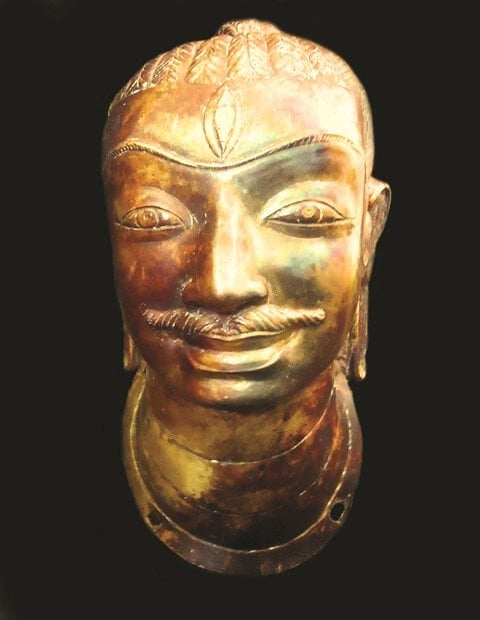
Each person has a fairly modern metal detector: The body of the device is attached to the center and top of a circular base like a pot lid; a wire connects the earpiece to the device. Through the earpiece, the detector identifies and analyzes the received signals. When they receive a signal, they dig, search, and retrieve a few pieces of iron, aluminum, or copper from the ground. They diligently search and sell scrap metal day after day as a hobby in their spare time from farming.
Also working as a war relic scavenger, Mr. Nguyen Van Bup, residing in Ham Nhon commune, discovered a bronze statue of Amitabha Buddha, a candlestick, an incense burner, and a bronze lion while searching along the sand dunes in the Bau Theu area. Another person found seven bronze Buddha statues in Ham Chinh commune, Ham Thuan Bac district. The district police handed them over to the provincial museum.
In many places and at different times, while scavenging for scrap metal, people have inadvertently found ancient tools such as axes, hoes, and swords, as well as bronze jewelry like bracelets and earrings. These ancient inhabitants were buried in jar-shaped tombs in burial sites belonging to the Sa Huynh culture, dating back more than 2,500 years. The money earned from selling a few ounces of bronze is not much, but those scavenging for scrap metal have unknowingly aided those who vandalize many important archaeological sites. Archaeologists are outraged to see many tombs dug up, with jar-shaped tombs shattered into hundreds of pieces, all because of a few bronze rings.
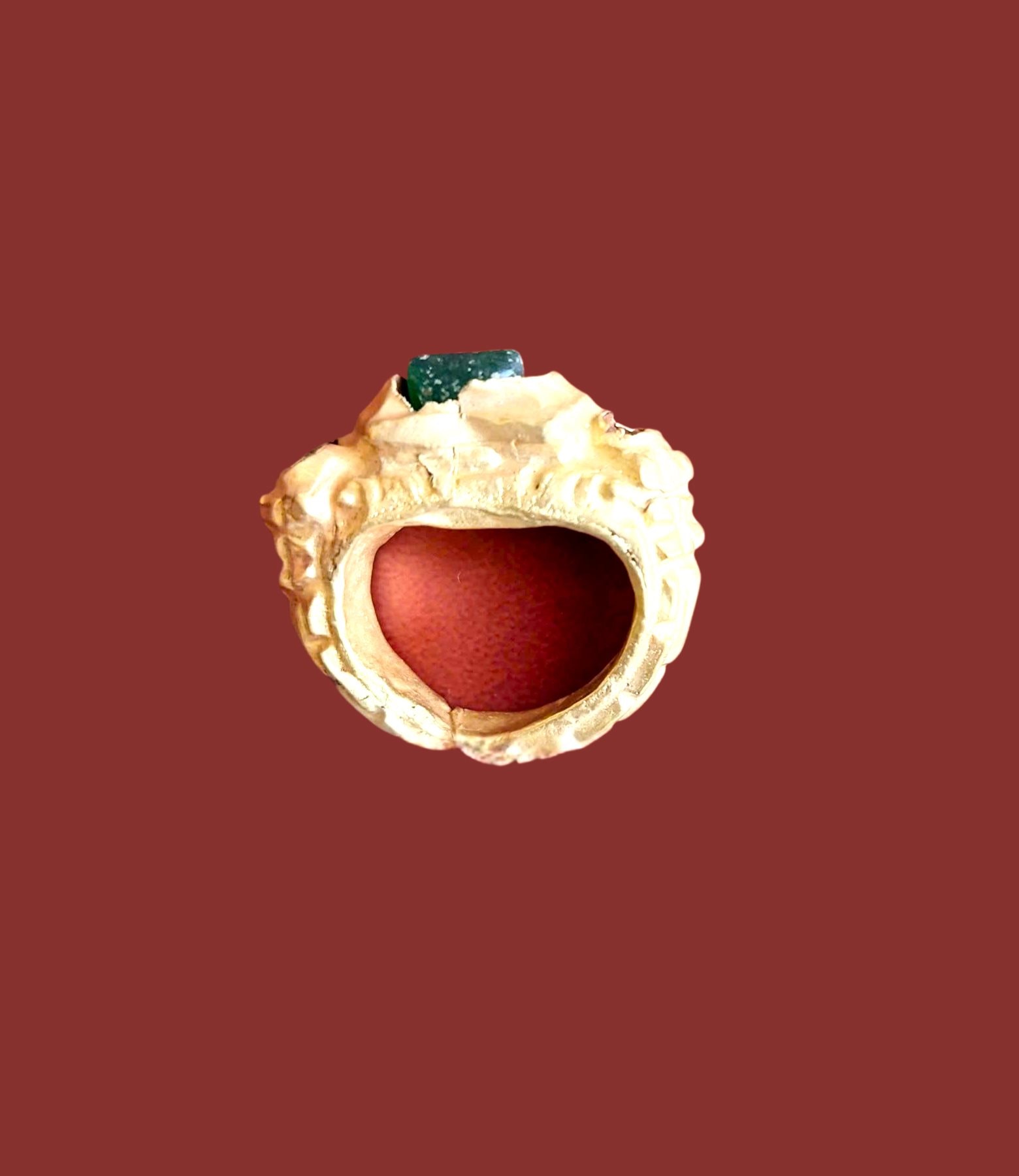
Even Shiva was detected by the detector.
As archaeologists, my colleagues and I often gather information from farmers, those setting traps for monitor lizards, and even those specializing in metal detection. We've heard stories of people finding gold earrings, bracelets, or even artifacts made of both bronze and porcelain buried in a bronze basin… they consider it "good fortune" gold and quickly sell it, not daring to keep it at home. Such stories are usually kept secret, and by the time we hear about them, it's often long past.
The scrap metal collectors boasted that their high-quality metal detectors could detect metal at great depths quickly and accurately. Even objects buried at great depths were discovered. This was the case with the gold statue of a goddess, gold rings, and precious stones buried in a ceramic jar, which were discovered by the metal detector in 2002 on a sand dune in Hamlet 1, Hong Liem Commune. We recount the story below, based on records kept at the Provincial Museum, dated December 26, 2002.
At 2 PM on February 4, 2002 (the 1st day of the 11th lunar month of the Year of the Horse), two men residing in Luong Nam village, Luong Son commune, Bac Binh district, brought a metal detector to the field of Mr. Nguyen Thanh Thuong in village 1, Hong Liem commune. Both men repeatedly scanned the field with the detector. Suddenly, the detector signaled the presence of metal. They used hoes to dig, but the soil was hard, and the object was at an unusually deep level. One man secured the scene, while the other went to where Mr. and Mrs. Nguyen Thanh Thuong were working nearby to borrow a long-handled hoe to dig. After digging about 1.5 meters, they discovered a ceramic jar (which the discoverers called a ceramic pot) with a thick, rusted copper lid, indicating that the object had been buried inside for a very long time. Eager to see the lid and the earthenware jar filled with sand, a man named Ty reached inside and dug up the sand, then successively pulled out a golden statue head, over 20 cm tall, hollow inside, and four gold rings. They only had time to quickly wipe the contents with their clothes to check what they had unearthed. Once they were sure it was real gold, they quickly left, without filling the hole back up for the landowner.
Having witnessed everything from the beginning, after the two men left with the statue and four gold rings, leaving behind the jar and a rotten bronze lid, Mr. Thuong scooped out all the sand inside and found a gold ring with three eyes and a stone. Later, he asked some Cham people and learned that it was a Mưta ring, a distinctive piece of jewelry from their ancestors. Thus, including the ring Mr. Thuong found in the jar, there were a total of five rings.
The discovery of the gold statue in Mr. Thuong's field by two scrap metal collectors was kept secret from everyone. Not even Mr. Thuong and his wife told anyone. It wasn't until December 26, 2002, that the information reached the Provincial Museum, provided by a local resident. The Department of Culture and Information contacted the Provincial Police (Cultural and Ideological Security Protection Department PA25) and sent an officer to the discovery site that same afternoon.
We left our motorbike at a villager's house and walked for over 30 minutes to reach Mr. Thuong's farm. Luckily, we met him and his wife there. Seeing the police, he guessed we were there for some reason. He led us to the deep hole where the metal detectorists had discovered the gold statue nearly a month earlier. It was a deep hole, with hard, light pink sandy soil… and Mr. Thuong and his wife recounted the story as described above.
Speaking about the statue, he said it was made of gold because it was entirely gold when brought up. It was a female statue along with four gold rings. I asked how he knew it was a female statue, and he said it was because he saw long hair on the head, with a few small strands, and a bun at the back. I spent quite a while working with Mr. and Mrs. Thuong to hear more about their work searching for metal in the area. He said that it wasn't their first time searching; many people had searched before but hadn't found anything, either because of their equipment or because it wasn't their luck yet... As evening approached, the couple donated a 35 cm tall ceramic jar and several broken pieces of the copper lid to the museum. As for the Mưta ring, we made a receipt and bought it back.
Regarding the story after unearthing the golden statue, the two men from Luong Nam, Luong Son, secretly took it to Phan Thiet to have it tested and then sold it at a gold shop. No one knows which gold shop they sold it to, how much they got, or whether the statue was kept or melted down. Much later, some local residents told us that both men who found the statue had bought Chinese-made Dream motorcycles and renovated their houses.
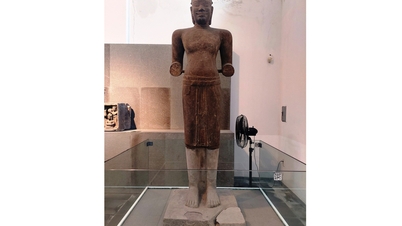
Although they couldn't see the golden statue head in person, based on the detailed descriptions from Mr. and Mrs. Thuong, such as the details on the head, estimated measurements, color, etc., and comparing it with a golden statue discovered in Quang Nam in 1997 and another golden statue discovered in Phan Thiet in the early 20th century (currently at the Vietnam National History Museum), both are statues of the god Shiva. The descriptions of the shape and measurements of these two golden statues are very similar to the one recently discovered in Hong Liem. Both golden statues are national treasures. At that time, the Scientific Council of the Department of Culture and Information estimated that the statue discovered in Hong Liem was a golden statue of the god Shiva, dating back to the 10th century. It's a pity that if the golden statue discovered in Hong Liem had been recovered in time, Binh Thuan would certainly have had another national treasure.
Source: https://baobinhthuan.com.vn/phat-hien-tuong-vang-co-champa-128234.html
![[Photo] General Secretary and President To Lam presides over the meeting to approve the draft report on the results of the second inspection by the Politburo of the Standing Committee of the Hanoi City Party Committee.](https://vphoto.vietnam.vn/thumb/1200x675/vietnam/resource/IMAGE/2026/05/26/1779789811432_a2-bnd-4430-9620-jpg.webp)
















































































Comment (0)