

 |
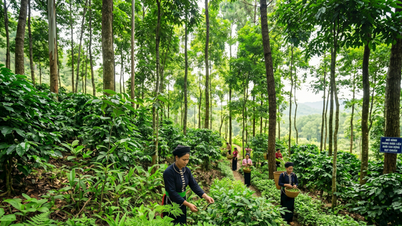
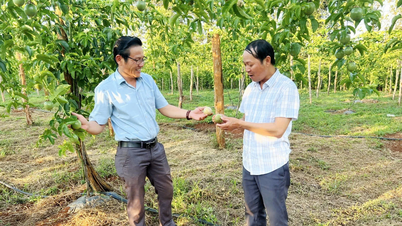
| Mr. Hoang Van Son picks Buddha's hand fruit for customers. |
A chance encounter
Upon inquiry, locals advised me to go to Hamlet 7, near the road leading to Thien Duong Cemetery Park, in the former Lang Quan commune (now Yen Son commune), and ask for "Son Phat Thu" (Buddha's Hand Mountain), and everyone would know.
In April, the road to Hamlet 7 was shrouded in dust. The inter-hamlet road, still under construction, was constantly being moved by trucks carrying soil and construction materials, spewing clouds of dust that painted the sky yellow. Under the scorching sun, in a Buddha's hand citron orchard nestled amidst lush green rice fields, Mr. Hoang Van Son nimbly cut each ripe green Buddha's hand citron, carefully placing them into styrofoam boxes, preparing them for shipment to customers.
Son was so busy that he was simultaneously talking to reporters, managing a team of workers preparing the land to expand the area for planting pomelo trees on the alluvial plain, providing technical guidance via Zalo video , and taking orders. Looking at this young man nearing 40, no one would guess that he was once a notorious Buddha's hand fruit trader.
Taking the reporter home to start the story, Mr. Son reminisced: Originally a Buddha's hand fruit trader, he started trading in 2017. Every day, he traveled to the communes of the former Ham Yen district to buy Buddha's hand fruit and sell it to the lowlands. Through many ups and downs, the price of Buddha's hand fruit has never dropped, always remaining stable at 20,000 - 25,000 VND/kg. If the "harvesting area" in Hoai Duc ( Hanoi ) experienced a crop failure, the price would often rise to 40,000 - 50,000 VND/kg. Moreover, the trees yield a stable harvest, several times more profitable than rice grown on the same area.
At the end of 2019, he boldly invested 30 million VND to renovate 2 acres of his family's rice land, installing fences, a drainage system, and an irrigation pump to plant Buddha's hand citron. Given that the plant requires nearly two years to bear its first fruit, Mr. Son's first harvest was a failure. He said that while others got 20 fruits per tree, he only got 5, and some trees didn't bear any at all. "I only earned 5 million VND that whole season. Thinking about the failure made me very sad, but I was determined to find a solution," Mr. Son said sadly.
Having learned from experience everywhere, Mr. Son gradually tamed this finicky plant, sensitive to dew, harsh sunlight, and dry weather. Therefore, producing beautiful fruit requires meticulous and arduous care. He explained that the most important things are fertilizing, spraying fungicides and pesticides, and pruning regularly. Good ventilation increases photosynthesis and promotes balanced growth, resulting in larger fruit.
 |
| The Buddha's hand citron tree is a new direction in the economic development of Yen Son commune. |
Initial success
According to Le Van Tuan, Vice Chairman of the People's Committee of Yen Son commune, the Buddha's hand citron tree is gradually proving to be a suitable production direction, opening up opportunities to increase income for farmers in Yen Son commune. The proactive innovation in production thinking, bold application of science and technology, and flexible combination with digital technology in product promotion and consumption, as exemplified by Mr. Hoang Van Son, has enhanced the value of agricultural products. When agricultural production is linked to market demand and modern methods, the fields are not only places for cultivation but also become a foundation for sustainable livelihoods, creating motivation for people to confidently stay and legitimately enrich themselves on their homeland.
Mr. Son confided that, honestly, after seven years of growing this plant, the most difficult thing has always been treating the sap-oozing disease. If not treated promptly, it will spread and cause mass death. There were days when he spent the whole day enduring rain and sun in his Buddha's hand citron orchard, but luckily, the heavens smiled upon him. Finally, in the 2025 harvest, Mr. Son succeeded. He said his family harvested over 2 tons of fruit, generating revenue of over 70 million VND. This was also the first successful harvest after a series of failures.
Holding a ripe, golden Buddha's hand fruit with segments spreading out like a hand, Mr. Son explained that there are many varieties of Buddha's hand fruit, but the most effective is the white-flowered variety. It's easy to grow, easy to care for, and grows faster than the green and mutated green varieties. In particular, when it bears fruit, the proportion of fruit that spreads out like a hand is higher. Growing Buddha's hand fruit is difficult, but producing beautiful, high-quality fruit requires considerable effort. He revealed that, thanks to applying the right techniques, his orchard produces fruits weighing 3-4 kg, and although they are twice as expensive as regular ones, he sells everything he produces.
I'm quite curious about the sales style of this honest farmer, Mr. Son. Besides the business connections he's had since he started trading, he now livestreams on social media. He's witty and seems to have a knack for it, as he sometimes can't even keep up with orders, so he limits his livestreaming to focus on taking care of his plants.
No sooner had he said goodbye than Hoang Van Son slung a bottle of medicine over his shoulder. He said that this year he expanded his planting area by adding 6 sao (approximately 0.6 hectares) of rice paddies in addition to the 2 sao already planted, bringing the total to nearly 200 Buddha's hand citron trees on an area of nearly 3,000 square meters, and 2 sao of alluvial land to plant more red pomelos from Ham Yen. "If successful, I will replicate this model for people in the surrounding area to follow, so that young people will stay connected to their homeland instead of leaving as is currently the case," Mr. Son affirmed.
Le Duy
Source: https://baotuyenquang.com.vn/kinh-te/nong-lam-nghiep/202604/phat-thu-bam-dat-yen-son-cdf09c4/















![[Photo] Reception to welcome General Secretary and President To Lam and his wife on their State visit to the Philippines](https://vphoto.vietnam.vn/thumb/1200x675/vietnam/resource/IMAGE/2026/06/01/1780295488620_vna-potal-chieu-dai-chao-mung-tong-bi-thu-chu-tich-nuoc-to-lam-va-phu-nhan-tham-cap-nha-nuoc-toi-philippines-8798060-7855-jpg.webp)














































Comment (0)