

Looking back at the results of the 2021-2025 period
After the merger, Phu Tho province has a total tea cultivation area of approximately 15,000 hectares, with a production of over 183,000 tons; it is one of the top three localities nationwide in terms of tea cultivation area and production.
Along with positive changes in the mindset and awareness of tea growers, concentrated production areas and value chain linkages have also been expanded. Many large-scale production areas have been established in the province, covering approximately 5,800 hectares. The application of advanced technology and mechanization in tea production has contributed to ensuring food safety, improving productivity, quality, and product value. The tea processing system has developed, with an average processing output of about 60,000 tons per year. The structure of processed tea products has shifted towards increasing the proportion of green tea and other teas (oolong, flavored, matcha, etc.). Management and brand building for tea have received attention, with many products receiving the "Phu Tho Tea" certification mark. Currently, the province has 39 tea products achieving OCOP status of 3 stars or higher, including 17 OCOP 4-star products and 2 OCOP 5-star products.
Notably, many tea-growing areas in the province have been linked to agricultural tourism and community tourism, such as Pà Cò, Võ Miếu, Long Cốc, Xuân Đài, etc. This has contributed to enhancing the reputation, economic value, and competitiveness of tea products in the area. With increasingly improved tea production efficiency, many families have become wealthy from tea cultivation, making a significant contribution to socio-economic development and the construction of new rural areas in the locality.
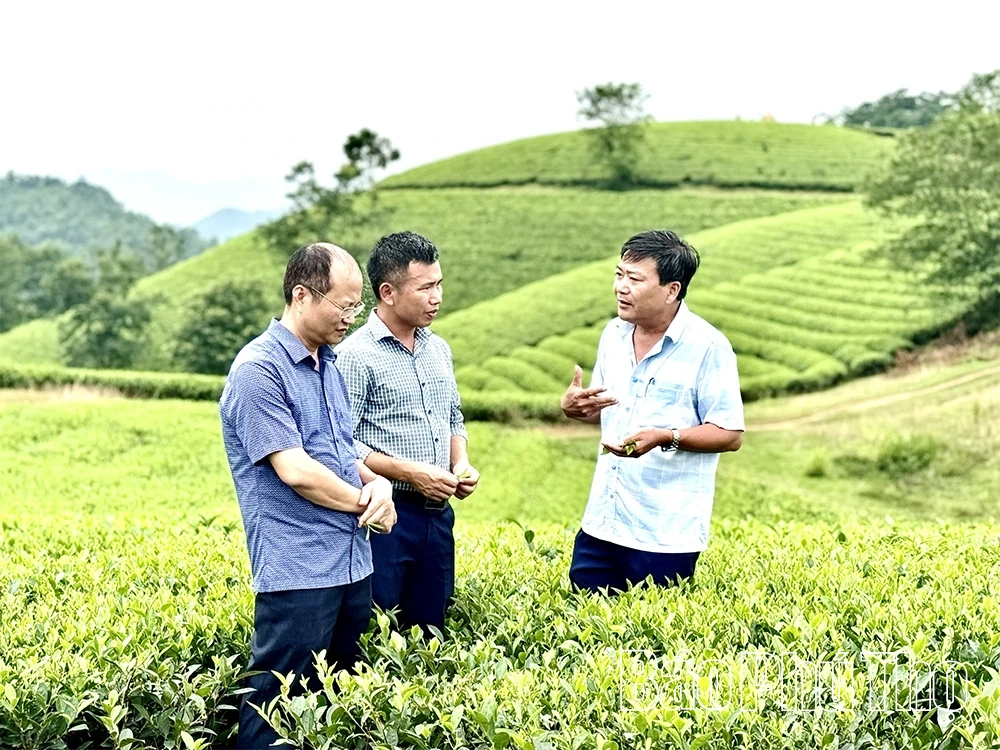
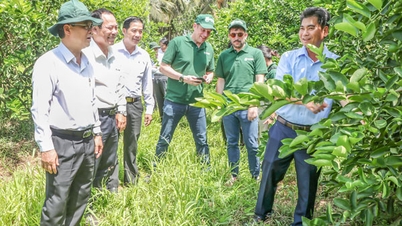
Leaders of the Department of Crop Production and Plant Protection surveyed and assessed the development of concentrated tea growing areas in Long Coc commune.
Despite the achievements, the tea production development still faces several challenges and limitations: In some localities, guidance and direction are insufficient; production is small-scale and fragmented, lacking linkages; awareness of commodity production and food safety is limited; the link between raw material development and processing facilities is weak; the proportion of tea varieties used for high-quality green tea processing is low, with the main product being black tea, processed crudely, and not yielding high economic efficiency; the area of Shan Tuyet tea has not been adequately preserved and exploited, and has not become a primary livelihood for ethnic minorities in the highlands; the activities of cooperatives and cooperative groups are still largely superficial; attracting businesses to invest in production, preservation, processing, and consumption remains difficult...
Develop the tea industry into a key sector with high added value.
According to Comrade Nguyen Hong Yen, Head of the Crop Production and Plant Protection Sub-Department (Department of Agriculture and Environment), in order to overcome existing shortcomings and limitations and improve economic efficiency in production, a sustainable and multi-valued tea cultivation development plan is needed.
The province strives to maintain the existing tea acreage, with an average yield of 135 quintals/hectare of fresh tea buds, and a total production of 189,000 tons. Approximately 1,500 hectares of old, aging tea varieties will be replanted and replaced with new varieties. 90% of the tea acreage will apply Integrated Plant Health Management (IPHM); 80% of the tea acreage will apply good and safe production practices (GlobalGAP, Rainforest Alliance, VietGAP, organic, etc.); over 70% of concentrated tea production areas will be managed, assigned planting area codes, packaging facilities, and have product traceability. At least 5 more organizations, businesses, and cooperatives will be granted the right to use the "Phu Tho Tea" certification mark. The province will maintain existing OCOP tea products, including 2 products certified as 5-star OCOP. It will also preserve areas with approximately 5,000 ancient Shan Tuyet tea trees. Cultivate approximately 400 hectares of Shan Tuyet tea intensively. Establish safe tea production areas, linking production and processing; form and develop five points for promoting the tea culture of the ancestral land in conjunction with tourism development.
To make the tea industry a key sector with high added value, the province aims to maintain a stable black tea raw material area of approximately 8,000 hectares; a green tea and high-quality tea raw material area of approximately 5,500 hectares belonging to cooperatives and production groups; and a concentrated Shan Tuyet tea raw material area of approximately 500 hectares. The development of tea production areas will follow an ecological approach, linked with the development of cultural tourism, agriculture, and traditional crafts.
In product processing, arrange tea preliminary processing points for each concentrated raw material area, ensuring harvesting and preliminary processing of raw materials on the same day; encourage businesses and establishments to innovate processing lines and equipment to modernize and deeply process, ensuring food safety; apply quality management systems according to national and international standards; implement advanced management system certifications such as ISO and HACCP; continue to invest in modern technology and equipment to improve tea product quality; diversify tea products and develop products as raw materials and auxiliary materials for the food, cosmetics, and medical industries.
Regarding trade, continue to support the creation, management, exploitation, and development of trademarks, brands, and intellectual property for tea products; strengthen the promotion of trademark registration and standardization of product quality so that the province's processing enterprises can be awarded the "National Brand of Vietnamese Tea"; register for intellectual property protection of the "Phu Tho Tea" certification mark in some potential foreign markets such as the US, EU, Japan, India, China, etc.
Bui Minh
Source: https://baophutho.vn/phat-trien-cay-che-ben-vung-da-gia-tri-241549.htm




![[Photo] General Secretary and President To Lam receives Amazon's Senior Vice President David Zapolsky](https://vphoto.vietnam.vn/thumb/1200x675/vietnam/resource/IMAGE/2026/05/22/1779466547770_a1-bnd-3513-6601-jpg.webp)







































































Comment (0)