

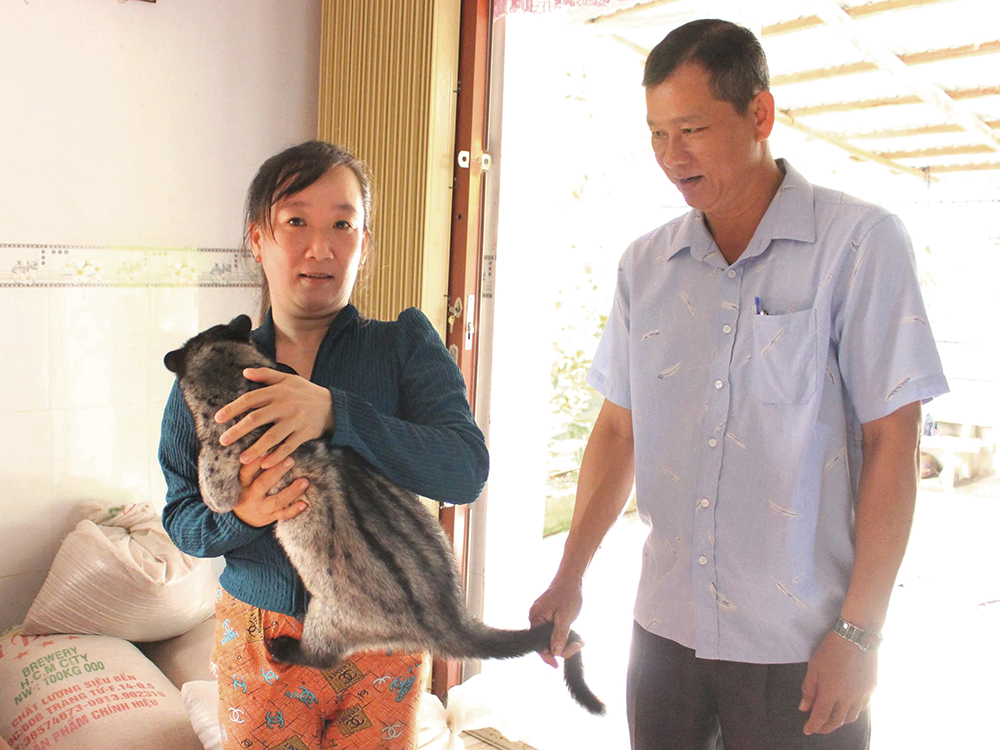
Thanks to raising civets, Ms. Tuyen's family earns an income of 200-300 million VND per year.
We visited the family of Ms. Doan Thi Mong Tuyen, a member of the Hung Phu Agricultural Cooperative, in Hung Phu hamlet, Hiep Hung commune, just as she was feeding her civets. Their main food source consists of ripe bananas and small fish – easily found and inexpensive ingredients.
Ms. Tuyen's family has been involved in civet farming for over ten years. Initially, seeing some acquaintances successfully raising them, she decided to try raising three civets. Thanks to diligently learning from experience and applying appropriate techniques, the civet herd has grown steadily. From the initial three breeding animals, the herd has now increased to over 50, with female civets making up the majority, facilitating the maintenance and development of the herd. In particular, with a systematic care process and nutritious feed, the civets reproduce regularly (a female civet gives birth to about three litters per year, with 3-5 offspring per litter). The healthy, high-quality breeding stock allows her family to supply dozens of breeding pairs to the market each year, generating an income of 200-300 million VND per year.
Ms. Tuyen said: “Civets are easy to raise; you just need to know how to build cages, care for them, and breed them successfully. Civets start reproducing from 10 months old, but it's best around 12 months old. Currently, each breeding pair sells for 6.5-7 million VND. The market for breeding civets is quite stable, and the number of breeding civets my family has is not enough to meet customer demand.”
Civets are wild animals, and in addition to registering their breeding with the authorities, Ms. Tuyen's family always informs the management unit whenever they increase or decrease the herd size and strictly adheres to regulations when buying and selling breeding stock, ensuring legal origin. When selling, Ms. Tuyen wholeheartedly shares her experience and provides technical guidance to help breeders apply the techniques effectively.
Recognizing the clear economic benefits of the civet farming model, many households in Hung Phu hamlet have boldly followed suit, including Mr. Nguyen Nhi Anh. Initially, due to difficult circumstances, he started with only two breeding civets. After joining the cooperative, in addition to receiving guidance on breeding techniques, his family also received preferential loans from the Social Policy Bank. Thanks to this, he confidently borrowed 100 million VND to invest in building cages and expanding his herd. To date, his civet herd has grown to over 30 breeding animals, providing Mr. Nhi Anh's family with a stable income of over 100 million VND per year.
According to Nhi Anh, compared to other pets, civets are easy to raise and care for, but the process must be followed correctly. During the rearing process, the cages should be cleaned daily, and the drinking water changed regularly. In addition, civets have a wild nature and are very aggressive; if kept together, they often bite each other, so they must be kept separately.
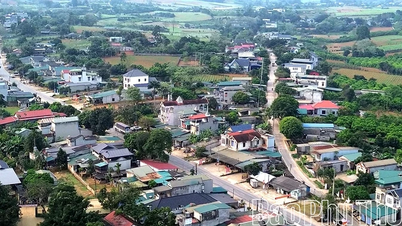
Currently, the Hung Phu Agricultural Cooperative attracts about 20 households raising civets in Hung Phu hamlet, with a total herd ranging from 250-300 animals. The cooperative not only helps connect farming households but also opens up a new, sustainable direction for the rural economy. By participating, people have the opportunity to exchange and share experiences in caring for their civet herds, from breeding techniques and disease prevention to ensuring hygiene in the enclosures. In particular, thanks to the collective farming model, members have an advantage in finding and expanding markets for their products.
Mr. Nguyen Chi Khanh, Vice Chairman of the Vietnam Fatherland Front Committee of Hiep Hung commune and Chairman of the Farmers' Association of the commune, said: The civet farming model of the members of Hung Phu Agricultural Cooperative has brought clear results, with many households earning several hundred million VND per year. Not only does it help people escape poverty and achieve legitimate wealth, but the model also contributes to diversifying livestock in the locality. This is considered a sustainable economic development direction in rural areas. To date, there are about 60 households raising civets in Hiep Hung commune, with a total herd of over 1,000 animals.
Text and photos: CAM LINH
Source: https://baocantho.com.vn/phat-trien-kinh-te-voi-mo-hinh-nuoi-chon-huong-a191814.html

![[Image] A brilliant symphony and explosive power in the skies of Da Nang.](https://vphoto.vietnam.vn/thumb/1200x675/vietnam/resource/IMAGE/2026/05/31/1780196945787_anh-man-hinh-2026-05-31-luc-10-08-51.png)













![[Video] Sunset at Lap An Lagoon – Where the sun sets over the fishing nets](https://vphoto.vietnam.vn/thumb/340x192/vietnam/resource/IMAGE/2026/05/31/1780192137701_beach-landscape-sea-water-nature-grass-745871-pxhere-com.jpeg)



































































Comment (0)