

Support for the far-right AfD party in Germany has increased by 11%, to 16% among those under 25, according to an Infratest Dimap poll. This shift has helped the AfD achieve a historic second place nationwide.
Although the far right isn't performing well in every area, and they're a relatively small group on a continent with an aging population, this trend will still worry mainstream parties, who will face snap elections later this month in France and federal elections next year in Germany.
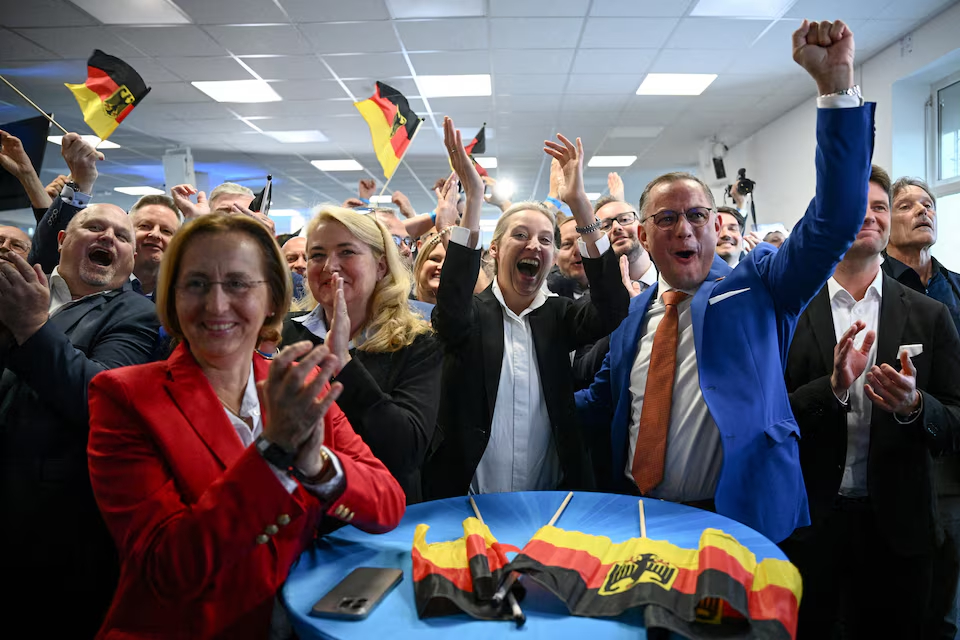
AfD co-leaders react to the results after European Parliament votes concluded in Berlin, Germany, on June 9. Photo: Reuters
Economic concerns increase, climate change decreases.
A recent study shows that young Germans are increasingly worried about inflation, expensive housing, and social divisions, and less worried about climate change. The Green Party won only 11% of the youth vote on June 9th, a drop of 23%.
"They no longer believe that simply working hard will lead to a better future, and they are disillusioned with the ruling parties," said study lead author Simon Schnetzer, noting that the economic gloom is making them more receptive to the AfD's anti-immigration rhetoric.
Christoph, 17, a business student in Berlin, said he finds recent immigrants in Germany more prone to violence and unwilling to integrate.
Ensar Adanur, 17, a German of Turkish descent, said: "I'm worried because I see the far right wanting to deport people even if they have German citizenship like me. But Germany is home to me."
According to pollster Ipsos, in France, the far-right National Rally (RN) party garnered 25% of the vote among those aged 18-24, a 10% increase compared to the overall increase of around 8%, bringing its share to 31.4%. While the majority of young people in the EU's two leading powers still support left-wing parties, many are concerned about this latest trend.
Even in Poland, support for the far-right coalition among voters aged 18-29 has risen from 18.5% to 30.1%, making them the top choice for that demographic group.
On social media
Analysts say the relative proficiency of far-right parties in video apps like TikTok and YouTube is a major factor behind their growing success with younger generations.
Recent research on German youth shows that 57% of young people learn about news and politics through social media. German Chancellor Olaf Scholz, like many mainstream politicians, also joined TikTok just a few months ago. "If you don't participate in channels aimed at young people, you simply don't exist," Schnetzer said.
In Spain, social media influencer Alvise Perez won 6.7% of the youth vote, compared to 4.6% of the total vote across all age groups, after conducting an anti-immigration and anti-corruption campaign almost exclusively on Instagram and Telegram.
Meanwhile, the far-right Vox party, which is very strong on TikTok, garnered 12.4% of the vote among those under 25, compared to 9.6% overall.
Ngoc Anh (according to Reuters)
Source: https://www.congluan.vn/phe-cuc-huu-xam-nhap-vao-gioi-tre-chau-au-nhu-the-nao-post299300.html
![[Photo] General Secretary To Lam visits the exhibition space showcasing books, photo exhibitions, and achievements of digital transformation in journalism.](/_next/image?url=https%3A%2F%2Fvphoto.vietnam.vn%2Fthumb%2F1200x675%2Fvietnam%2Fresource%2FIMAGE%2F2025%2F12%2F19%2F1766110879215_1766110240024-jpg.webp&w=3840&q=75)


![[Photo] Enchanting ancient rose garden on the mountainside in Nghe An](/_next/image?url=https%3A%2F%2Fvphoto.vietnam.vn%2Fthumb%2F1200x675%2Fvietnam%2Fresource%2FIMAGE%2F2025%2F12%2F19%2F1766109900916_vuon-hong-chin-do-thu-hut-du-khach-toi-check-in-o-ha-noi-3-20162778-1671624890024-1671624890104198100259.jpeg&w=3840&q=75)















































![[INFOGRAPHIC] Overview of the Hoa Phat Dung Quat Rail and Special Steel Production Plant Project](https://vphoto.vietnam.vn/thumb/402x226/vietnam/resource/IMAGE/2025/12/19/1766111183203_z7339170069817-126a3e5a095f62e606a0be41015c1b80.jpeg)














































Comment (0)