

On the afternoon of June 19th, the National Assembly passed the amended Law on Prices with 459 votes in favor (92.91%). The amended Law on Prices, comprising 8 chapters and 75 articles, will take effect from July 1st, 2024.
Previously, the Standing Committee of the National Assembly submitted a report explaining why the price ceiling had not been abolished and why this commodity was allowed to operate under market mechanisms.
According to Le Quang Manh, Chairman of the National Assembly's Finance and Budget Committee, regarding the price of domestic air passenger transport services (air tickets), the majority of opinions agree with the Government 's proposal: the State sets a maximum price (price ceiling) to ensure the interests of the people; some opinions suggest abolishing the regulation on price ranges.
The Standing Committee of the National Assembly believes that, in the current context, where the aviation market still has limited competition, promoting the synchronized and modern development of various modes of transport requires further effort, especially since the North-South high-speed railway has not yet been implemented and put into operation; and the impact and consequences of removing the price ceiling regulation have not yet been assessed.
To ensure the autonomy of airlines while simultaneously protecting the rights of citizens, the State needs to maintain price caps on domestic air passenger transport services as a tool for state price management. This ensures the State's responsibility in stabilizing the market, maintaining healthy competition, and promoting socio-economic development.
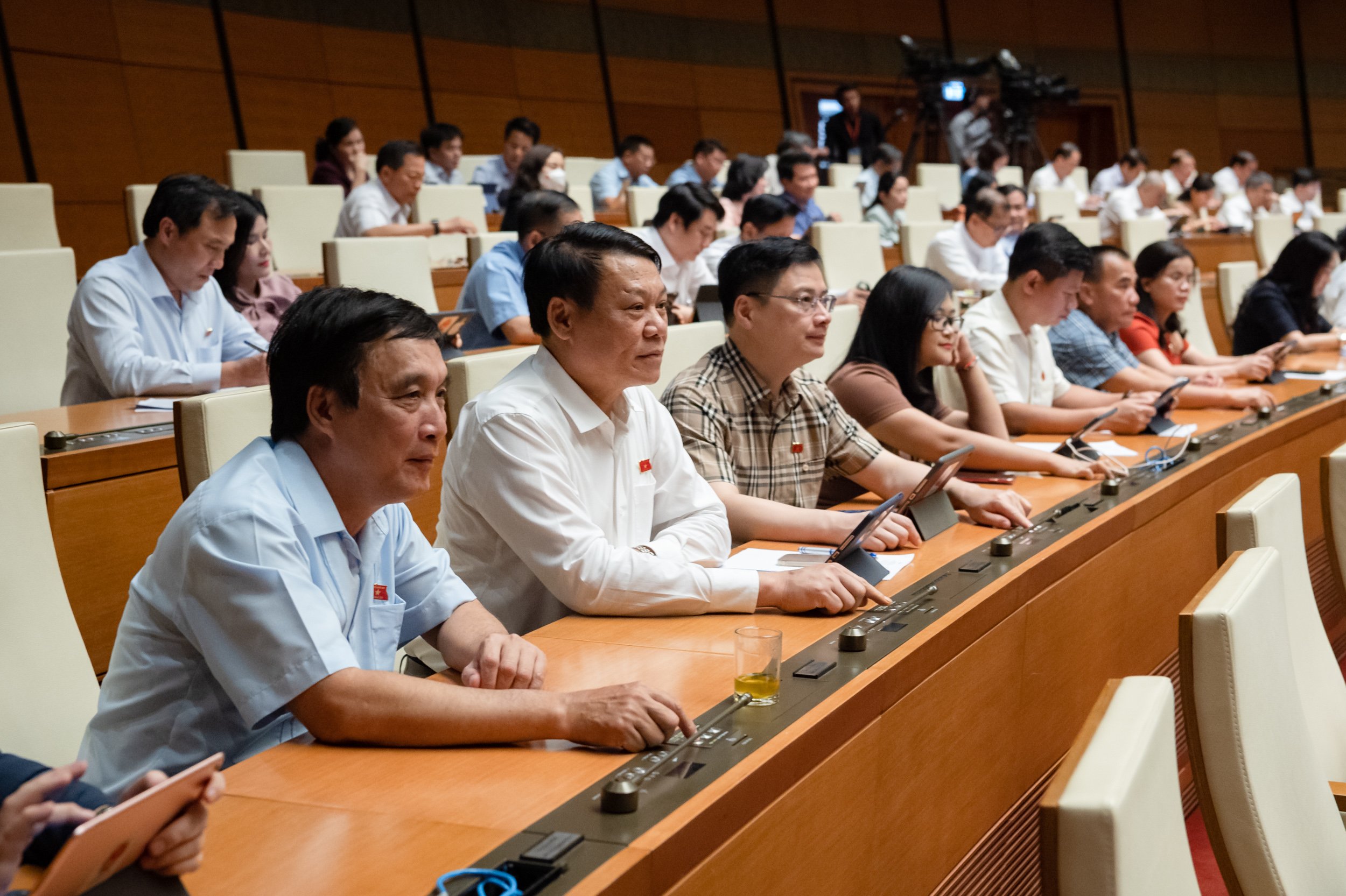
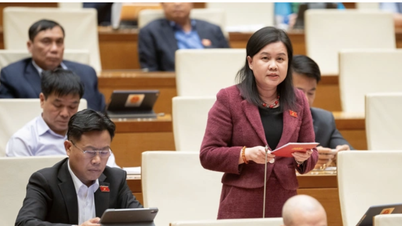
Members of the National Assembly vote to pass the amended Law on Prices.
Based on the actual context, careful consideration of different opinions, and the principle of majority decision-making, the Standing Committee of the National Assembly requests the National Assembly to allow the establishment of a price ceiling for domestic air passenger transportation services.
Regarding the proposal to regulate price ranges for textbooks (including a floor price), the Standing Committee of the National Assembly believes that, according to the current Price Law, textbooks are not a commodity whose prices are determined by the State.
However, since the 14th National Assembly, many delegates have suggested that the State should control the price of this commodity to protect the interests of the people and prevent price increases by publishers.
Responding to the delegates' opinions, the Standing Committee of the National Assembly directed that a price ceiling be set and no price floor be set for this item, because textbooks are essential goods with a very large consumer base and a wide-ranging impact. The price of this item directly affects a large number of people, including those with low incomes.
Currently, in the method of calculating textbook prices, publishers include distribution costs and offer very high discounts (in the 2022-2023 school year, the discount for textbooks was 28.5% of the cover price, and for workbooks it was 35% of the cover price), leading to high book prices compared to the income of many people. Therefore, it is necessary to have control tools to ensure that this does not negatively impact the public.
Not setting a price floor is reasonable because this is a specialized product with a mandatory consumer base, including vulnerable groups. If a price floor were set, book publishers would not be able to sell books to the public at a price lower than the floor, thereby directly affecting the rights of the people, especially those with low incomes.
Currently, the government has not proposed setting a price floor, so the impact of establishing a price floor for textbooks has not been assessed. Therefore, according to the Law on the Promulgation of Legal Documents, there is insufficient basis to add a regulation on price floors.
Furthermore, textbooks are a diverse commodity, consumed nationwide, making it difficult to calculate a floor price that is appropriate for each type of book and suitable for all regions. In practice, depending on the socio-economic situation at any given time, the government will decide on an appropriate ceiling price.
Regarding the opinion that not setting a price floor would lead to unfair competition, the Standing Committee of the National Assembly stated that the Competition Law already clearly stipulates prohibited competitive practices. Relevant authorities need to strengthen control. Violations will be handled according to the law.
Therefore, in order to stabilize the market for textbook prices, create healthy competition, and protect consumer interests, the Standing Committee of the National Assembly requests the National Assembly to allow the Draft Law to only stipulate a price ceiling, not a price floor.
The National Assembly also agreed not to add "milk for the elderly" and pork to the List of goods and services subject to price stabilization .
Source


![[Photo] Closing Ceremony of the 10th Session of the 15th National Assembly](/_next/image?url=https%3A%2F%2Fvphoto.vietnam.vn%2Fthumb%2F1200x675%2Fvietnam%2Fresource%2FIMAGE%2F2025%2F12%2F11%2F1765448959967_image-1437-jpg.webp&w=3840&q=75)


![[Photo] Prime Minister Pham Minh Chinh holds a phone call with the CEO of Russia's Rosatom Corporation.](/_next/image?url=https%3A%2F%2Fvphoto.vietnam.vn%2Fthumb%2F1200x675%2Fvietnam%2Fresource%2FIMAGE%2F2025%2F12%2F11%2F1765464552365_dsc-5295-jpg.webp&w=3840&q=75)















































![[OFFICIAL] MISA GROUP ANNOUNCES ITS PIONEERING BRAND POSITIONING IN BUILDING AGENTIC AI FOR BUSINESSES, HOUSEHOLDS, AND THE GOVERNMENT](https://vphoto.vietnam.vn/thumb/402x226/vietnam/resource/IMAGE/2025/12/11/1765444754256_agentic-ai_postfb-scaled.png)









































Comment (0)