

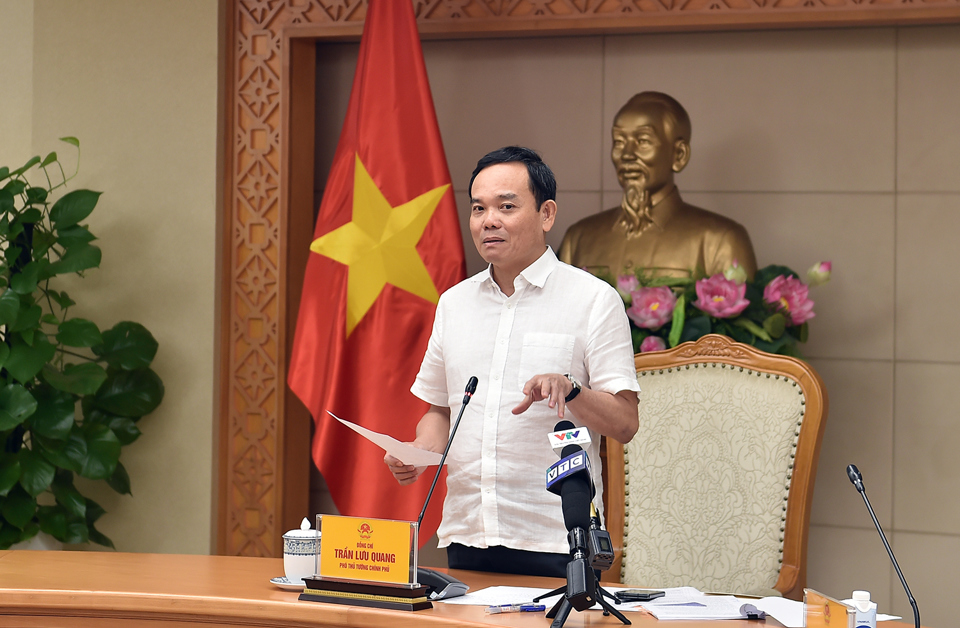
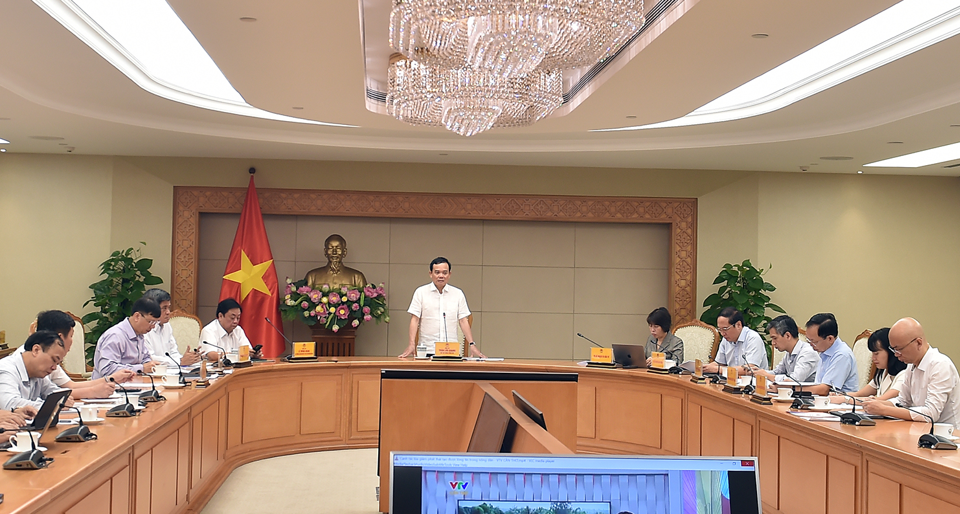
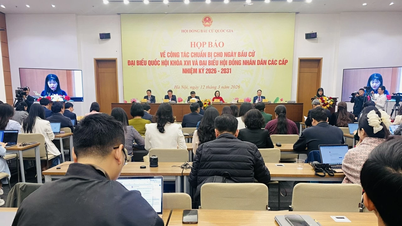
Also attending the meeting were Minister of Agriculture and Rural Development Le Minh Hoan, and representatives from the Ministries of Natural Resources and Environment, Planning and Investment, Finance, Industry and Trade, and the Government Office.
Reporting at the meeting, Deputy Minister of Agriculture and Rural Development Tran Thanh Nam stated: To implement the Project, the Ministry of Agriculture and Rural Development has established a Steering Committee for the Project, with the participation of the Ministry of Planning and Investment, the Ministry of Finance, the Ministry of Natural Resources and Environment, the State Bank of Vietnam, representatives from the World Bank (WB), and leaders from 12 provinces and cities in the Mekong Delta region.
The Steering Committee has five specialized working groups, including: the Policy Group; the Group for mobilizing international resources for support; the Capacity Building and Training Group; the Communication and Community Extension Group; and the Production Guidance and Construction of the Measurement, Reporting and Verification (MRV) System Group.
The Ministry has developed a technical process for producing high-quality, low-emission rice in the Mekong Delta and a plan to enhance the capacity of partners and agricultural cooperatives to develop value chain linkages for the implementation of the Project.
The Ministry has also coordinated with provinces to review the current status of production areas in terms of infrastructure, production organization, and farming methods, especially reviewing the status of cooperatives in the Vietnam Sustainable Agriculture Transformation Project (VnSAT) giai đoạn 2015-2022.
Currently, the Ministry of Agriculture and Rural Development is working with the World Bank and 12 localities to finalize the project idea for the loan "Support for infrastructure and technology for high-quality and low-emission rice in the Mekong Delta".
The Ministry has also implemented 7 pilot models in Can Tho City, Dong Thap, Kien Giang, Tra Vinh and Soc Trang provinces over 3 seasons. The results will be finalized in the 2025 Winter-Spring season so the Ministry can officially recognize the emission factors from rice production.
According to initial assessments, the rice cultivation model under the Project in the Summer-Autumn crop season of 2024 in Can Tho City has yielded positive results, such as a 10-15% reduction in total input costs, including a 2-2.5-fold reduction in seed usage, a 30% reduction in fertilizer use, and a 30-40% reduction in irrigation water.
Rice yield in the pilot model reached 6.13-6.51 tons/ha compared to 5.89 tons/ha in the control model. Profit in the pilot model reached 21-25.8 million VND/ha, 1.3-6.2 million VND/ha higher than the control model.
The pilot model helped reduce CO2 emissions by 2 tons/ha compared to the control model of removing straw from the fields, and by 12 tons/ha compared to the control model of continuous flooding using the method of burying straw after harvest.
In particular, many businesses have committed to purchasing all the rice produced in the pilot models.
However, the implementation of the Project still faces certain difficulties, primarily because Vietnam is the first country in the world to implement large-scale emission reduction in rice cultivation; the activities and content are all new and lack precedents for reference.
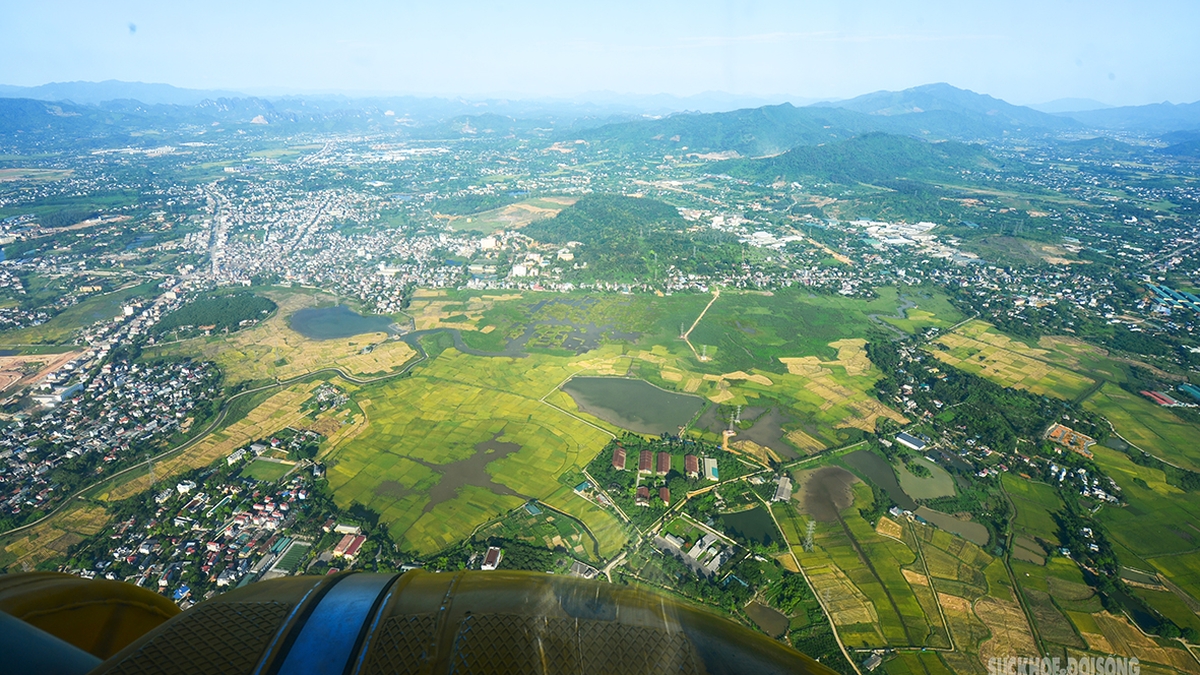
Farmers' understanding of the Project is limited, and some households still produce according to old practices. For the Project to be effective, it must first have the consensus of the farmers. The minimum scale of participation in the Project must be contiguous land of 50 hectares or more, while in many provinces, rice cultivation areas are still fragmented and small.
The number of households participating in linkages through cooperatives, cooperative groups, and partnerships with businesses is limited, especially in provinces that have not yet participated in the VnSAT project.
The infrastructure supporting high-quality, low-emission rice production in localities is not yet synchronized and needs further investment in the future. The number of businesses participating in linkages with cooperatives and cooperative groups to invest in and purchase products is still limited.
Currently, there is no separate funding line for the project from the domestic budget, while the process of developing a project to borrow funds from the World Bank requires time.
To promote the implementation of the Project and ensure it meets the set schedule and objectives, the Ministry of Agriculture and Rural Development proposes that the Government submit to the National Assembly a Resolution on piloting a number of specific policies on the use of ODA funds and preferential loans from foreign donors at the October 2024 session.
The Ministry also recommended that the Government approve the principle for the Ministry of Agriculture and Rural Development to work with the Asian Development Bank (ADB) to prepare a project for the $270 million loan and support the implementation of the Scheme.
In addition, the Ministry also proposed that the Government agree in principle to allow the Ministry of Agriculture and Rural Development to propose medium-term budget funding for the period 2026-2030 for infrastructure not yet invested in from WB and ADB funds, and to continue working with the WB and other donors to expand loans after 2027 to ensure sufficient capital for the implementation of the entire Project until 2030.
At the meeting, leaders of ministries and sectors all affirmed that they would work together with the Ministry of Agriculture and Rural Development in the implementation of the Project, in the spirit of the Prime Minister's directive: only discuss how to proceed, not how to back down.
Ministries and sectors requested the Ministry of Agriculture and Rural Development to urgently calculate and clarify the funding sources for the Project; specific policies on the use of ODA and preferential loan funds; maximize the use of policies supporting high-quality rice cultivation; and identify areas for investment in high-yield, high-quality rice to serve as a basis for the Project's implementation.
Concluding the meeting, the Deputy Prime Minister emphasized that the project aims to create a new production method in line with global production and consumption trends; to create a breakthrough in agricultural thinking in the "Nine Dragons" region, which is facing the impacts of rapid and unpredictable climate change; to contribute to improving the income and living standards of rice farmers and businesses; and to help Vietnam realize its goal of achieving net-zero emissions by 2050.
The Deputy Prime Minister highly appreciated the Ministry of Agriculture and Rural Development and the localities for proactively implementing the Project, which has initially yielded very positive results, as shown by indicators such as increased productivity, reduced costs, and increased profits from the application of pilot models based on inheriting achievements from the VnSAT Project and a series of technical support projects from non-governmental organizations.
Agreeing with the opinions that a coordinated effort from the central government, local authorities, farmers, and businesses is needed in implementing the Project, the Deputy Prime Minister requested the Ministry of Agriculture and Rural Development to play a coordinating role, proactively handle tasks within its authority, and report to the Prime Minister on issues beyond its authority.
Emphasizing that much work remains to be done, the Deputy Prime Minister requested the Ministry of Agriculture and Rural Development to clearly define the tasks, responsibilities for implementation, expected deliverables, and completion deadlines for each task and work item.
Regarding the WB loan project, the Ministry of Agriculture and Rural Development must clarify the investment items and work content, ensuring consistency, avoiding duplication and overlap with the contents already invested in and to be invested in by the Mekong Delta Sustainable Development Project adapting to climate change (Mekong DPO); and ensuring compliance with the plans approved by competent authorities.
Regarding the proposal to establish a working group to develop the WB loan project, the Deputy Prime Minister instructed the Ministry of Agriculture and Rural Development to submit an official report to the Prime Minister for consideration and decision in accordance with regulations.
Source: https://kinhtedothi.vn/ra-soat-tien-do-trien-khai-de-an-1-trieu-ha-lua-chat-luong-cao.html
![[Photo] Ba Lang An Lighthouse - the "eye of the sea" amidst the "rock museum" of Quang Ngai province.](https://vphoto.vietnam.vn/thumb/1200x675/vietnam/resource/IMAGE/2026/05/29/1780038698840_anh-man-hinh-2026-05-29-luc-14-10-42.png)


![[Image] Pleasant weather helps students enter the 10th grade entrance exam with confidence.](https://vphoto.vietnam.vn/thumb/1200x675/vietnam/resource/IMAGE/2026/05/29/1780034401612_ngay-1-thi-lop-10-minh-duy-8-5009-jpg.webp)

































































Comment (0)