

We need to have a vision to master core technologies.
At the scientific conference "Ensuring Security and Technological Self-Reliance in Vietnam's Chip Manufacturing Process in the National Digital Transformation Process" held on August 22nd in Hanoi, Mr. Tran Kim Chung - Chairman of CT Group emphasized: In reality, technology is hotter than ever today. The world is facing a new security threat: a type of malware that operates at the CPU level, meaning it can hide deep within hardware and bypass most security solutions.
According to the Chairman of CT Group, today there is no such thing as true independence if it remains dependent on technology. Vietnam is undergoing a strong digital transformation at an unprecedented pace. However, this rapid and powerful digital transformation is also opening up new challenges.
"Currently, we have completed the first axis of digital transformation, which is citizens. We are now moving on to the second axis, which is organizations, and the third axis, which is digital transformation along the ground, in the marginal space, and across multiple layers. This includes many layers, from underground, above ground, and at ground level, encompassing all structures from trees to mountains, rivers, and cities... Thus, in the third axis, the amount of data is much larger, and the number of hardware devices involved is even greater. However, currently, we are relying entirely on foreign-made chips."
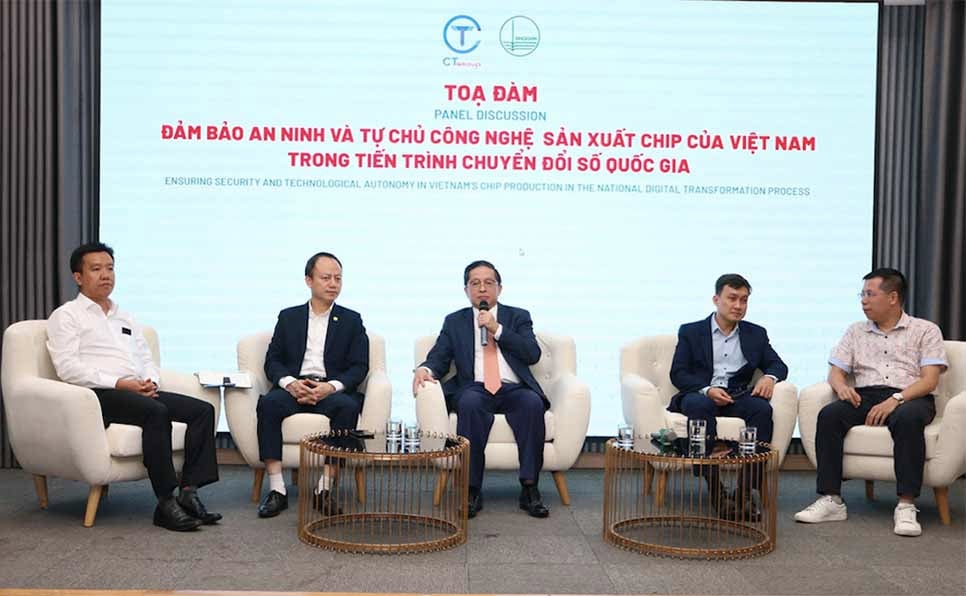
"This means we could be disrupted at any time, and we could lose national data. We might also not be prepared for emergencies. Therefore, we need a higher vision: mastering core technologies from design and manufacturing to commercialization of semiconductor chips," Mr. Chung emphasized.
In addition, it is necessary to create "Made by Vietnam" products to serve both the people's needs and national defense and security, and to compete on equal terms in the global market.
Above all, it is essential to build an independent, self-reliant, and robust semiconductor industry, laying the foundation for high technology and national self-reliance. Only then can Vietnam truly become the new semiconductor hub of Southeast Asia, serving both national needs and supplying the world.
Associate Professor Dr. Thai Truyen Dai Chan, a member of the CTGroup Scientific Council, believes that the current race for control over semiconductor chips among major powers is not just a commercial issue but also a geopolitical battle, because whoever controls semiconductors will control a large portion of future technological power.
Therefore, if a country does not master integrated circuits, the risks are enormous. First, economically, a single disruption in the global supply chain, such as a pandemic or trade tensions, can paralyze numerous industries. This directly impacts GDP, employment, and social stability. In terms of security and defense, all modern military systems, from radar, satellites, and UAVs to high-precision weapons, depend on semiconductor components. If the supply is cut off, defensive capabilities will be diminished. More dangerously, imported circuits may contain "security vulnerabilities" (backdoors), creating a risk of unauthorized access and threatening national sovereignty. Furthermore, this dependence hinders the process of technological innovation.
Sharing the same view, Colonel, Dr. Le Hai Trieu, Director of the Institute of Electronic Engineering under the Security Industry Department (Ministry of Public Security), emphasized that while some domestic enterprises are doing very well in the design of integrated circuits, production is still carried out abroad, and this poses risks to security and increases costs.
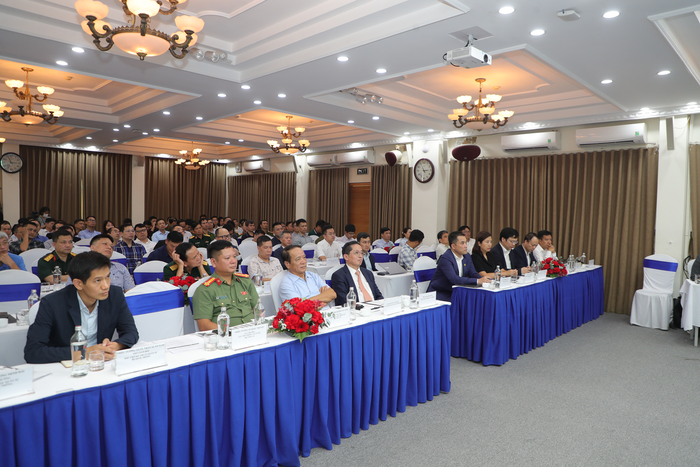
Currently, the chips used for Vietnamese identity cards and passports are widely used worldwide (accounting for up to 95% of the global market share for EMV, eID, and e-Passport chips) and will continue to be used in the future. Therefore, domestic semiconductor companies should focus on producing these products.
We need to decide which chip lines absolutely must be developed domestically.
At the seminar, Mr. Chung proposed that the Ministry of Public Security and the Ministry of National Defense should clearly decide which types of chips absolutely must be developed domestically. CT Group is ready to work with Hanoi National University to research, develop, and meet this demand.
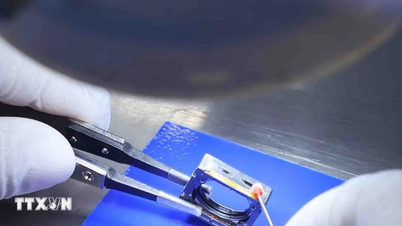
Designing a standard chip takes about two years. Then there's the photolithography process, which, if handled by companies like TSMC, takes another three to four months. After that comes the packaging and testing process. In general, it takes more than two years to produce a chip. Therefore, if we mass-produce all the necessary chips starting now, we wouldn't have them until 2027, while the digital transformation process is progressing rapidly.
We also suggest that the National University, together with CT Group, can cooperate with units of the Ministry of Public Security and the Ministry of National Defense to conduct joint research. This is to develop standardized products based on our own developed chips. We can develop products that meet standards. Within CT Group, we don't just make chips; we can also make circuit boards, sensors, and drones in many different categories," said the Chairman of CT Group.
CT Group also proposed that Hanoi National University and CT Group cooperate with the Ministry of Public Security and the Ministry of National Defense to establish a laboratory for chip testing, and to develop a common chip, specifically a SIM chip for drones, for registration purposes.
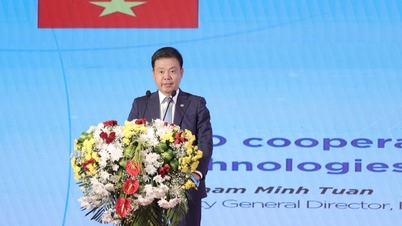
Speaking at the conference, Professor Pham Bao Son, Vice Director of Vietnam National University, Hanoi, expressed his confidence that Vietnam National University, Hanoi, and CT Group will together create new values, contributing to enhancing national technological capabilities, ensuring security and self-reliance in semiconductor chip technology, and successfully achieving the national digital transformation goals.
Source: https://doanhnghiepvn.vn/cong-nghe/rui-ro-khi-phu-thuoc-vao-chip-cua-nuoc-ngoai/20250822053535897
![[Photo] Secretary of the National Assembly Party Committee, Chairman of the National Assembly presides over the meeting of the Standing Committee and Executive Committee of the National Assembly Party Committee.](https://vphoto.vietnam.vn/thumb/1200x675/vietnam/resource/IMAGE/2026/06/03/1780480353201_ndo_br_bnd-2585-jpg.webp)
![[Photo] General Secretary and President To Lam presides over a meeting with the Central Organizing Committee.](https://vphoto.vietnam.vn/thumb/1200x675/vietnam/resource/IMAGE/2026/06/03/1780482764658_a1-bnd-4741-3342-jpg.webp)



![[Photo] First session of the 14th Congress of the Vietnam Trade Union](https://vphoto.vietnam.vn/thumb/1200x675/vietnam/resource/IMAGE/2026/06/03/1780465947883_ndo_br_img-3852-jpg.webp)















































![[Video] Sunset at Lap An Lagoon – Where the sun sets over the fishing nets](https://vphoto.vietnam.vn/thumb/1200x675/vietnam/resource/IMAGE/2026/05/31/1780192137701_beach-landscape-sea-water-nature-grass-745871-pxhere-com.jpeg)
































Comment (0)