

A number of major indices declined simultaneously. Specifically, in the Tokyo market (Japan), the Nikkei 225 index fell 0.8% to 59,140.23 points.

In China, Hong Kong's Hang Seng index fell 0.9% to 25,931.13 points, while the Shanghai Composite index on the Shanghai exchange dropped 0.3% to 4,093.25 points.
Stock markets in Sydney, Singapore, Taipei, Mumbai, Bangkok, and Wellington were all in the red. The only bright spot was the Seoul market (South Korea), which set a new record high thanks to strong growth in technology stocks, especially in the artificial intelligence (AI) sector.
South Korean chipmaker SK hynix has just announced a record-breaking surge of nearly 400% in net profit for the first quarter of 2026. This momentum follows positive signals from Tesla's better-than-expected earnings report and the optimistic business outlook of Texas Instruments. According to Bloomberg, nearly 80% of companies in the S&P 500 index have so far released first-quarter 2026 financial results that exceeded analysts' expectations.
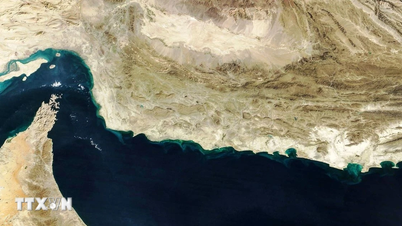
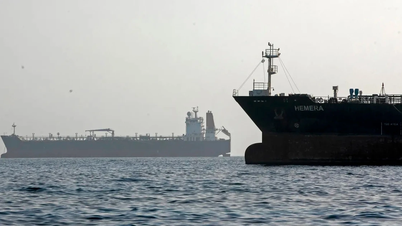
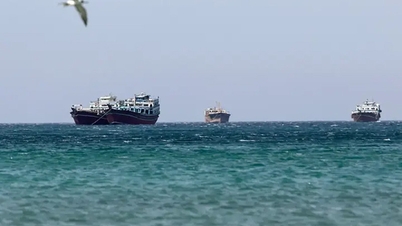
Tensions at sea escalated when Iran's Islamic Revolutionary Guard Corps (IRGC) seized two cargo ships and fired on another in the Strait of Hormuz. Iran has stated that all ships must obtain permission before entering or leaving the Gulf via this waterway, which carries approximately 20% of the world's oil and gas, along with many other essential goods.
Iranian Parliament Speaker Mohammad Bagher Ghalibaf declared on social media that the US maintaining a naval blockade is a "blatant violation" of the seven-week ceasefire. He asserted that Iran will not reopen the strait until the US lifts the blockade.
Analysts warn the market may be underestimating the severity of supply disruptions. Skye Masters, an expert at the National Australia Bank (NAB), citing the Washington Post, said the US Department of Defense estimates it will take up to six months to completely clear mines from the Strait of Hormuz, and that this process is unlikely to begin before the conflict ends.
Expert Raphael Olszyna-Marzys from J. Safra Sarasin Bank noted that while reaching a narrow agreement to reopen the strait would benefit both sides, any misunderstanding of each other's intentions could escalate tensions to a new level.
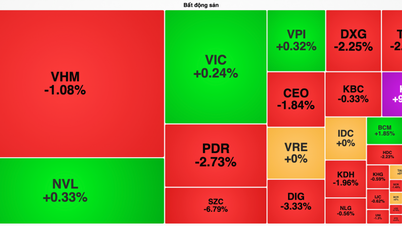
In Vietnam, the VN-Index rose 13.06 points (0.70%) to 1,870.36 points, while the HNX-Index fell 2.13 points (0.83%) to 253.23 points.
Source: https://baotintuc.vn/thi-truong-tien-te/sac-do-bao-trum-thi-truong-chung-khoan-chau-a-20260423160911199.htm

![[Photo] Ba Lang An Lighthouse - the "eye of the sea" amidst the "rock museum" of Quang Ngai province.](https://vphoto.vietnam.vn/thumb/1200x675/vietnam/resource/IMAGE/2026/05/29/1780038698840_anh-man-hinh-2026-05-29-luc-14-10-42.png)
![[Image] Pleasant weather helps students enter the 10th grade entrance exam with confidence.](https://vphoto.vietnam.vn/thumb/1200x675/vietnam/resource/IMAGE/2026/05/29/1780034401612_ngay-1-thi-lop-10-minh-duy-8-5009-jpg.webp)























































































Comment (0)