

By 2025, Dak Lak aims to establish itself as the "durian capital" with an area of nearly 45,000 hectares (accounting for a quarter of the country's total area), an estimated production of 390,000 tons, and an estimated export revenue of 1.1 billion USD. However, this overly rapid development, coupled with inadequate governance, particularly regarding the management of planting area codes, has led to numerous negative consequences.
Data from the Department of Agriculture and Environment also reveals a significant discrepancy: Out of nearly 45,000 hectares, only 269 growing areas, covering over 7,400 hectares (approximately 28% of the harvested area), have been granted codes. This means that over 70% of the remaining area relies on intermediaries or other means for distribution, leading to the misuse of codes, fraudulent export documentation, and a lack of transparency regarding origin.
 |
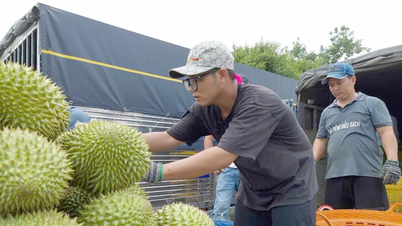
| Farmers in Dak Lak are harvesting durian in the 2025 season. |
Ms. Nguyen Thi Thanh Thuc, Chairwoman of AutoAgri Software Technology Joint Stock Company and a member of the Executive Board of the Dak Lak Durian Association, frankly pointed out that lax management and a lack of data synchronization have created loopholes for the "request-and-grant" mechanism, giving rise to intermediary forces that "make the rules," pushing businesses into taking risks and ultimately getting into legal trouble.
Many businesses also believe that compliance with standards regarding growing areas, packaging facilities, quarantine, and traceability is essential for an export industry. However, due to the limited number of growing area and packaging codes, businesses face pressure to find ways to both purchase and sell goods while meeting all legal requirements without violating regulations.
Furthermore, the quality of durian is at an alarming level due to the continued presence of banned chemicals such as Auramine O and heavy metals (cadmium) exceeding permissible levels. Of 130 samples tested for residue in the growing region, only 38 showed no detectable residue; the rest are awaiting results or have issues requiring further action.
 |
| Durian is creating life-changing opportunities for many farmers and businesses, and generating significant revenue for Dak Lak province. |
Mr. Nguyen Huu Chien, Director of Tan Lap Dong Agricultural Service Cooperative (Pong Drang commune), shared his concerns about the fact that an export container often has to gather produce from 10-15 different farmers with inconsistent farming practices. "If just one shipment is contaminated with Yellow O, contains cadmium residue, or violates plant quarantine regulations and is returned, not only will businesses suffer billions of dong in losses, but the planting area code for a large region could be suspended, affecting honest farmers," Mr. Chien said.
The Ministry of Agriculture and Environment has officially launched the Vietnam Agricultural Product Traceability System. This is a digital platform serving the comprehensive recording, management, and retrieval of information on agricultural, forestry, and aquatic products from production and processing to distribution in the market. Initially, the system will be piloted for durian fruit from January 1, 2026 to June 30, 2026, with the participation of 5 businesses, applying electronic authentication labels (QR/NFC/RFID). |
Furthermore, the lack of qualified laboratories locally is also a major obstacle. Currently, samples for testing often have to be sent to major cities, causing delays and increased costs for businesses during peak harvest seasons.
Faced with the risk of rapid, uncontrolled growth that could disrupt the industry's structure, many fundamental solutions have been proposed to tighten discipline in the 2026 durian season. In particular, to address the issue of transparency in the industry, the urgent solution is to thoroughly apply digital transformation and data linkage between management agencies.
Ms. Nguyen Thi Thanh Thuc suggested that the management agency should apply a "stock zoning" mechanism to the planting area codes. Accordingly, each code would be assigned a production limit corresponding to the actual area. The tax and customs authorities would deduct the production limit each time customs clearance is completed; when the limit reaches zero, export activities under that code would be immediately blocked. "If the Ministry of Agriculture and Environment, along with the tax and customs authorities, share data and strictly enforce this process, fraud and falsification of documents will certainly be eliminated," Ms. Thuc affirmed.
According to the Department of Agriculture and Environment, fresh durian from Dak Lak is currently exported to many countries and territories such as China, Thailand, Taiwan (China), Hong Kong (China), Japan, and the United States… However, China remains the main export market, with approximately 220,000 tons.
 |
| Durian fruit is packaged for export at Chanh Thu Export Fruit Processing Factory in Dak Lak. |
Ms. Dang Thi Thuy, Deputy Director of the Dak Lak Department of Agriculture and Environment, said that in 2026, the province will resolutely restructure the agricultural sector towards sustainability instead of focusing solely on increasing acreage. The Department will review the planting area planning in 62 communes and wards currently developing durian cultivation to integrate it into the province's overall plan. "We will publicly disclose the list of violating establishments and substandard agricultural supplies on the electronic information portal so that people and businesses are aware. At the same time, we will promote digital transformation and build a national database system on planting areas to ensure transparency of information, aiming for all export shipments to have clearly traceable origins," Ms. Thuy emphasized.
According to the leaders of the Department of Agriculture and Environment, in the first quarter of 2026, the agricultural sector will coordinate with the Provincial Tax Department to organize in-depth training for cooperatives and businesses to resolve difficulties regarding invoices and documents, bring durian business operations into order, avoid budget losses and legal risks for businesses.
Durian is bringing life-changing opportunities to many farmers and significant revenue to Dak Lak province. However, to maintain its position in the international market, it is time for this industry to accept the "pain" of eliminating loopholes in management and transforming from a fragmented production mindset to a responsible, transparent, and modern agricultural system.
Source: https://baodaklak.vn/tin-noi-bat/202601/sau-rieng-dak-lak-and-the-challenge-of-sustainable-development-39e0405/















![[Video] Sunset at Lap An Lagoon – Where the sun sets over the fishing nets](https://vphoto.vietnam.vn/thumb/340x192/vietnam/resource/IMAGE/2026/05/31/1780192137701_beach-landscape-sea-water-nature-grass-745871-pxhere-com.jpeg)



![[Image] A brilliant symphony and explosive power in the skies of Da Nang.](https://vphoto.vietnam.vn/thumb/1200x675/vietnam/resource/IMAGE/2026/05/31/1780196945787_anh-man-hinh-2026-05-31-luc-10-08-51.png)































































Comment (0)