

The risk of residual contamination in the soil must be monitored and addressed promptly.
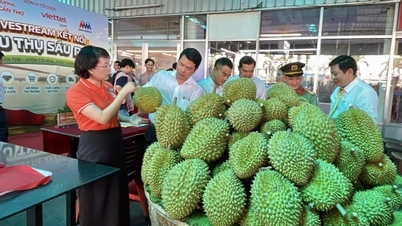
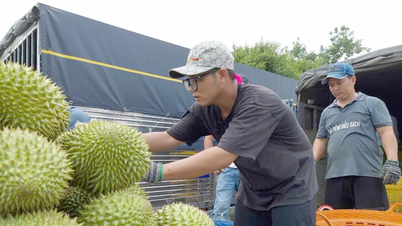
The Vietnamese durian industry is entering a period of strong growth with an area of approximately 195,000 hectares, a production of nearly 1.8 million tons, and export revenue reaching around US$3.86 billion in 2025. However, along with the expansion of acreage and intensive farming, the pressure to control quality, especially regarding heavy metal residues, is becoming an urgent requirement.

Pressure to control quality, especially regarding heavy metal residues, is becoming an urgent requirement for the durian industry. Photo: Minh Đảm.
According to preliminary research by the Southern Fruit Research Institute, cadmium (Cd) has been found in some durian-growing regions. Although most soil and fruit pulp samples remain within safe limits according to Vietnamese standards, the risk of exceeding the control limits of import markets necessitates early monitoring and action.
In particular, the Chinese market currently controls the cadmium content in durian flesh to not exceed 0.05 mg/kg. This is considered one of the major technical barriers to durian exports.
According to the Southern Fruit Research Institute, cadmium in agricultural soil can originate from various sources such as inorganic fertilizers, especially phosphate fertilizers, agricultural supplies, environmental waste, and prolonged cultivation practices.
A 2025 survey of 63 durian orchard soil samples showed that approximately 60% of the samples contained cadmium exceeding 0.05 mg/kg of soil. However, all samples were still significantly lower than the Vietnamese agricultural soil standard according to QCVN 03:2023/BNNMT, which is 4 mg/kg of soil.
Of the more than 300 durian pulp samples analyzed, only about 5% exceeded the 0.05mg/kg limit required by the Chinese market. This result indicates that the risk has appeared but is not yet widespread.
In Dong Thap province , specialized agencies surveyed 115 durian growing areas that had been assigned codes to assess the risk of cadmium residue in the soil. Of these, 17 areas showed no detectable cadmium, 53 areas had levels below 0.1 mg/kg, 31 areas had levels between 0.1 and 0.2 mg/kg, 10 areas had levels between 0.2 and 0.3 mg/kg, and 4 areas had levels above 0.3 mg/kg. However, all samples still showed significantly lower levels than the current agricultural soil standard.
According to the research team, soil pH has a significant impact on the ability of plants to absorb cadmium. Survey results show that the closer the soil is to neutral, the lower the risk of cadmium absorption by plants. This is considered an important basis for developing appropriate soil improvement and nutrient management solutions for durian-growing regions.
According to Dr. Vo Huu Thoai, Director of the Southern Fruit Research Institute, for newly developed durian growing areas, farmers need to cooperate in production according to a unified, verified, and certified safe and effective cultivation process. Dr. Thoai also advises farmers to proactively check cadmium levels in the soil to take early action if any risk of cadmium accumulation is detected.
A cadmium hazard map needs to be developed soon.
Based on research findings, the Southern Fruit Research Institute has proposed several biological and environmentally friendly solutions to reduce cadmium absorption in the soil and durian fruit.

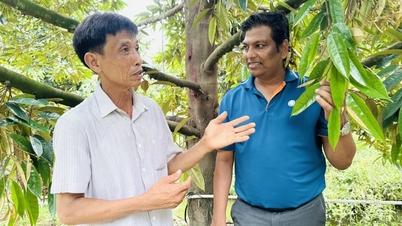
A delegation from the Department of Crop Production and Plant Protection visited a model for cadmium remediation in durian trees in Dong Thap province, implemented by the Southern Fruit Research Institute, in early 2026. Photo: Minh Dam.
Recommended solutions include raising soil pH with lime, increasing the use of organic fertilizers, limiting the overuse of chemical fertilizers, especially phosphate fertilizers, controlling the quality of agricultural inputs, and using biochar to adsorb cadmium in the soil.
In addition, the application of microbial preparations capable of cadmium fixation and improving soil microbial ecosystems is also considered a suitable direction for the development of ecological, low-emission agriculture.
In addition to technical solutions, experts recommend the early development of cadmium risk maps in key durian-producing regions, enhanced monitoring of heavy metal content in soil, irrigation water, fertilizers, and products, and the improvement of cultivation processes to reduce cadmium absorption through biological and low-emission methods.
The research team also suggested intercropping cadmium-absorbing plants such as water spinach, amaranth, mustard greens, water hyacinth, or water ferns to support soil remediation. After each cultivation cycle, plant biomass should be collected and properly processed to limit the release of cadmium back into the environment.
Source: https://nongnghiepmoitruong.vn/can-giai-phap-thuan-thien-de-kiem-soat-cadimi-d813592.html

![[Image] Nearly 125,000 Hanoi students completed the Literature exam for the 10th grade entrance exam.](https://vphoto.vietnam.vn/thumb/1200x675/vietnam/resource/IMAGE/2026/05/30/1780117233041_ndo_br_thiet-ke-chua-co-ten-2-png.webp)







































































Comment (0)