

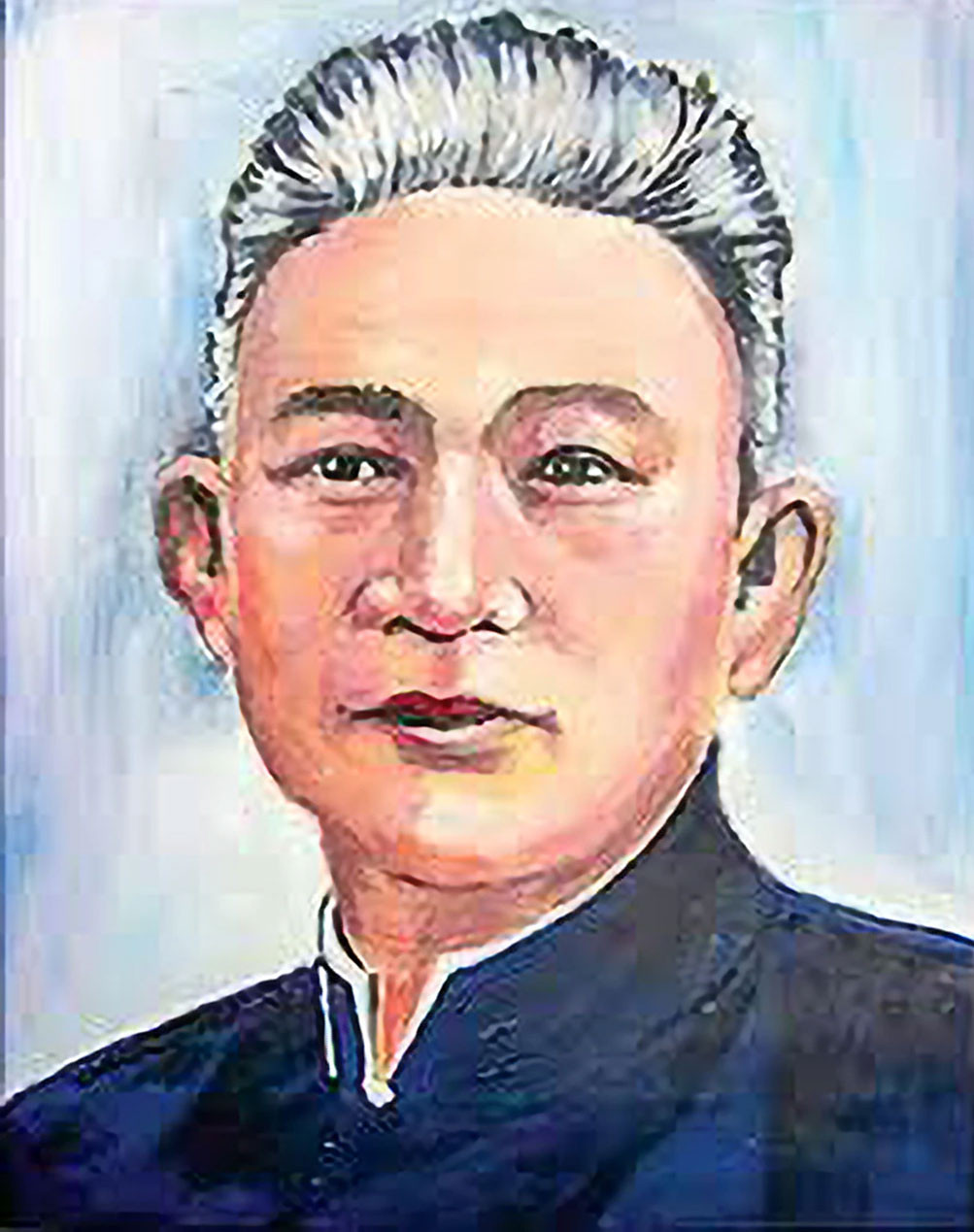
While facing severe financial hardship, Tan Da received a letter from Nguyen Van Vinh, editor of the Trung Bac Tan Van newspaper, inviting him to be an assistant writer. The letter requested that he write a social commentary and four poems each month. The payment was fifteen dong per commentary and ten dong per poem, meaning Tan Da would receive one hundred silver coins a month. In his dire financial situation, this was no small sum. With that money, the poet could cover all his expenses. He wouldn't have to worry about medicine or food. It seemed like a rare stroke of luck, and someone in such a situation would surely be delighted and readily accept the request from someone who admired his talent. However, after a night of reflection, Tan Da wrote a letter to Nguyen Van Vinh, declining the offer to be an assistant writer for the Trung Bac Tan Van newspaper. He stated that if he were to contribute to society, he would have to establish his own literary publication to fully implement his literary ideas and present his ideals to the nation. If writing for a newspaper depended on that institution, my own thoughts and views on society and literature could not be expressed as I wished. “Besides, Mr. Nguyen Van Vinh was a renowned writer; if I wrote for his newspaper, the readers would think I was following him to curry favor. That is something I disliked most. For these reasons, even in poverty and hunger, I refused to act against my own principles.” That was the character of Tan Da. (Nguyen Van Phuc - Me and Tan Da - Tan Da on the author and his works, pages 74, 75, Education Publishing House, 2001).
However, the poet's life was a long series of failures and failed examinations – he disregarded becoming an official and resolutely pursued a career in journalism to create literature and art. But "His An Nam magazine was born, then failed, then was born again, and failed again, forcing the poet to wander aimlessly from North to South. Perhaps even the Creator envied the talented, and often mocked literary figures." (Nguyen Van Phuc). He also taught classical Chinese and opened a fortune-telling clinic to make a living, but he couldn't support himself. Nevertheless, Tan Da's prestige at that time was immense. A man like Phan Khôi wrote: “I knew Mr. Nguyễn Khắc Hiếu since 1918, when I began writing for the Nam Phong magazine in Hanoi . One bitterly cold spring night, I was lying reading a book in the attic of that journalist's house on Hàng Bông Street, which was then the residence of Mr. Nguyễn Bá Trác. Suddenly, a visitor came in. Mr. Trác introduced him to me: 'Here, Mr. Nguyễn Khắc Hiếu.' I felt a jolt of electricity run through me, a shiver ran down my spine, and I jumped up! Indeed. The name Nguyễn Khắc Hiếu at that time was not insignificant, and for me it was even more solemn. I shuddered at the thought; it was truly so.” (Phan Khôi: Me and the Poet Tản Đà - Tao Đàn No. 9-10-1939).
Tản Đà's eccentricity was also quite unique: "Carrying his writings to sell at the Heavenly Market, sending letters to the celestial court to propose marriage, swimming standing up in the Sam Son sea and eating raw seafood, going to the forest for a vegetarian meal, drinking champagne with fermented pork sausage on a high-speed train, visiting the tomb of the Tay Son King with a brazen prayer: 'Northern Vietnam, Son Tay - Nguyen Khac Hieu passed through this place'" (Nguyen Tuan - Tan Da, a swordsman - Tao Dan, July 1939).
Tản Đà's eccentricity made him unlikable to many. Lưu Trọng Lư wrote: “In truth, it wasn't just in his eating habits or in his conversations; everywhere he went, he knew how to annoy people. People told me another story about him. At that time, he had just moved to a certain province. Simultaneously, a governor had also just taken office there. A high-ranking official, who appreciated talent, heard of the poet's reputation in the province and sent someone – apparently a district official – to invite him in for a drink. But Tản Đà calmly told the messenger:
"I am very grateful to you, sir, but please tell him that if he—a high-ranking official—wants to summon the citizen Nguyen Khac Hieu to the province, and issues a warrant, I will go immediately. But if the high-ranking official is someone who, after reading my poems and writings, takes a liking to me, then I invite him to come here, even if it's just a humble thatched hut, so that I may serve him wine. But he absolutely refused to go. Truly, one could not be more arrogant and unpleasant than that." (Luu Trong Lu, Now, When the Coffin Lid Is Closed - Tao Dan Magazine, July 1939)
In his later years, the poet fell into poverty, hardship, and illness, and then passed away in an attic at Nga Tu So, Hanoi, at the age of 50 on June 7, 1939, but left behind a literary career that marked a milestone - a towering link in the history of national literature. Many people have respectfully written mournful poems about the person "High talent, low fate, suppressed ambition / Wandering in the world, forgetting his homeland." (Visiting the old grave by the roadside). I think, the life, including the career and integrity of the poet Tan Da, is not only meaningful for the past?
Source: https://baolamdong.vn/si-khi-nha-tho-444919.html




![[Image] Nearly 125,000 Hanoi students completed the Literature exam for the 10th grade entrance exam.](https://vphoto.vietnam.vn/thumb/1200x675/vietnam/resource/IMAGE/2026/05/30/1780117233041_ndo_br_thiet-ke-chua-co-ten-2-png.webp)






















![[Photo] Admire the coral "masterpiece" amidst the million-year-old heritage of Dak Lak province.](https://vphoto.vietnam.vn/thumb/1200x675/vietnam/resource/IMAGE/2026/05/30/1780107638639_y25-jpg.webp)




























































Comment (0)