

Since ancient times, people in coastal areas have known how to harvest it for food, and recently, as the Earth warms up, the whole world has become interested in it because of its almost inexhaustible supply, high nutritional value, and strong medicinal properties.
Food of a thousand years
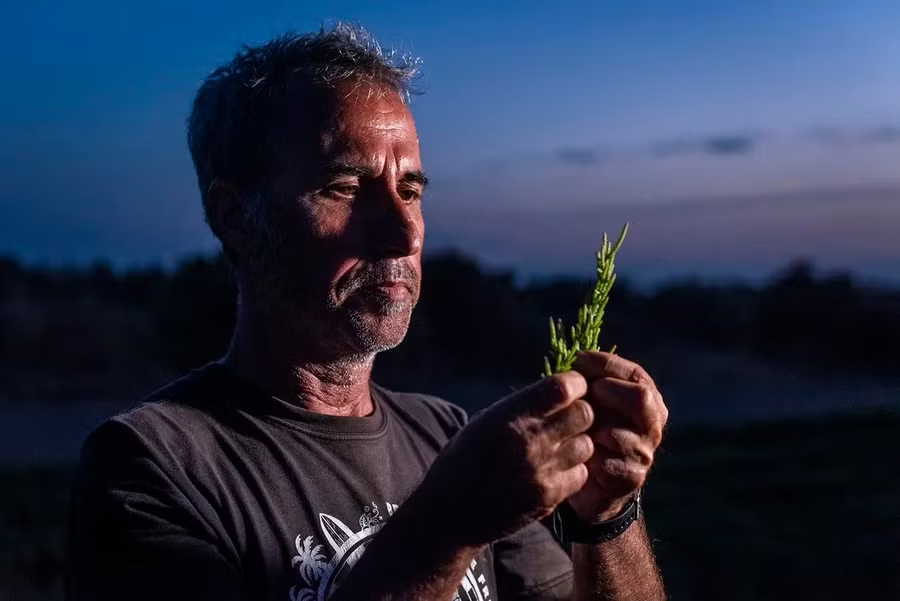
Coastal asparagus is a bushy succulent that grows abundantly in coastal areas, especially in extremely saline swamps. Outwardly, coastal asparagus is quite… unsightly, lacking leaves and branching out in all directions in a tangled mess. The 16th-century English naturalist William Turner described it as “skinny, all joints.”
Despite its unattractive appearance, coastal asparagus is edible. According to archaeological and ethnographic findings, North Africans have been eating it since the Bronze Age. Native Americans also consider it a daily green vegetable, and the indigenous people of Western Canada are extremely fond of it, packing it as a food reserve for long journeys.
One of the earliest tribes to eat coastal asparagus was the Tlingit, who lived in North Africa. They called it suk kadzi – knotted rope that grows on the beach.
With over 50 different species, coastal asparagus grows abundantly along the coast. Around late spring, when its tender shoots are at their juiciest, they are harvested, boiled or blanched several times, and then eaten immediately or canned, jarred, frozen, or pickled. Coastal asparagus shoots are a green color similar to seaweed, and their flavor and texture resemble spinach or asparagus stalks. Because they are very salty, they must be pre-processed with boiling water and cooked without added salt.
Great prospects
Although familiar to most coastal residents, coastal asparagus is not a globally popular vegetable. In Spain, it grows abundantly in the mangrove swamps of the Guadiana and Carreras estuaries, yet Díaz Cárdenas, a local tour guide, was completely unaware of this.
One day in 2013, Díaz was leading a group of French tourists on a tour when someone told him that in France, people eat the shoots of this plant. He was extremely surprised, immediately searched for information, and after researching, decided to cultivate it properly.
After initially struggling to find a market, Díaz eventually stabilized his income thanks to local restaurants that demanded seasonal exotic vegetables. He expanded his farm, joined a global group of coastal asparagus farmers, and actively promoted his crop.
Despite the heat and salinity, coastal asparagus quickly became a superfood because it not only addressed environmental challenges such as combating land degradation and saltwater intrusion, but also opened up prospects for prosperous agricultural development.
Today, Díaz cultivates two acres of coastal asparagus, yielding approximately four tons of young shoots annually. Under the intense early morning sun, he walks into the field with his scissors, squats down, and cuts handfuls of shoots, dropping them into plastic containers. This superfood is quite expensive, fetching around 180 euros per kilogram even when purchased locally.
Besides the young shoots, coastal asparagus also yields seeds. Scientific research indicates that its seeds are incredibly rich in protein and contain up to nine essential amino acids that the human body needs but cannot produce on its own. Furthermore, coastal asparagus seeds are rich in vitamins and important minerals such as magnesium, calcium, and potassium.
Even the old stems of coastal asparagus are not useless. They are burned to ash to make soap. "You could say that the entire coastal asparagus plant is money," Díaz excitedly shared.
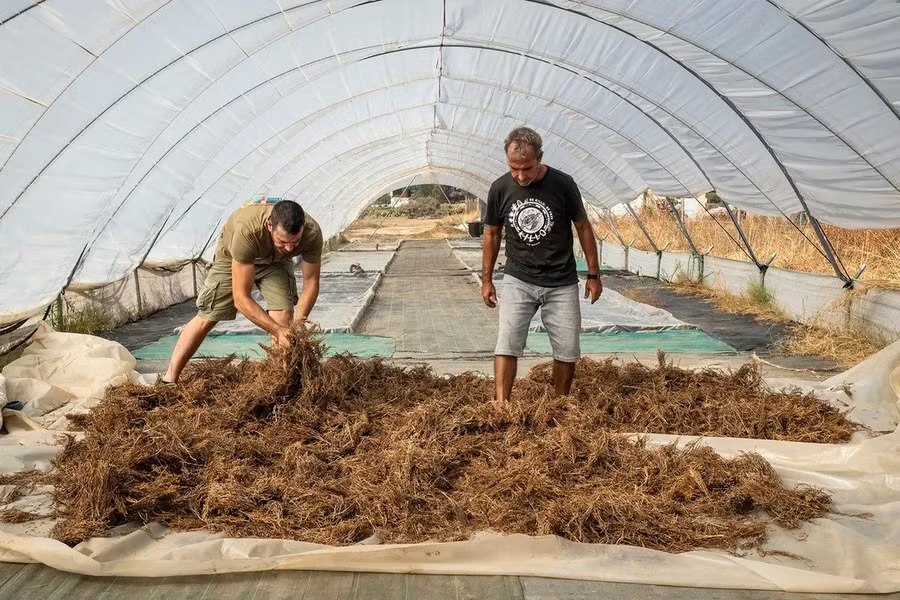
In recent years, researchers have focused on exploring the potential of coastal asparagus. They have discovered that it produces unusual molecules that can be extracted and processed into a variety of things, from skincare creams to animal feed, and even drugs to prevent or treat vascular disorders. Clinical trials from 2022-2024 showed that coastal asparagus is safe and effective in treating mild strokes.
Besides being good for cardiovascular health, coastal asparagus also helps lower blood pressure and LDL cholesterol, fights inflammation, and boosts the immune system. Every year, scientists publish new findings about it, all of which are beneficial to human health. Farmers like Díaz are thrilled, hailing coastal asparagus as "the crop of the future for the world."
Currently, coastal asparagus is being tested and cultivated across continents. Even in the hot, arid Middle East, it thrives without difficulty. Instead of freshwater, which is becoming increasingly scarce each year, coastal asparagus only needs seawater. Given the reality of saltwater intrusion due to rising sea levels, it is truly the number one choice for both the ecosystem and human health.
In addition, coastal asparagus has a feature that every coastal farmer needs: salt absorption. Its root system penetrates deep into the soil, absorbing salt and metals, effectively addressing salinity and preventing desertification more effectively than any other plant.
Source: https://giaoducthoidai.vn/sieu-rau-xanh-tu-bien-post779658.html







































































































Comment (0)