Opening up avenues for sustainable livelihoods.
Over the years, the mulberry cultivation and silkworm rearing model in western Gia Lai province has proven to be highly effective economically . Thanks to its suitability to the local soil and climate conditions, and its stable market demand, this model has helped many households gradually increase their income, improve their living standards, and move towards sustainable production.
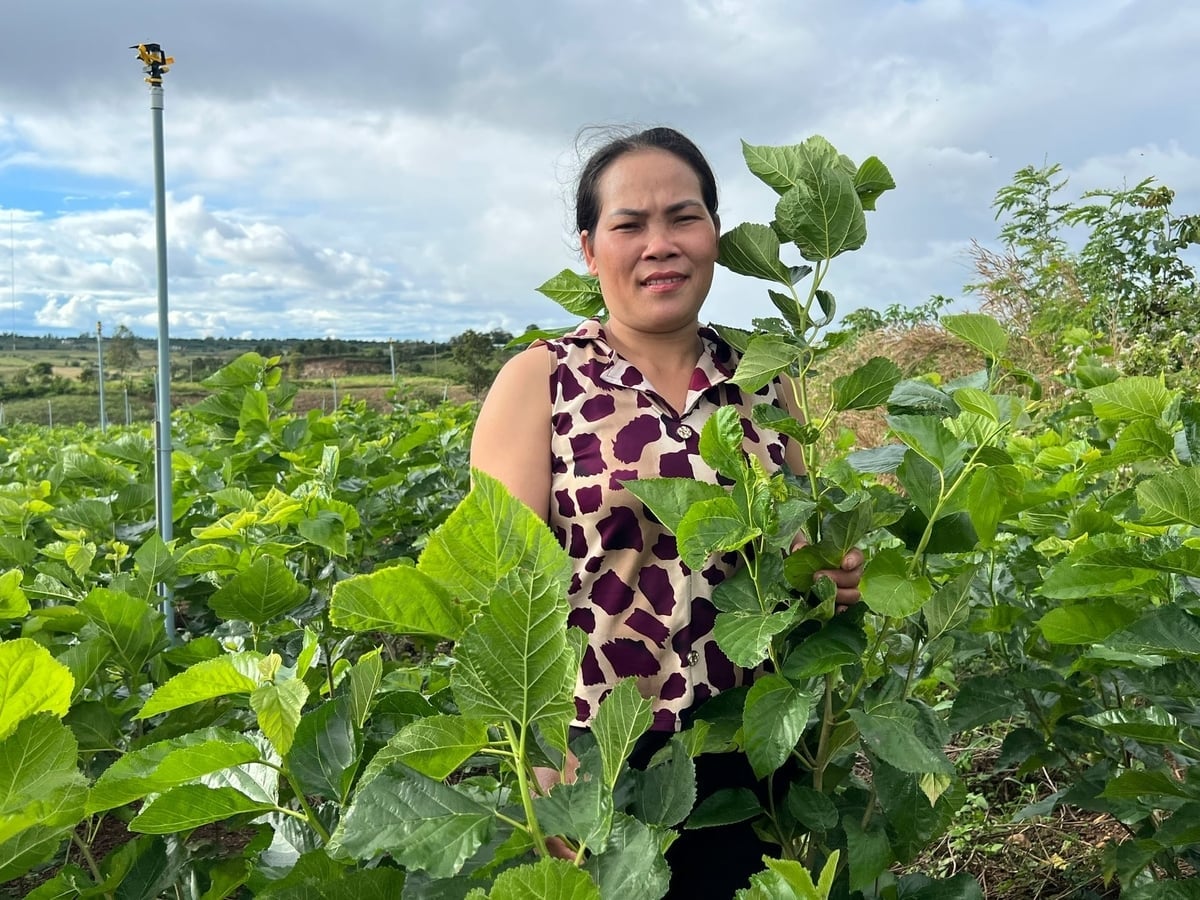
Ms. Hoang Thi Mai's family currently cultivates over 5 hectares of mulberry trees. Photo: Tuan Anh.
Ms. Hoang Thi Mai (Ia Sam village, Ia Hru commune) is one of the households that started engaging in mulberry cultivation and silkworm rearing early on. Previously, she had failed many times in growing pepper, sugarcane, and raising cattle. At the end of 2018, she and her husband visited a mulberry cultivation and silkworm rearing model in Lam Dong province and decided to try it themselves. In early 2019, she planted one sao (approximately 1000 square meters) and raised her first batch of silkworms, but due to the long distance for transporting the silkworms and her lack of expertise, many died.
Undeterred, by 2021, thanks to support in obtaining standard silkworm breeds and technology transfer, Mai's family's mulberry cultivation and silkworm farming model began to show clear results. To date, her family has expanded the area to over 5 hectares, raising 5 boxes of silkworms per batch, twice a month, earning hundreds of millions of dong per month.
Also in Ia Sam village, Mr. Le Van Duong previously grew pepper and coffee, but with low yields. In 2018, he and several other households in the village went to learn about the mulberry cultivation and silkworm farming model and tried it on a small area. Initially, they faced many difficulties due to unstable seed sources and limited techniques, but once they mastered the process, the economic benefits became increasingly apparent.
To date, Mr. Duong has invested in planting 2 hectares of mulberry trees and raising 4-6 boxes of silkworms each month, yielding a profit of approximately 600 million VND per year. In the future, he plans to further expand the area for mulberry cultivation and silkworm farming.
Not only has Mr. Duong enriched his own family, but he has also actively supported many households in the village in switching to mulberry cultivation and silkworm farming. Since 2024, he has directly shared his experience, provided technical guidance, and connected new households with markets. As a result, many households feel secure in their production.
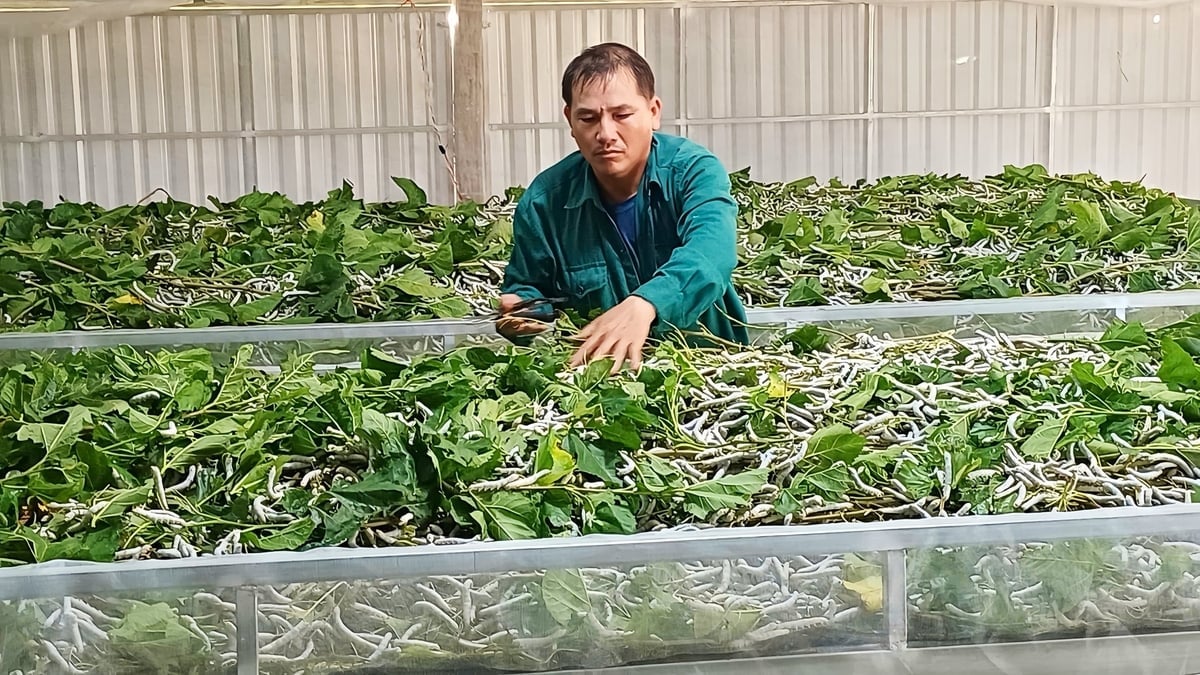
The mulberry cultivation and silkworm rearing industry helps stabilize the livelihoods of the local people. Photo: Tuan Anh.
According to Mr. Pham Huu Vien, Acting Head of the Economic Department of Ia Hru commune, the entire commune currently has over 128 hectares with 256 households participating in mulberry cultivation and silkworm rearing. This model is becoming a strength of the locality, contributing to the transformation of the crop structure, creating local jobs and reducing risks in agricultural production.
"In the coming time, the commune will continue to review and survey to determine the direction for expanding the area for mulberry cultivation and silkworm farming, in accordance with the soil conditions, climate, and needs of the people," Mr. Vien shared.
Linking production to create stable output.
Having been involved in mulberry cultivation and silkworm rearing for many years, Mr. Nguyen Van Hung (Hoi Phu ward, Gia Lai province) quickly realized that the amount of land available for production in Lam Dong was shrinking, making it difficult to form contiguous farming areas to expand production scale.
Through his research, Mr. Hung realized that the soil and climate conditions in Gia Lai were suitable for mulberry trees and silkworms. In particular, the land available was ample, facilitating long-term, concentrated production planning. Therefore, he and his wife chose Gia Lai as their destination, not only to expand production but also to create sustainable livelihoods for local farmers.
In 2022, the couple invested in purchasing 10 hectares of land in Kdang commune, establishing a concentrated mulberry cultivation area, installing a water-saving irrigation system, and simultaneously investing in a production technical area, a silkworm farm, a silk reeling workshop, and housing for technical staff.
Based on centralized production, Mr. Hung established the Gia Lai Silkworm Cooperative, organizing a closed-loop chain with farmers from supplying silkworm breeds and transferring technology to guaranteeing product sales. "To ensure people feel secure in silkworm farming, we must guarantee stable inputs, and especially stable outputs," Mr. Hung shared.
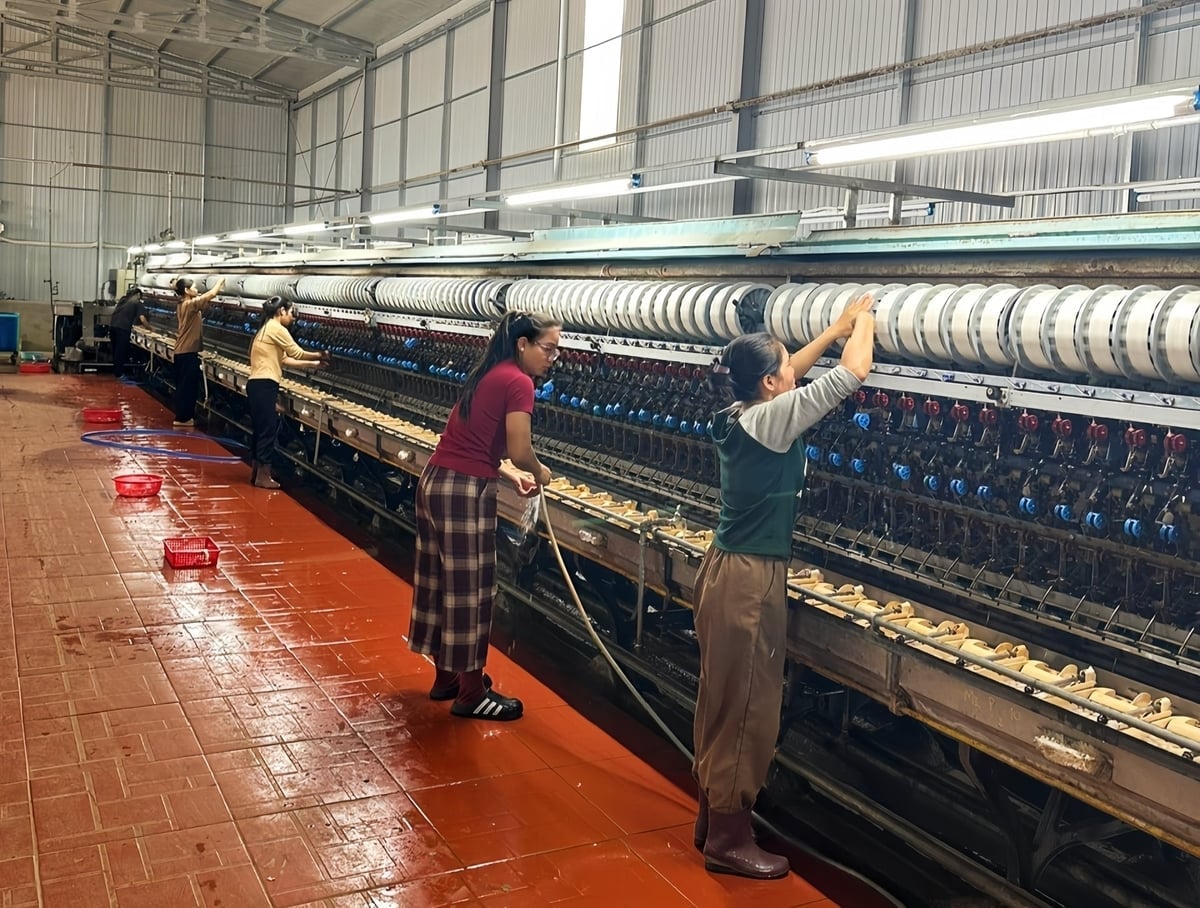
Mr. Nguyen Van Hung's crab silk breeding factory. Photo: Tuan Anh.
Since mid-2024, noticing that some localities such as Ia Lau and Ia Mo communes, despite having cultivated mulberry trees and raised silkworms, were not achieving high efficiency due to technical limitations, Mr. Hung personally went to the grassroots level to guide people through each step of the production process. To date, nearly 1,000 households in this area have participated in mulberry cultivation and silkworm farming. Thanks to support with seeds, techniques, and product distribution, people are confident in investing, gradually increasing their income and stabilizing their lives.
Currently, the Gia Lai Silkworm Cooperative supplies an average of over 3,000 boxes of silkworm larvae to local people each month. After about 16 days of rearing, each box of silkworms yields 70-80 kg of cocoons, which the cooperative buys entirely at a price of approximately 210,000 VND/kg. Besides its production efficiency, the cooperative's silk reeling workshop and silkworm farm also provide regular employment for over 120 unskilled laborers with stable incomes ranging from 7 to 10 million VND per month.
Source: https://nongnghiepmoitruong.vn/sinh-ke-ben-vung-tu-nghe-trong-dau-nuoi-tam-d791798.html



![[Photo] The General Secretary, President and his wife begin their state visit to the Philippines.](https://vphoto.vietnam.vn/thumb/1200x675/vietnam/resource/IMAGE/2026/05/31/1780230559452_anh-man-hinh-2026-05-31-luc-19-28-11.png)
![[Photo] Solemn bathing ceremony and Buddha procession in Hue](https://vphoto.vietnam.vn/thumb/1200x675/vietnam/resource/IMAGE/2026/05/31/1780228263543_1-jpg.webp)
![[Photo] Admire the coral "masterpiece" amidst the million-year-old heritage of Dak Lak province.](https://vphoto.vietnam.vn/thumb/1200x675/vietnam/resource/IMAGE/2026/05/31/1780221235105_anh-man-hinh-2026-05-31-luc-16-53-27.png)
![[Image] Hanoi Police officially crowned champions of V-League 2025/2026](https://vphoto.vietnam.vn/thumb/1200x675/vietnam/resource/IMAGE/2026/05/31/1780244769054_ndo_br_039d561b692be875b13a-jpg.webp)





![When forestry is a 'weakness' of Nghe An?: [Part 1] Living a precarious life amidst the golden forests](https://vphoto.vietnam.vn/thumb/402x226/vietnam/resource/IMAGE/2026/05/30/1780156547904_1-2-001514_717-225327.jpeg)





![[Video] Sunset at Lap An Lagoon – Where the sun sets over the fishing nets](https://vphoto.vietnam.vn/thumb/340x192/vietnam/resource/IMAGE/2026/05/31/1780192137701_beach-landscape-sea-water-nature-grass-745871-pxhere-com.jpeg)
![The Essence of Viet Bac Villages: [Part 3] The Precious Fragrance of Nghinh Tuong](https://vphoto.vietnam.vn/thumb/402x226/vietnam/resource/IMAGE/2026/05/29/1780020600366_5237-tinh-tuy-ban-lang-viet-bac-bai-3-chuyen-o-nghinh-tuong-050626_700.jpeg)
![The Quintessence of Northern Vietnam's Villages: [Part 2] The Famous Cassava Noodles of Kunming](https://vphoto.vietnam.vn/thumb/402x226/vietnam/resource/IMAGE/2026/05/28/1779937455892_3929-3144-mien-dong-15-nongnghiep-023138.jpeg)
![The Essence of the Village: [Part 1] Wine on the mountain, tea in the clouds - Bang Phuc](https://vphoto.vietnam.vn/thumb/402x226/vietnam/resource/IMAGE/2026/05/27/1779841729178_3821-1jpg-nongnghiep-103814.jpeg)


























![[Photo] Admire the coral "masterpiece" amidst the million-year-old heritage of Dak Lak province.](https://vphoto.vietnam.vn/thumb/402x226/vietnam/resource/IMAGE/2026/05/31/1780221235105_anh-man-hinh-2026-05-31-luc-16-53-27.png)





























Comment (0)