

The domain (.com) has the most compromised accounts, followed by domains associated with Brazil (.br), India (.in), Colombia (.co), and Vietnam (.vn). Of these, the (.vn) domain accounted for 5.5 million compromised accounts in 2023.
In response to the growing threat, Kaspersky has launched a dedicated landing page to raise user awareness of this issue and provide strategies to mitigate risks and damage.
Although the number of log files and malware infections in 2023 decreased slightly by 9% compared to 2022, this does not mean that cybercriminals' login credentials theft will decrease. Kaspersky suggests that some of the information stolen in 2023 may leak onto the dark web at some point in 2024. Therefore, the actual number of infections is likely higher than 10 million .
According to Kaspersky's assessment of the ability of hackers to penetrate data logs, the number of infections in 2023 is predicted to reach approximately 16 million.
On average, cybercriminals steal 50.9 login credentials per infected device, indicating a growing threat to individuals and businesses. Threat actors will use this information for nefarious purposes such as carrying out cyberattacks, selling or freely distributing information on dark web forums and underground channels on platforms like Telegram.
According to Kaspersky data, login credentials have been stolen from 443,000 websites worldwide over the past five years, potentially including login information for social media platforms, online banking services, e-wallets, internal systems, and business emails.
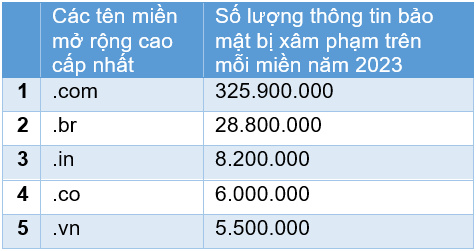
The amount of compromised security information per domain in 2023, according to Kaspersky statistics.
Accordingly, the (.com) domain had the highest number of compromised accounts. Nearly 326 million login credentials and passwords for websites on this domain were compromised in 2023. This was followed by the (.br) domain with nearly 29 million compromised accounts, then (.in) with 8.2 million, (.co) with nearly 6 million, and (.vn) with over 5.5 million.
To protect information from data-stealing malware, users should implement a comprehensive security solution across all devices. This will help prevent infections and alert them to potential threats, such as suspicious websites or phishing emails that could be sources of infection.
Source: https://nld.com.vn/so-vu-danh-cap-du-lieu-qua-phan-mem-doc-hai-tang-7-lan-tu-nam-2020-196240417163458987.htm

![[Photo] Admire the coral "masterpiece" amidst the million-year-old heritage of Dak Lak province.](https://vphoto.vietnam.vn/thumb/1200x675/vietnam/resource/IMAGE/2026/05/30/1780107638639_y25-jpg.webp)
















![[GALLERY] The million-dollar 007 blockbuster is causing a sensation on Steam, is it worth buying?](https://vphoto.vietnam.vn/thumb/402x226/vietnam/resource/IMAGE/2026/05/29/1780064112088_ta-2-png.webp)


























































































Comment (0)