


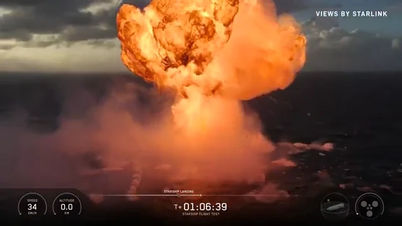
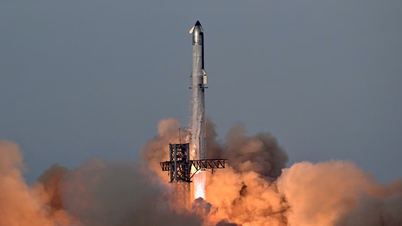
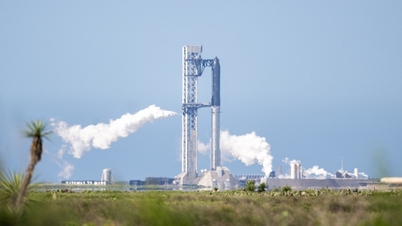
Preparations are underway for SpaceX's Starship's 12th test flight in Texas, USA - Photo: REUTERS
According to the US Federal Aviation Administration (FAA) on May 20, SpaceX aims to conduct up to 10,000 launches per year within the next five years.
This figure is many times higher than the approximately 170 launches the company plans to conduct in 2025, putting around 2,500 satellites into orbit, according to Reuters.
Bryan Bedford, head of the FAA, said he had spoken directly with SpaceX President Gwynne Shotwell about the plan. However, the FAA stressed that SpaceX would have to demonstrate greater reliability and safety before being granted permission to scale up operations.
Currently, the FAA is responsible for authorizing all commercial launches in the U.S. and must ensure that missile operations do not endanger air traffic. Mr. Bedford warned that if the number of launches increases too rapidly, the FAA itself could become a "bottleneck" due to a lack of resources and personnel to manage it.
Simultaneously, SpaceX also revealed its IPO plans, which are predicted to surpass all previous listings.
Financial records show the company projected revenue of approximately $18.7 billion in 2025, but an operating loss of $2.6 billion due to heavy spending on space, AI, and satellite infrastructure projects.
According to many estimates, SpaceX could raise around $75 billion from its IPO – significantly higher than Saudi Aramco's record of $26 billion in 2019. If it achieves the expected valuation, founder Elon Musk could become the first person to own assets exceeding $1 trillion.
One of SpaceX's most important revenue streams today is its Starlink satellite internet service.
The company's network of approximately 10,000 low-orbit satellites is providing internet access to around 10 million people in 150 countries and territories, generating approximately $4.4 billion in operating profit last year.
Meanwhile, some other business segments have become controversial, particularly after SpaceX acquired Musk's social media platform X and AI company xAI. Financial records show that SpaceX's AI business alone lost approximately $6.4 billion last year.
SpaceX says the funds raised from the IPO will be used to fuel its ambitions to send humans to the moon and build a colony on Mars.
The company's filings even state a long-term goal of establishing a settlement with at least 1 million people on the red planet to ensure the long-term survival of humanity against "extinction threats".
Super-constellation of satellites alters Earth's atmosphere.
New research from University College London (UK) shows that by 2029, launches serving super-constellations of satellites, particularly SpaceX's Starlink, could account for up to 42% of the total climate impact of the entire space industry.
The main cause is the amount of soot (black carbon) produced from rocket engines and from the burning stages of rockets or satellites when they re-enter the atmosphere. Black carbon in the upper atmosphere can reduce the amount of sunlight reaching the ground, affecting photosynthesis in plants and thus impacting agricultural productivity.
In addition, there is a risk of altering the rainfall cycle and other atmospheric processes.
Source: https://tuoitre.vn/spacex-dat-muc-tieu-10-000-vu-phong-ten-lua-moi-nam-chuan-bi-ipo-ky-luc-20260521145430687.htm
![[Photo] Ba Lang An Lighthouse - the "eye of the sea" amidst the "rock museum" of Quang Ngai province.](https://vphoto.vietnam.vn/thumb/1200x675/vietnam/resource/IMAGE/2026/05/29/1780038698840_anh-man-hinh-2026-05-29-luc-14-10-42.png)




![[Image] Pleasant weather helps students enter the 10th grade entrance exam with confidence.](https://vphoto.vietnam.vn/thumb/1200x675/vietnam/resource/IMAGE/2026/05/29/1780034401612_ngay-1-thi-lop-10-minh-duy-8-5009-jpg.webp)










![[GALLERY] The million-dollar 007 blockbuster is causing a sensation on Steam, is it worth buying?](https://vphoto.vietnam.vn/thumb/402x226/vietnam/resource/IMAGE/2026/05/29/1780064112088_ta-2-png.webp)
















































































Comment (0)