

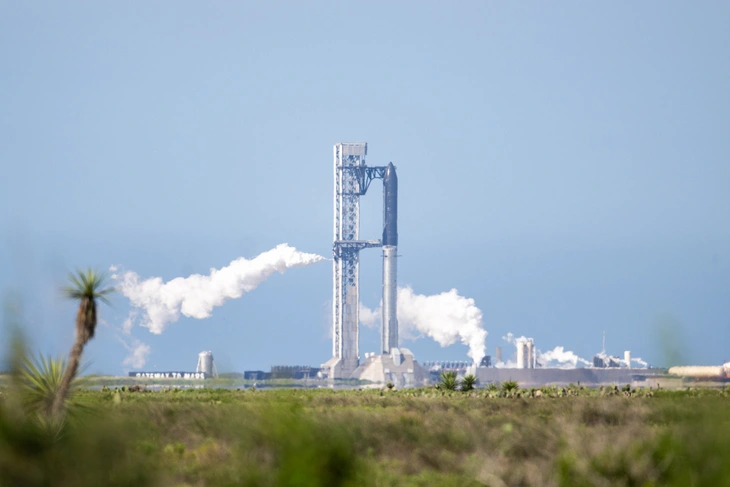
SpaceX delayed the launch of its Starship V3 rocket just 30 seconds before liftoff on May 21 - Photo: AFP
According to Reuters, on May 21, SpaceX had to cancel its 12th test launch of the Starship rocket from Texas (USA) just seconds before launch.
SpaceX reports indicate the delay was due to technical issues. Specifically, the countdown timer was paused multiple times because the fuel temperature and pressure readings exceeded the reference values.
Additionally, billionaire Elon Musk, the owner of SpaceX, also announced on social media that a hydraulic latch on one of the launch tower's giant mechanical arms did not retract as designed.
Remarkably, the decision to postpone the launch was made just 30 seconds before the rocket was due to leave the launch pad.
"If this issue can be resolved tonight, there will be another test launch tomorrow (May 22)," Musk wrote.
SpaceX announced that the optimal time for the rocket launch on May 22nd would last 90 minutes, starting at 5:30 PM (Central US Time).
The Starship rocket that participated in the May 21 test launch was the V3 version. This is the newest and largest version produced, incorporating dozens of improvements to facilitate the rapid launch of Starlink satellites and future manned lunar missions by the US National Aeronautics and Space Administration (NASA).
V3 is also the result of months of painstaking redesigning of Starship by the SpaceX engineering team, following a series of failures in 2025.
In fact, SpaceX's failed rocket launches are nothing new.
This is a pivotal test after months of testing delays. The company's engineering culture has long been considered to be far more risk-taking than other long-established giants in the aerospace industry.
The engineering team here operates on the philosophy of pushing new spacecraft to the brink of failure, then refining them through continuous iteration.
Prior to the launch, Musk himself proactively lowered expectations.
"There is a large assembly line of V3 spacecraft and booster rockets sitting in the factory," he asserted, adding that a failed test launch would "not affect the progress" of future Starship test flights by "more than a month."
If launched, Starship would make a low-altitude flight from Texas, traveling nearly halfway around the Earth, dropping 20 Starlink satellite models before making a controlled landing in the Indian Ocean at the end of a journey of about an hour.
Source: https://tuoitre.vn/ten-lua-starship-lon-nhat-bi-hoan-phong-chi-30-giay-truoc-gio-roi-be-20260522111153962.htm




![[Photo] General Secretary and President To Lam presides over a meeting on preparations for the review of one year of operation of the three-tiered government system.](https://vphoto.vietnam.vn/thumb/1200x675/vietnam/resource/IMAGE/2026/06/02/1780391821195_a1-bnd-4595-9717-jpg.webp)



















![[Video] What to do when changing phones from June 15, 2026?](https://vphoto.vietnam.vn/thumb/402x226/vietnam/resource/IMAGE/2026/06/02/1780386426938_dt-jpg.webp)












































































Comment (0)