


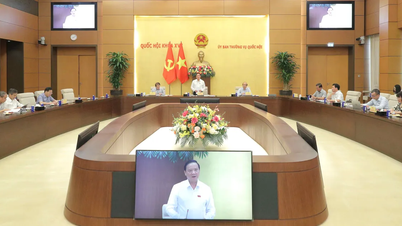
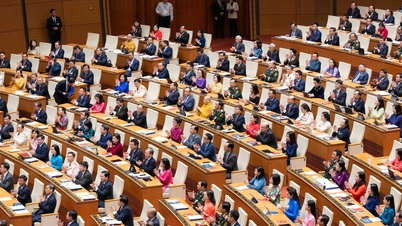
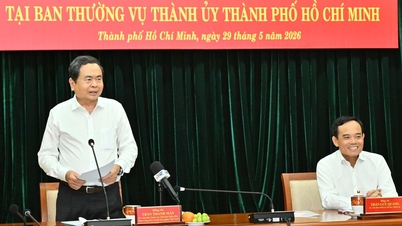
Delegates listen to the Presentation and Verification Report on the draft Law amending and supplementing a number of articles of the Law on Legal Aid - Photo: VGP/Nhat Bac
Authorized by the Prime Minister to present the draft Law, Minister of Justice Hoang Thanh Tung stated that the purpose of developing the draft Law is to address some limitations and shortcomings of the 2017 Law on Legal Aid; to better ensure people's access to legal aid, in line with the country's socio-economic situation and conditions; to enhance the professionalism and effectiveness of legal aid work; to strongly apply digital technology; and to meet the requirements of judicial reform, administrative reform, and the implementation of the current two-tiered local government model.
The draft Law consists of 3 articles: Article 1. Amendments and additions to a number of articles of the 2017 Law on Legal Aid (amending and supplementing 21 articles, repealing 3 articles); Article 2. Transitional provisions and Article 3. Implementation provisions.
The draft Law amending and supplementing several articles of the Law on Legal Aid has revised and improved the regulations on the categories of people eligible for legal aid. Accordingly, the condition of "financial hardship" has been removed for the following groups: biological parents, spouses, and children of martyrs and those who raised martyrs when they were young; people affected by Agent Orange; and people with disabilities, as these are special groups with unique personal circumstances or physical and mental impacts (the group of people affected by Agent Orange and people with disabilities).
Regarding legal aid providers, the draft Law adds a provision stating that legal aid providers who transfer to a Legal Aid Center in another locality will have their cards reissued. This is because legal aid provider cards are issued and managed by the Chairman of the Provincial People's Committee within the local area. When transferring to another locality and continuing to work as a legal aid provider, the card from the previous workplace must be revoked and a new card issued at the new workplace.
Regarding who can become legal aid collaborators, the draft Law expands the group to include retirees holding the rank of specialist or higher who have worked in legal affairs for 5 years or more at agencies of the Communist Party of Vietnam , the Vietnam Fatherland Front, and its member organizations; it also adds a group of state officials with a bachelor's degree in law, with 5 years or more of experience in legal work, and with the written consent of their workplace, in order to attract qualified and experienced legal personnel to participate in legal aid. At the same time, the draft Law does not limit the geographical area for registration as a legal aid collaborator.
The draft law also removes the provision regarding the geographical conditions for establishing branches of the State Legal Aid Center in areas with particularly difficult socio -economic conditions, inconvenient transportation, and where there are no law firms or legal consulting organizations participating in legal aid, in order to align with the two-tiered local government structure. At the same time, it empowers the Chairman of the Provincial People's Committee to decide on the establishment and location of the center's branches based on the actual conditions in the locality, thereby granting greater authority to the local government.
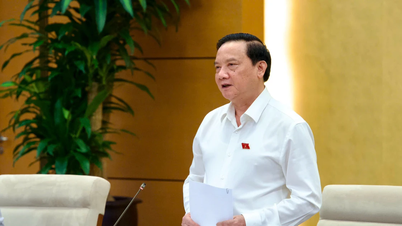
Presenting a summary of the verification report on the draft Law, the Chairman of the National Assembly's Committee on Law and Justice, Phan Chí Hiếu, stated that the Committee on Law and Justice basically agrees with the contents of the draft Law, such as: Expanding the scope of those eligible for legal aid by removing the condition of "financial hardship" for some groups of people stipulated in the current Law on Legal Aid, while adding some new groups of people.
The regulations regarding the conditions and locations for establishing branches of the State Legal Aid Center are abolished, and the authority to proactively decide on the establishment and location of branches is granted to the Chairman of the Provincial People's Committee. Regulations on the appointment, dismissal, issuance, and revocation of legal aid cards; and the standards and conditions for issuing cards to legal aid collaborators are amended and supplemented. Some regulations on administrative procedures and documentation are abolished, and the Government and the Minister of Justice are tasked with providing detailed regulations.
In addition, the Committee on Law and Justice proposed further research into developing a roadmap for a strong reform of the legal aid model, with the State playing a leading role in designing policies, commissioning and controlling the quality of legal aid, while the implementation of legal aid is mainly handled by legal service organizations.
There is a suggestion to add a provision in Clause 5, Article 1 that legal aid providers who are dismissed from their positions should be those "subject to administrative measures such as compulsory rehabilitation or compulsory education" to prevent risks related to ethical conduct and to prevent such individuals from participating in legal aid activities.
Furthermore, the Committee on Law and Justice proposed regulations on the requirements and handling of legal aid cases (Clause 8, Article 1) in a way that establishes the principle of allowing legal aid to be provided in necessary cases when complete legal aid application documents cannot yet be provided, and assigns the Government to regulate in detail the relevant documents, procedures, and processes.
Dieu Anh
Source: https://baochinhphu.vn/sua-doi-luat-tro-giup-phap-ly-mo-rong-doi-tuong-tinh-gon-thu-tuc-102260409101353956.htm

![[Photo] Ba Lang An Lighthouse - the "eye of the sea" amidst the "rock museum" of Quang Ngai province.](https://vphoto.vietnam.vn/thumb/1200x675/vietnam/resource/IMAGE/2026/05/29/1780038698840_anh-man-hinh-2026-05-29-luc-14-10-42.png)



![[Image] Pleasant weather helps students enter the 10th grade entrance exam with confidence.](https://vphoto.vietnam.vn/thumb/1200x675/vietnam/resource/IMAGE/2026/05/29/1780034401612_ngay-1-thi-lop-10-minh-duy-8-5009-jpg.webp)










































































Comment (0)