


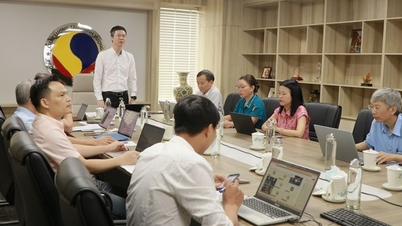
Visiting the QTSC R&D Labs, a research and development center for new products located in the Quang Trung Software Park, Ho Chi Minh City - Photo: TTD
From there, it quickly became a civilized, modern, and creative city, a center of economy , culture, society, science, technology, and innovation.
These are the opinions of experts and National Assembly representatives regarding Resolution 09.
Prof. Dr. Nguyen Ky Phung (Head of the Management Board of Ho Chi Minh City High-Tech Park):
Empowering Ho Chi Minh City to proactively experiment with new models and technologies.

Professor Dr. Nguyen Ky Phung
Resolution 09 of the Politburo is of particular significance to Ho Chi Minh City in its new development phase, as it for the first time clearly sets out the requirement to build a growth model based on science and technology, innovation, digital transformation, labor productivity, and competitiveness.
This is not only a direction for economic development but also a requirement for a comprehensive restructuring of Ho Chi Minh City's urban development model in the context of increasingly fierce global competition.
For many years, Ho Chi Minh City's growth has been primarily based on urban expansion, infrastructure investment, and the exploitation of traditional advantages. However, this model is gradually reaching its limits.
Without shifting to a growth model based on knowledge, data, technology, and innovation, the city will struggle to maintain its role as the economic engine and compete with major centers in the Asian region.
A crucial point of Resolution 09 is that science, technology, and innovation are no longer supporting sectors but must become core drivers of growth. This aligns with the development trends of modern megacities, where data, digital technology, artificial intelligence (AI), and the innovation ecosystem determine urban competitiveness.
In my opinion, this draft Law on Special Cities has initially demonstrated that spirit. The thinking behind lawmaking has shifted from traditional administrative management to modern urban governance based on data and technology.
Features such as science and technology cities, controlled testing mechanisms (sandboxes), digital government, data centers, digital infrastructure, and new economic models show that Ho Chi Minh City is being positioned to become the innovation hub of the region.
A strong decentralization mechanism for cities is crucial. In the fields of science, technology, and digital transformation, if every issue requires consultation through traditional procedures, it will be difficult to keep pace with the global technological development.
Empowering Ho Chi Minh City to proactively experiment with new models, technologies, and policies is essential.
However, to fully realize the spirit of Resolution 09, the draft Law on Special Cities needs further refinement in several core areas related to science, technology, and innovation.
The draft mentioned digital transformation, AI, data, and innovation many times, but it largely remained a guideline. What the city needs is not just a perspective, but strong enough institutional tools to implement it in practice.
In the digital age, data is a strategic resource for cities. Therefore, clear mechanisms are needed regarding open data, interconnected data sharing, exploitation of public data, and urban data governance. Without solving the data problem, it will be very difficult to build a truly digital government or smart city.
In addition, Ho Chi Minh City needs a stronger sandbox mechanism for AI, fintech, blockchain, autonomous vehicles, drones, and new business models. A sandbox is not just a technology testing ground, but also an institutional testing ground.
Resolution 09 has opened up a very broad development vision for Ho Chi Minh City in the new phase. The important issue now is to quickly institutionalize that spirit with a truly groundbreaking, strong, flexible, and internationally competitive special urban law.
If this is achieved, Ho Chi Minh City will become a center for science and technology, innovation, and the digital economy.
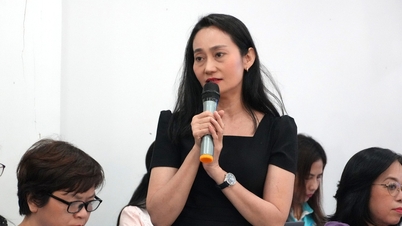
Representative Trinh Thi Tu Anh (member of the National Assembly's Committee on Science, Technology and Environment):
Training high-quality human resources and attracting talent to Ho Chi Minh City.

Representative Trinh Thi Tu Anh
Resolution 09 established a strategic operating system in which high-quality human resources and new productive forces are positioned as the core engines driving the entire socio-economic development of Ho Chi Minh City towards international standards.
Clearly, human resource development in this period is no longer a matter of supplementary solutions, but rather a structural revolution requiring fundamental changes from state management thinking to the operating models of educational institutions.
To attract and utilize talent effectively, Ho Chi Minh City needs to shift from a mindset of "rolling out the red carpet with high salaries" to one of "creating an ecosystem that fosters innovation."
Let's look at the historical lessons of Singapore from previous decades through the strategy of the Agency for Science, Technology and Research (ASTAR) or the Silicon Valley model in the US.
Accordingly, the city must boldly apply a controlled experimentation mechanism in science management, allowing for lump-sum payments based on the final product, and accepting the risk and failure rate in adventurous research.
Simultaneously, establish "miniature knowledge-based economy" models around the Vietnam National University Ho Chi Minh City and the High-Tech Park to create a natural pull for global gray capital flows.
In the era of AI, semiconductor chips, biotechnology, and green finance, Ho Chi Minh City needs compelling data rather than qualitative guidelines.
Specifically, to realize the goal of becoming a digital economic hub accounting for 40% of GRDP by 2030, the city needs a strategy to accelerate training, especially of high-quality human resources in key economic sectors such as semiconductor chip design and packaging, big data, and AI within the next five years.
Currently, the city's proportion of trained workers with degrees and certificates is relatively high compared to the national average, but it represents a bottleneck when compared to the standards of cities like Seoul or Taipei, where this rate exceeds 50% in key industries.
To bridge this gap, the city needs to implement a tripartite "training alliance" model, requiring large technology corporations, when receiving investment incentives, to commit to technology transfer and cooperate with universities to develop curricula according to international accreditation standards...
Assoc. Prof. Dr. Tran Hoang Ngan (National Assembly representative from Ho Chi Minh City):
A solid foundation for Ho Chi Minh City's rapid and sustainable development.
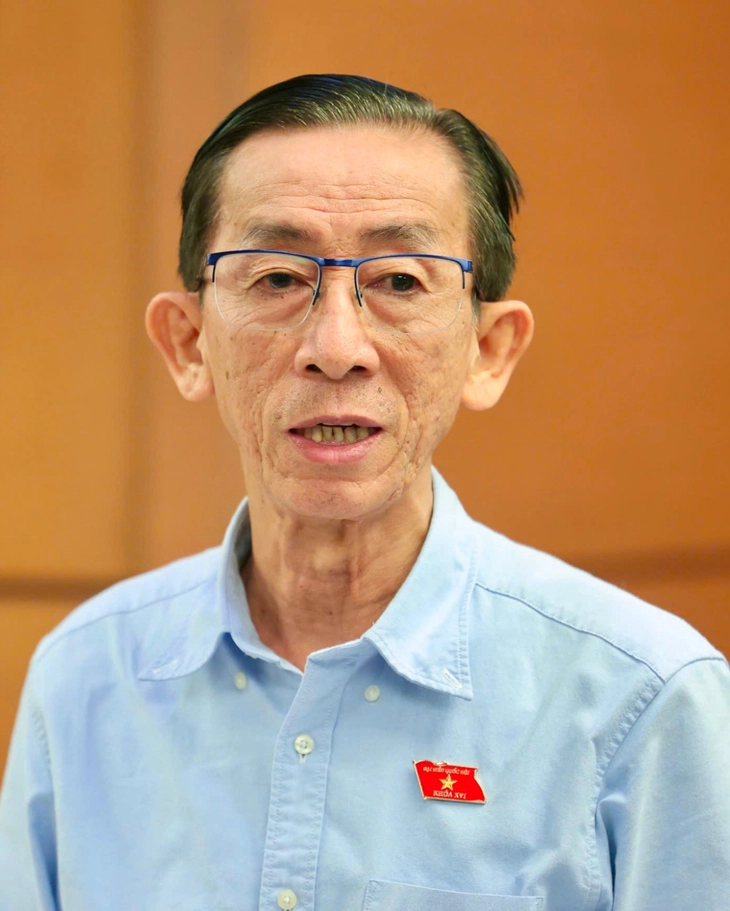
Assoc. Prof. Dr. Tran Hoang Ngan
While previous resolutions primarily focused on specific and superior mechanisms and policies to overcome difficulties and create favorable conditions for the city's development, Resolution 09 has taken a more far-reaching approach. It moves from special mechanisms towards creating a new institutional foundation for Ho Chi Minh City, a "megacity."
This can be considered a very important point, because Ho Chi Minh City, after merging with Binh Duong and Ba Ria - Vung Tau, has become one city.
"Ho Chi Minh City in the New Era" - a special urban area, a center of economy, culture, science and technology, innovation, international integration, and an important growth pole for the whole country.
Resolution 09 of the Politburo has assigned very important tasks in the new era for Ho Chi Minh City to become a symbol of Vietnam's dynamic development. At the same time, it should be a place where aspirations for development, global competitiveness, and a spirit of innovation converge.
The resolution also emphasizes the goal of transforming Ho Chi Minh City by 2045 into a civilized, modern, dynamic, and innovative city, a center of economy, culture, society, science and technology, and innovation in Asia.
By 2075, Ho Chi Minh City aims to become a smart, modern, and comprehensively developed global city on par with developed cities worldwide, achieving green and sustainable growth, a high quality of life, adaptation to climate change, and maintaining a minimum GRDP growth rate of 10%.
To accomplish these crucial tasks, in the coming period, along with raising awareness to create consensus, the city needs to coordinate with central agencies, the National Assembly, and the Government to lead and direct the development and promulgation of the Law on Special Urban Areas and other specific, superior mechanisms and policies, while simultaneously perfecting the planning system and regulations on investment, finance, budget, construction, etc., related to these areas.
Specifically, the law must create a superior institutional framework, thoroughly decentralize power, strengthen the authority and responsibility of leaders at all levels, coupled with a power control mechanism, in order to unleash the city's current development potential. Furthermore, it must possess a long-term strategic vision, anticipating future trends in line with the spirit of Resolution 09.
Source: https://tuoitre.vn/tai-cau-truc-mo-hinh-phat-trien-cua-do-thi-tp-hcm-20260528085254961.htm
![[Photo] Standing Committee member of the Party Central Committee Tran Cam Tu working with the Central Inspection Committee](https://vphoto.vietnam.vn/thumb/1200x675/vietnam/resource/IMAGE/2026/05/28/1779969579668_ndo_br_bnd-2495-jpg.webp)







































































Comment (0)