

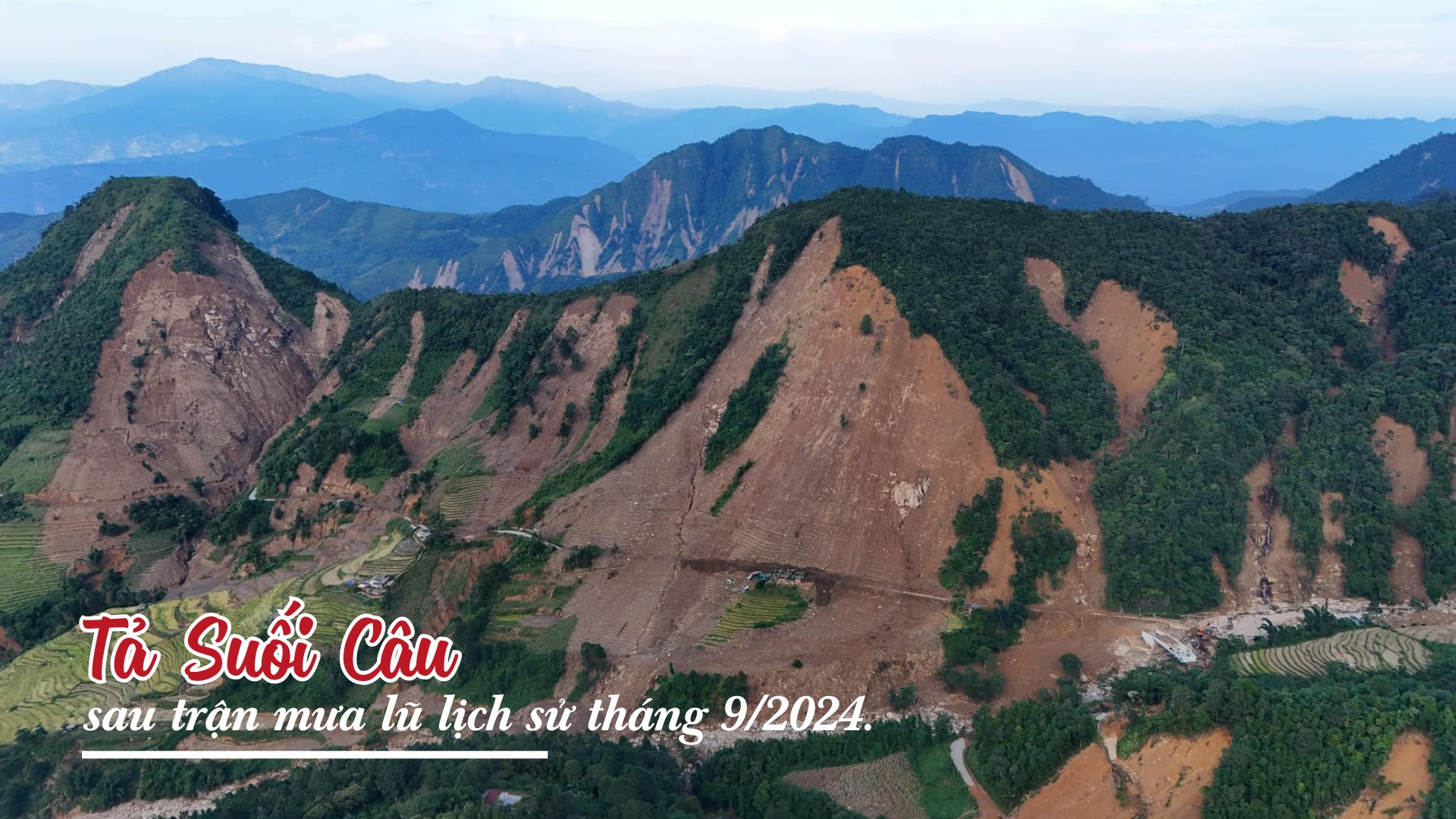
In the Dao language, Ta Suoi Cau means "village with a large stream." True to its name, Ta Suoi Cau village is situated along a steep mountainside in the high-altitude border region with China. The terrain is rugged and fragmented, with large streams flowing through the village. Following their traditional way of life and production, the Red Dao people here often live along these streams, making farming, livestock raising, and water access convenient. Therefore, Ta Suoi Cau village is inherently vulnerable to natural disasters, such as floods and heavy rains.
Even a year later, the people of Ta Suoi Cau village are still shaken when they recall the historic floods of September 2024.
In 2008, Ta Suoi Cau also experienced floods and landslides that completely destroyed 5 houses, but in the history of this area, there has never been a flood as devastating as the one last September.
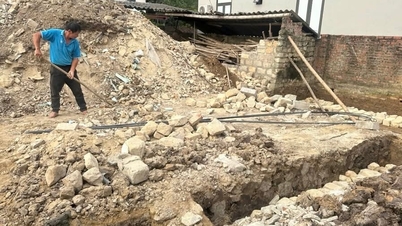
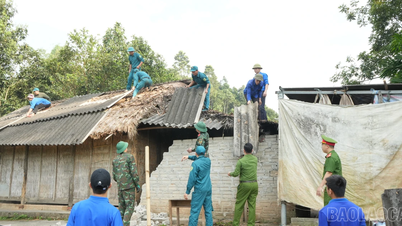
After the heavy rains, the muddy streams flowed like waterfalls, and large chunks of earth from the mountain ranges slid down, burying a long stretch of road from A Mu Sung, completely isolating Ta Suoi Cau village and the former A Lu commune. The floods buried many areas of cypress trees, tea plantations, and terraced rice fields belonging to the villagers. In the village, three houses were completely destroyed, many families suffered damage to their homes, and five households had trout and sturgeon farms swept away. The Ta Suoi Cau Kindergarten and Primary School building was also affected by landslides behind it... That was the story of the natural disaster a year ago, but now Ta Suoi Cau has revived after the floods.
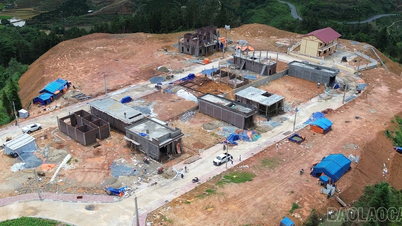
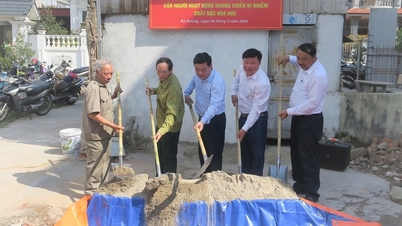
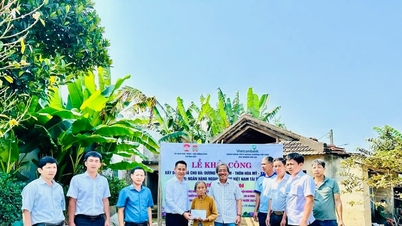
Following the Party Secretary of Ta Suoi Cau village, we visited families whose houses were completely destroyed by natural disasters last autumn. The families of Mr. Chao Lao U, Mr. Chao Phu Sieu, and Mr. Phan Lao Su have all moved out of the landslide-prone area and received support from the government and various organizations and individuals, ranging from 300 million to 500 million VND, to build new, decent houses.
Standing beside his newly built, sturdy house, Mr. Chảo Láo Ú said emotionally: "After the historic flood, my family didn't suffer any casualties, but we lost our house and fields, and it seemed impossible to recover. Thanks to the concern of the Party, the State, and benefactors, I now have a solidly built house, and this year I won't have to worry about storms anymore. My fellow villagers and I are very grateful to the Party and the State."
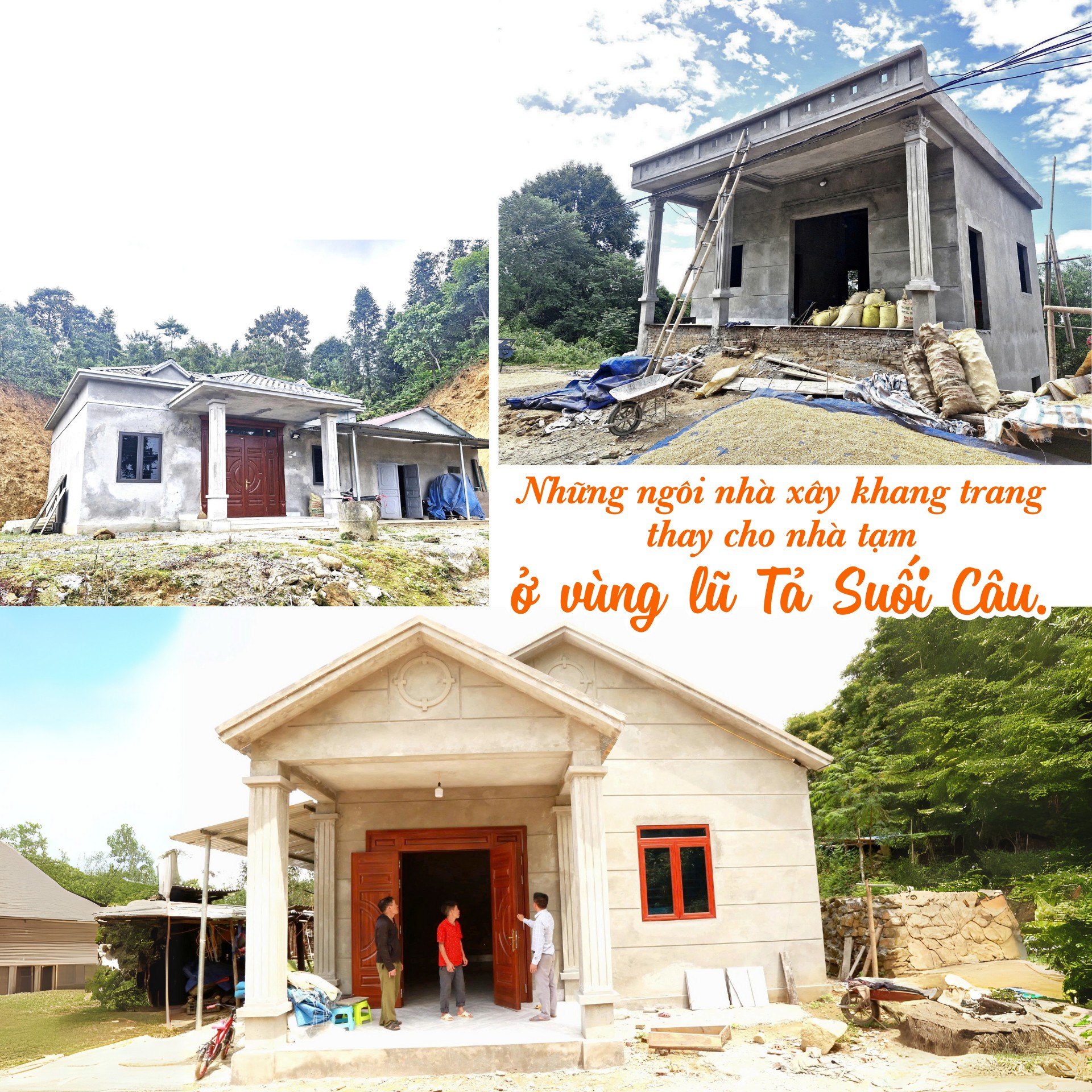
Walking through Ta Suoi Cau village today, it's not just Mr. Chao Lao U's family that has a newly built house; most households have constructed spacious new homes. Along with households affected by natural disasters receiving support, Ta Suoi Cau village also has 14 poor and near-poor households facing housing difficulties who are receiving government assistance to build new houses under the program to eliminate temporary and dilapidated houses.
My wife and I are both elderly and facing financial difficulties. Without government support, we don't know when we would have been able to live in such a beautifully built house. Families like those in Tan Lao Ta, Tan Phu Vang, Vang Lao Ta, Tan Sai Phu, Chao Lao Ta… have also built new houses and have stable housing. Now they just focus on developing their economy and increasing their income.
Indeed, the most visible change is the appearance of new houses in Ta Suoi Cau, replacing the old ones. But there is another change that is happening quietly, like a powerful underground stream: the relentless efforts and striving to improve the lives of the Dao people in the flood-prone area of Ta Suoi Cau.
When we arrived, Tan Ta May's family was busy harvesting and drying corn. Looking at the golden kernels drying on a floor covered with a plastic sheet to protect them from the rain, Ms. May said:
Last year, the terraced rice fields of my family were completely buried under mud, and the water source dried up, but instead of abandoning the land, my family switched to growing corn. This corn harvest yielded over 4 tons, which we will sell to buy rice, so we won't have to worry about a rice shortage.
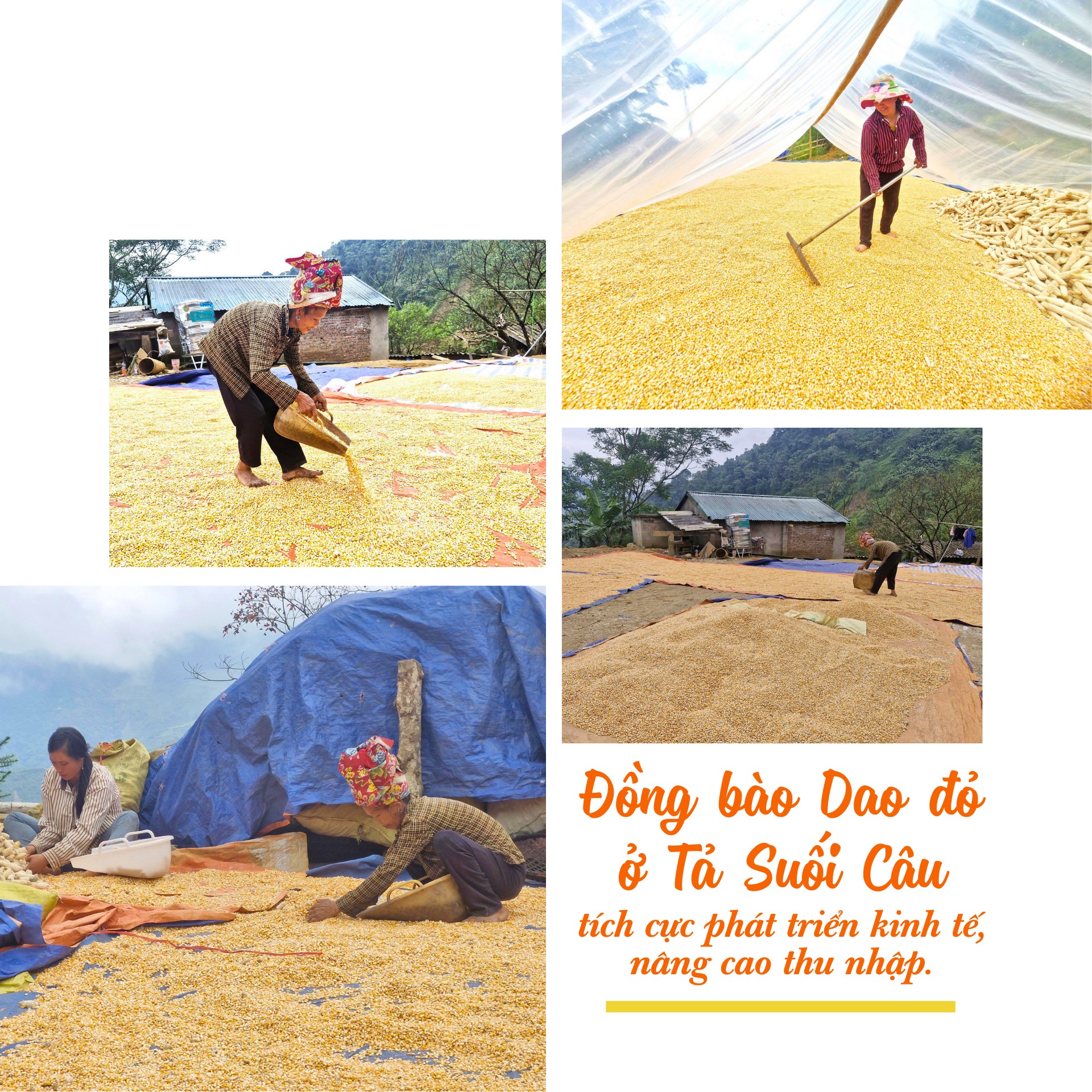
In September, the autumn sun casts a golden glow on the slopes of Ta Suoi Cau mountain. The red soil of the eroded mountain slopes remains, but is gradually being covered in green by grass and cornfields. Historically, despite living in an area prone to natural disasters, the Red Dao people of Ta Suoi Cau have been hardworking and proactive in production, resulting in a relatively better standard of living compared to other villages. Natural disasters and floods have not crushed the resilient spirit of the Dao people here in striving to build a prosperous life. On average, each household in Ta Suoi Cau harvests 3 tons of rice and 3-5 tons of corn annually.
Currently, Ta Suoi Cau village has over 100 hectares of cinnamon trees, 27 hectares of Shan Tuyet tea, in addition to terraced fields, cardamom, and purple cardamom. In spring, the villagers go to the forest to harvest ancient tea trees, and in summer they harvest corn. In autumn, the Dao people here are busy harvesting rice in the terraced fields and gathering purple cardamom. In winter, they go to the forest together to harvest cardamom, preparing to celebrate the traditional New Year.
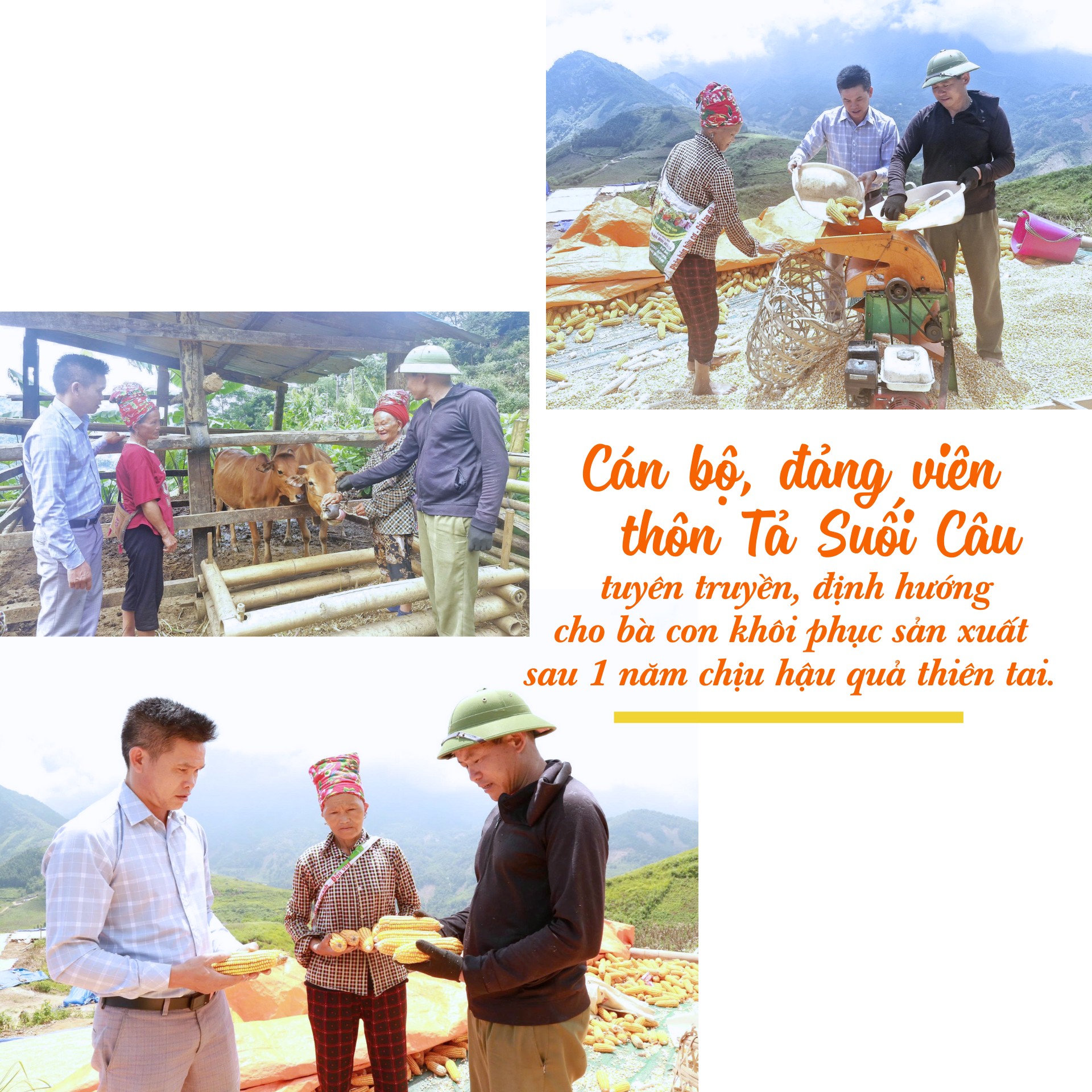
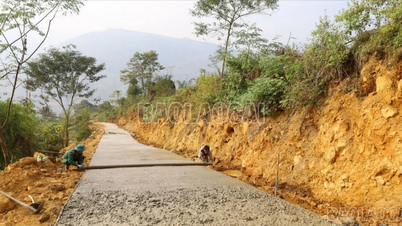
Bidding farewell to the land where the large stream flows through, Party Secretary Phan Lao Lu told us: "Ta Suoi Cau has revived after the floods, but the difficulties are not over yet. Many sections of the road to the village are still damaged by landslides, and the irrigation canals and water channels are still damaged and have not been restored. Of the 87 households, 28 are still poor or near-poor. Despite this, with the attention of the Party and the State, and the aspirations of the people, we believe that Ta Suoi Cau will stand firm at the headwaters of the border."
Performed by: Khanh Ly
Source: https://baolaocai.vn/ta-suoi-cau-hoi-sinh-post882706.html

















































































Comment (0)