

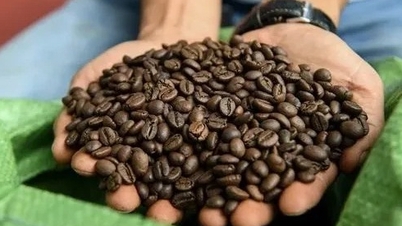
Coffee prices in the domestic market today (June 23) reversed course and increased by 300 VND/kg. Accordingly, the highest trading price in the localities was 66,500 VND/kg, recorded in Dak Nong province.
Domestic coffee price update
According to a survey conducted at 9:50 AM, the price of coffee today increased by 300 VND/kg.
According to reports, localities are currently purchasing coffee at prices ranging from 65,800 to 66,500 VND/kg.
Of these, Lam Dong province had the lowest price at 65,800 VND/kg. Next was Gia Lai province with a price of 66,000 VND/kg.
At the time of the survey, the purchase price in Dak Lak province was 66,300 VND/kg.
Dak Nong recorded a transaction price of 66,500 VND/kg - the highest among the surveyed localities.
Market | Medium | Change |
Dak Lak | 66,300 | +300 |
65,800 | +300 | |
Gia Lai | 66,000 | +300 |
Boeing Nong | 66,500 | +300 |
USD/VND exchange rate | 23,310 | 0 |
Unit of measurement: VND/kg
Exchange rate according to Vietcombank.

Coffee price trends from January to June 23rd. (Compiled by: Anh Thư )
World coffee price update
According to reports, coffee prices on the world market are fluctuating in opposite directions. Specifically, the online price of robusta coffee in London for July 2023 delivery was recorded at $2,792 per ton after an increase of 1.20% (equivalent to $33).
Arabica coffee futures for July 2023 delivery in New York were at 170.25 US cents per pound, after falling 1.16% (equivalent to 2 US cents) at 6:55 AM (Vietnam time).

Photo: Anh Thu
A Brazilian coffee research institute has begun a crucial phase in a two-decade-long project to develop naturally decaffeinated arabica coffee varieties, a development that researchers believe could have significant commercial potential.
This program is being developed at the Instituto Agronomico de Campinas (IAC), a leading coffee research center that has provided many high-yielding coffee plants that have helped Brazil become a powerhouse in the global coffee market, supplying more than a third of the world's commercial coffee production.
Researchers at IAC say they are beginning field trials in the region for some of the varieties they have developed over the past few years by crossbreeding different coffee plants that have very low caffeine content, using seed banks at their facilities.
If successful, the resulting varieties could find a niche market in major consumer regions such as Europe and the US among consumers who would prefer them over existing decaffeinated brands that are the result of chemical or industrial processes.
Companies selling decaffeinated coffee can also profit from reduced costs, as they can skip the industrial processes required to remove caffeine from regular coffee.
"The results we've had so far look very promising, and we're very optimistic," said Julio Cesar Mistro, a project monitoring researcher at IAC.
Several clonal lines developed at the center are being grown in different regions of Brazil. Coffee plants typically take two to three years to produce their first fruits, so there are still several years ahead before researchers can harvest the coffee plant and test it.
According to data from the National Coffee Association (NCA), decaffeinated coffee accounts for approximately 10% of the market in the United States, Reuters reports.
While many people drink specialty coffee to seek the energy boost provided by caffeine, some are intolerant to it or prefer to drink a "decaffeinated" version later in the day to avoid potential sleep disruption.
Source
![[Photo] Secretary of the National Assembly Party Committee, Chairman of the National Assembly presides over the meeting of the Standing Committee and Executive Committee of the National Assembly Party Committee.](https://vphoto.vietnam.vn/thumb/1200x675/vietnam/resource/IMAGE/2026/06/03/1780480353201_ndo_br_bnd-2585-jpg.webp)

![[Photo] General Secretary and President To Lam presides over a meeting with the Central Organizing Committee.](https://vphoto.vietnam.vn/thumb/1200x675/vietnam/resource/IMAGE/2026/06/03/1780482764658_a1-bnd-4741-3342-jpg.webp)




















![[Photo] First session of the 14th Congress of the Vietnam Trade Union](https://vphoto.vietnam.vn/thumb/1200x675/vietnam/resource/IMAGE/2026/06/03/1780465947883_ndo_br_img-3852-jpg.webp)


























![[Video] Sunset at Lap An Lagoon – Where the sun sets over the fishing nets](https://vphoto.vietnam.vn/thumb/1200x675/vietnam/resource/IMAGE/2026/05/31/1780192137701_beach-landscape-sea-water-nature-grass-745871-pxhere-com.jpeg)



































Comment (0)