

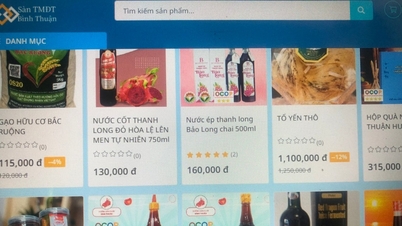
Tax laws stipulate that individuals conducting business, whether traditional or e-commerce, are subject to value-added tax and personal income tax if they generate revenue of 100 million VND or more per year. However, many online sellers who are obligated to pay taxes do not understand how to declare their taxes, leading to potential errors.
Therefore, disseminating information to individual business owners so they understand tax regulations and are supported in grasping and implementing these regulations is especially important.
Ms. Nguyen Thi Lan Anh, Director of the Department of Tax Management for Small and Medium-Sized Enterprises, Household Businesses and Individuals, General Department of Taxation, said that in recent times, the tax sector has always focused on promoting communication and support for taxpayers, and the General Department of Taxation's website (http://gdt.gov.vn) also has a dedicated section to support individual businesses in registering for tax, declaring and paying taxes electronically.

To improve the effectiveness of managing e-commerce activities, including sales on social media platforms, and to ensure transparency and equality in financial obligations for all individuals and organizations, whether conducting business through traditional or electronic methods, the tax authorities have been implementing many specific and coordinated solutions.
Firstly, we will continue to provide electronic tax services to support tax declaration and payment at level 4.0. In particular, in the near future, the General Department of Taxation will launch an electronic portal for individuals and business households engaged in e-commerce activities, enabling them to conveniently fulfill their tax obligations.
In addition, it is necessary to strengthen the dissemination of information and provide guidance to taxpayers participating in e-commerce business activities to ensure they declare and pay taxes in accordance with the law.
The tax authorities have proposed amending and supplementing legal regulations, requiring e-commerce platforms with online ordering functions to be responsible for withholding, declaring, and paying taxes on behalf of individual businesses operating on their platforms.
In addition, we will continue to enrich the large database on e-commerce, collecting information from various sources. Based on this, we will exploit and process the information to review taxpayers, bring them under management, require them to declare taxes in accordance with reality, adjust revenue, or handle tax collection.
Another solution is to build a risk management model for e-commerce businesses and individuals, applying artificial intelligence (AI) to process big data and provide warnings about potential tax risks.
Another measure is to continue implementing inspection and supervision of organizations and individuals engaged in e-commerce; businesses that own e-commerce platforms; shipping companies; and payment intermediaries.
In addition, coordinate with ministries and agencies to share and connect data to serve tax management for e-commerce activities as assigned in Directive 18.
According to Ms. Lan Anh, if a taxpayer's violation involves incorrect declaration, they will be penalized for incorrect declaration and late payment. If a taxpayer intentionally commits tax evasion, they will be fined 1 to 3 times the original tax amount. In cases where tax evasion reaches the level of criminal offenses, the case will be transferred to the police for handling according to the law.
Therefore, the tax authorities emphasize the importance of understanding and complying with tax obligations when conducting e-commerce business, especially for individuals.
Quoc Tuan
Source: https://vietnamnet.vn/tang-cuong-quan-ly-thue-voi-ca-nhan-kinh-doanh-online-2328649.html



![[Photo] Explore the US Navy's USS Robert Smalls warship](/_next/image?url=https%3A%2F%2Fvphoto.vietnam.vn%2Fthumb%2F1200x675%2Fvietnam%2Fresource%2FIMAGE%2F2025%2F12%2F10%2F1765341533272_11212121-8303-jpg.webp&w=3840&q=75)





























![[Video] The craft of making Dong Ho folk paintings has been inscribed by UNESCO on the List of Crafts in Need of Urgent Safeguarding.](https://vphoto.vietnam.vn/thumb/402x226/vietnam/resource/IMAGE/2025/12/10/1765350246533_tranh-dong-ho-734-jpg.webp)


























































Comment (0)