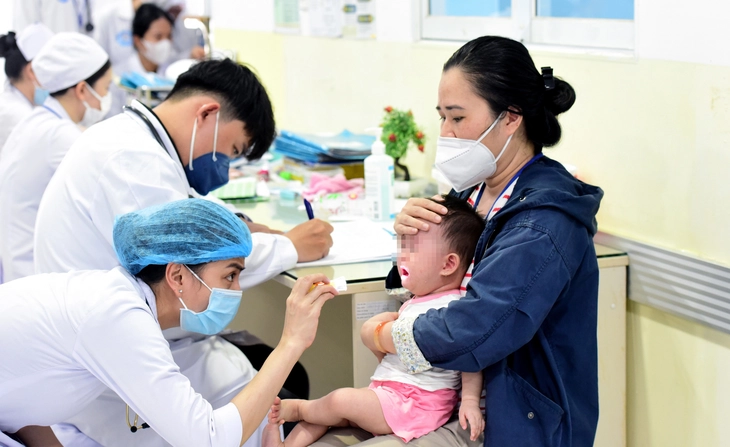
Increased allowances for doctors and medical staff are needed to prevent "brain drain" in public healthcare . (In the photo: examining a child at Children's Hospital 1 (Ho Chi Minh City) - Photo: DUYEN PHAN)
For nearly 15 years, on-call allowances, surgical allowances, epidemic control allowances, and meal allowances for healthcare workers have remained stagnant. High work pressure, rising living costs, and outdated salaries have led tens of thousands of healthcare workers in public hospitals to resign or move to private hospitals.
A cardiac catheterization procedure... 84,000 VND
Dr. A., who works at a tertiary hospital in Ho Chi Minh City, said that he and his colleagues perform about 6-7 cardiac catheterizations each day. However, the total daily allowance he receives is only just over 500,000 VND.
"When entering the interventional cardiology room, we doctors have to wear lead aprons weighing about 8kg, then stand and perform cardiac interventions on patients from morning until late evening. Yet, the allowance for each cardiac intervention for children is only 84,000 VND because it's only classified as a procedure," Doctor A. confided, hoping that the proposed increase in allowances would be implemented soon.
The doctors also gave a typical example: a difficult spinal surgery case where the surgical team stood continuously from 9:00 AM to 5:30 PM until their limbs went numb, but the lead surgeon only received 280,000 VND, while the assistant surgeon and technicians only received 200,000 VND.
The on-call allowance is also very low. Currently, doctors work about 5-7 on-call days each month, but the total on-call allowance is less than 1 million VND. This includes an allowance of 90,000 VND and 15,000 VND for meals for a 24-hour shift, from the morning of the previous day to the morning of the following day.
At the grassroots level, on-call pay and allowances are even lower. On-call pay for staff at commune health stations is currently 18,750 VND per night on weekdays and 32,500 VND per night on weekends, with a meal allowance of 15,000 VND per night. "On-call pay isn't even enough for a bowl of pho," one doctor lamented.
There is no one to "pass on the trade" to.
Working at a general hospital in the outskirts of Hanoi , Dr. Giang A Chinh (27 years old) shared that after nearly two years since graduating, his current monthly income is less than 9 million VND.
"Prices are constantly rising, while allowances remain the same for years," Mr. Chinh said sadly, frankly sharing that after obtaining his professional license, he plans to apply for a job at a private hospital to improve his life.
"Personally, I think the main reason doctors move to the private sector is income. In large hospitals that can provide a wide range of technical services, the living standards and income of doctors and medical staff are guaranteed, so very few people switch to private hospitals."
Therefore, income is the primary factor. If professional allowances are increased, and the income of medical staff, especially those at the grassroots level, is boosted, most doctors will be less likely to switch jobs. Everyone wants stability and to improve their professional skills. So, no one who is currently working here will switch to another place," Dr. Chinh frankly shared.
Speaking to Tuổi Trẻ newspaper, Dr. TN (Ho Chi Minh City), who has decades of experience working at a first-class hospital, shared that because the allowances are too "outdated," thousands of medical staff, not only in Ho Chi Minh City but also in other provinces, have quit their jobs in recent years.
"In my department, it's currently very difficult to find a doctor to 'pass on the trade' to, because most doctors, after training at public hospitals for a while and gaining experience, will move to private hospitals. Or, those who are determined have to take on extra work outside the hospital to make ends meet. Increasing their allowances and on-call pay is essential and must be implemented soon. Only when their worries about making ends meet are eased will medical staff feel secure enough to dedicate themselves to their work," said Dr. N.
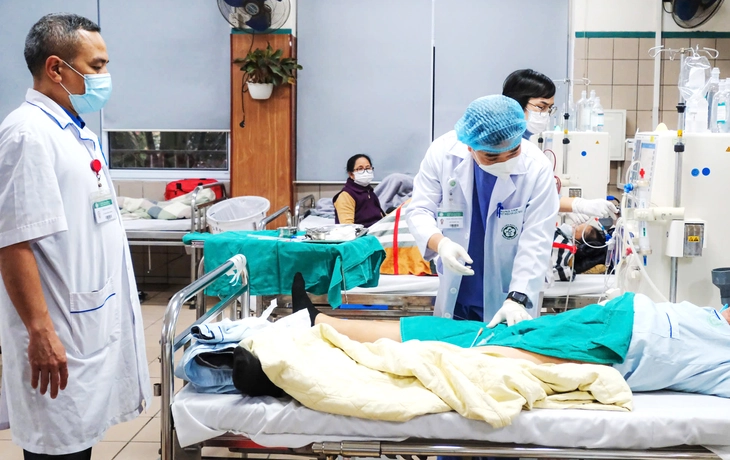
Doctors and nurses caring for patients at Bach Mai Hospital (Hanoi) - Photo: NAM TRAN
The new allowance should be calculated based on the base salary.
Speaking to Tuoi Tre newspaper, the leaders of Cho Ray Hospital (Ho Chi Minh City) stated that the allowances for on-call duty and surgery for doctors working at public medical facilities are regulated by Decree 73 of 2011 issued by the Prime Minister . Therefore, this regulation has been in effect for nearly 15 years and has not been adjusted upwards to date.
Compared to price fluctuations, inflation, and social changes, this allowance is outdated and very low. The current allowance system, which is set as an absolute amount, is unreasonable; it should be calculated based on the basic salary.
"Adjusting allowances according to the base salary will help them increase over time, in line with social development, and avoid the current situation of being outdated," this person commented.
The leadership of District 7 Hospital (Ho Chi Minh City) stated that allowances for surgery, procedures, on-call pay, and meals for medical staff must be increased, and this should even be implemented sooner. The current regulations, applied in 2011, are outdated and obsolete. While the regional minimum wage and civil servant salaries have increased, the cost of medical examinations and treatments and allowances remain unchanged.
However, when increasing allowances and on-call pay for medical staff, it is necessary to consider the appropriate pricing of medical services; otherwise, it will be very problematic. Previously, the basic salary increased, but the price of medical services did not, leading to many autonomous hospitals currently facing significant difficulties in paying salaries.

Allowances will increase from 30% to 70%.
The Ministry of Health is drafting a new decree stipulating certain special allowances and epidemic control allowances for civil servants, public employees, and workers at public health facilities.
Specifically, the staffing quota for a shift will be calculated based on the size and classification of the medical facility. Regarding allowances, employees working 24/7 shifts on weekdays will receive an allowance depending on the classification of the medical facility, ranging from 30% to 70%.
The Ministry of Health also proposed specific regulations on surgical and procedural allowances for medical staff directly involved in performing surgeries. Accordingly, surgical allowances are divided according to four types of medical facilities: special, type 1, type 2, and type 3. Many of the proposed allowances have increased by more than three times compared to current regulations.
This proposal from the Ministry of Health aims to concretize the policy of providing benefits for healthcare workers, ensuring the health and rights of employees in the face of rising living costs.
Public healthcare allocates 10-16% of its revenue to salary reform.
Given the reality that hospitals in Ho Chi Minh City have very low revenue-expenditure disparities, making it difficult to allocate funds for hospital operations, especially in the context of hospitals facing many difficulties due to inaccurate and inadequately calculated hospital fees, the City People's Council has passed a resolution stipulating the percentage of retained revenue to create a fund for salary reform in public health institutions.
Instead of having to allocate 40% as per the city's general allocation rate, public healthcare institutions will allocate 16% of their retained revenue for units with a financial autonomy level of 120% or higher; and 10% for other units.
With the regulations on the amount of retained revenue to create a fund for salary reform as described above, public hospitals operating under an autonomous mechanism will be able to ensure the resources to implement the policy of paying additional income according to the city's specific mechanism, while also establishing a fund for the development of their professional activities, contributing to improving the efficiency of medical examination and treatment for the people.
Over 600 healthcare workers in Ho Chi Minh City resigned in one year.
For 15 years, without any increase in allowances for on-call duty, surgery, or epidemic control, many doctors have quietly shifted to private hospitals and clinics. According to a report by the Ho Chi Minh City Department of Health, in 2024, the city's health sector recorded 642 resignations, including 286 doctors and 259 nurses, midwives, and medical technicians.
Notably, the majority of these resigning healthcare workers had many years of experience in the field and possessed high levels of expertise; while most of the newly recruited staff were young doctors and nurses who had recently graduated and would require a period of training.
When doctors switch from public to private sector, they risk losing their professional skills.
With many years of experience working in public and private hospitals in Ho Chi Minh City, Dr. Ho Manh Tuong, General Secretary of the Ho Chi Minh City Society of Reproductive Endocrinology and Infertility, believes that the movement of doctors between hospitals is a common occurrence worldwide, only becoming more frequent in Vietnam recently. There are many reasons why doctors move from public to private hospitals. Most of these doctors, after changing their work environment, experience less professional development due to the smaller number of patients and fewer cases that make it difficult to improve their skills. After a while, these doctors easily become outdated.
Starting salary for doctors is at level 2.
Regarding the proposal to increase special allowances for healthcare workers, Minister of Health Dao Hong Lan recently responded to voters from various provinces and cities.
Increase special allowances
Accordingly, the head of the Ministry of Health stated that currently, in addition to the salary stipulated by the Government, medical staff also receive many other allowances. These allowances include: preferential allowances based on profession; special allowances for 24/7 on-call duties, participation in epidemic control, and performing surgeries or procedures. Furthermore, medical staff also receive allowances for hazardous and dangerous work; allowances for areas with particularly difficult socio-economic conditions; and other special allowances at some hospitals or specifically for village health workers. In addition, the Minister of Health said that some localities have proactively issued resolutions of the Provincial People's Council to regulate the content and level of specific expenditures to attract medical personnel to work at the grassroots level and in the field of preventive medicine.
Regarding policy reforms, the Ministry of Health is currently proposing a starting salary level of 2 for positions such as doctors, preventive medicine doctors, and pharmacists upon recruitment, instead of starting from level 1 as currently.

Medical staff working at Children's Hospital 1 (Ho Chi Minh City) - Photo: DUYEN PHAN
Two decrees on allowances will be finalized in September 2025.
At the same time, the ministry is also developing two important new decrees: one is a decree replacing Decree 56/2011 on preferential allowances for specific occupations (expected to be completed in December 2025); the other is a decree regulating special allowances, epidemic control allowances, and support for village health workers - expected to be completed in September 2025.
According to the draft by the Ministry of Health, the expected funding sources will include: the state budget according to the decentralization of authority; the unit's retained revenue from its operations as stipulated; and the unit's legitimate revenue sources (if any). If the unit uses the funding sources specified in points a, b, and c of this clause but still does not have sufficient funds to implement the allowance regime stipulated in this decree, it will receive supplementary funding from the state budget according to the current budget decentralization.
Additional allowances for certain other groups.
For the first time, the Ministry of Health's draft regulations mention allowances for those involved in organ and tissue donation and transplantation activities, such as organ donation counseling, brain-dead resuscitation, tissue/organ retrieval, preservation, and transportation, and organ transplantation coordination. According to the Ministry of Health, currently only 33 hospitals have organ donation counseling teams, and not many of these teams operate effectively due to inadequate incentives. Similarly, pre-hospital emergency care is also emphasized as a key area, but there is no unified policy nationwide. Localities currently apply different policies; some rely on Decision 73/2011/QD-TTg, while others do not.
The draft proposes establishing a separate allowance system for pre-hospital emergency medical personnel and pre-hospital emergency coordination personnel. This group would receive an allowance to encourage continuous on-call duty, effective coordination, and providing first aid guidance to people at the scene.
XUAN MAI - THU HIEN - DUONG LIEU
Source: https://tuoitre.vn/tang-phu-cap-ngan-chay-mau-chat-xam-nganh-y-20250728084119285.htm





![[Image] Nearly 125,000 Hanoi students completed the Literature exam for the 10th grade entrance exam.](https://vphoto.vietnam.vn/thumb/1200x675/vietnam/resource/IMAGE/2026/05/30/1780117233041_ndo_br_thiet-ke-chua-co-ten-2-png.webp)





































































































Comment (0)