

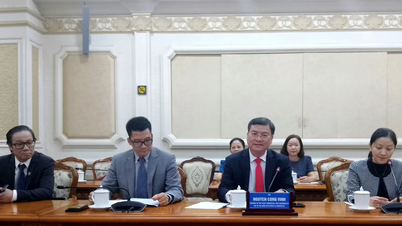
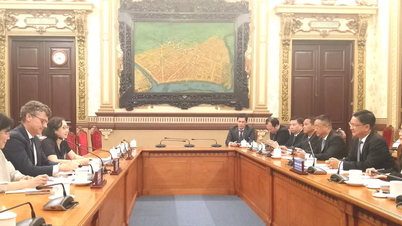
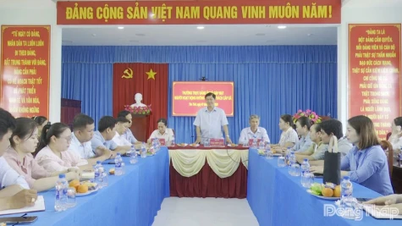
Also attending were: Nguyen Manh Cuong, Alternate Member of the Central Committee of the Party, Vice Chairman of the People's Committee of Ho Chi Minh City; Duong Anh Duc, Head of the Propaganda and Mass Mobilization Department of the Ho Chi Minh City Party Committee; Tran Thi Dieu Thuy, Vice Chairman of the People's Committee of Ho Chi Minh City; Tran The Thuan, Director of the Department of Culture and Sports of Ho Chi Minh City; Truong Minh Huy Vu, Director of the Institute for Research and Development of Ho Chi Minh City…
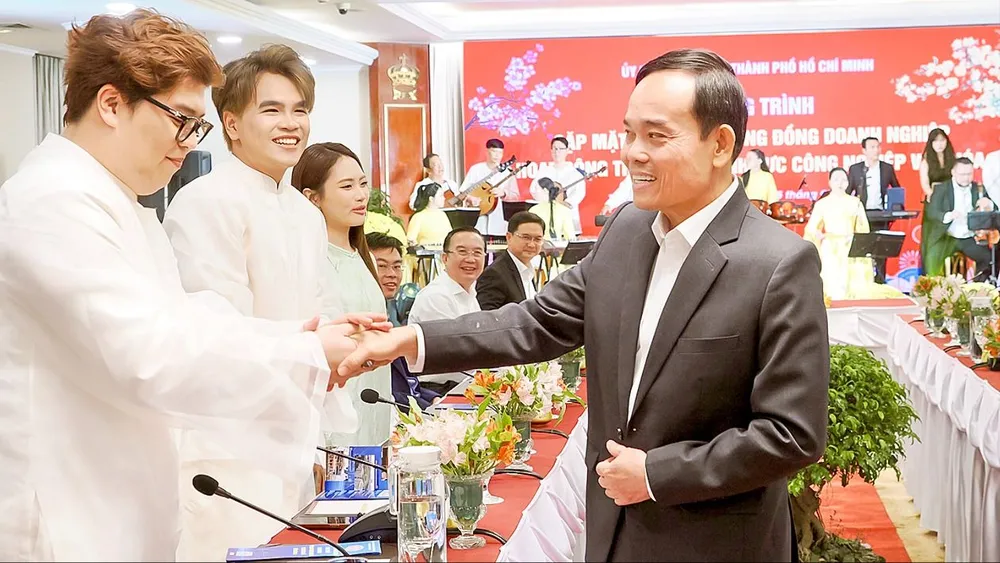
New growth drivers
According to a report by the Ho Chi Minh City Department of Culture and Sports, the city currently has the largest cultural industry in the country, with approximately 97,000 workers and more than 17,670 businesses operating in related fields. Between 2010 and 2019, the production value of cultural industries increased from over 36,000 billion VND to over 84,000 billion VND, contributing nearly 3.9% to the city's GRDP. Despite the severe impact of the Covid-19 pandemic, in 2020 the contribution still reached 3.54% of GRDP, exceeding the national target.
Ho Chi Minh City is also one of the pioneering localities nationwide to approve and implement the plan for the development of the city's cultural industry until 2030. The city has identified film, performing arts, advertising, cultural tourism, fine arts - photography - exhibitions, fashion, television - radio and digital content as key areas of focus. Notably, Ho Chi Minh City has been recognized by UNESCO as a "Creative City in the field of cinema," creating a foundation for the cultural industry to become a driving force for socio-economic development in the coming period.
Ho Chi Minh City currently has many favorable conditions for the development of the cultural industry, such as a significant amount of public assets after the reorganization of administrative units, and the recent construction of new public parks. These can serve as cultural spaces for the community, and cultural startups can use them to introduce their new products.
Secretary of the Ho Chi Minh City Party Committee, Tran Luu Quang
In his opening remarks at the meeting, Ho Chi Minh City Party Secretary Tran Luu Quang expressed his appreciation for the efforts and contributions of artists and businesses that have brought concrete cultural achievements to the city in recent years. He emphasized: “Ho Chi Minh City has a tradition and a ‘genetic code’ for cultural development, easily seen through many previous generations. The city's environment has great potential and ample room for cultural development.” According to Mr. Tran Luu Quang, developing the cultural industry in Ho Chi Minh City is something we must do and strive to achieve, because it is not just about economic development, but also the spiritual foundation of the people and the city.
Long-term strategy for the cultural industry
In order for the cultural industry to make a practical contribution to the city's development, at the meeting, many organizations operating in the cultural sector expressed interest in infrastructure and facilities for cultural events that can generate significant revenue.
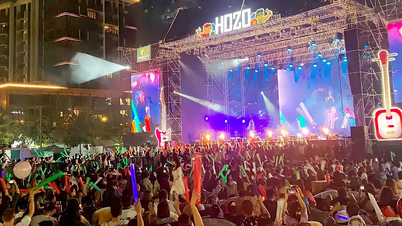
Ms. Bui Viet Ha, Director of External Relations and Public Relations at Yeah1 Group, stated that while Vietnamese youth previously primarily followed international idols, the opposite trend has now emerged. About two months ago, during the "Brother Overcoming a Thousand Obstacles" event, the organizers noted significant interest from international fans, including Korean audiences eager to meet Vietnamese artists. However, Ms. Viet Ha also expressed concern: "To organize large-scale music festivals, Vietnam still lacks professional venues with a capacity of 50,000-100,000 spectators. Utilizing large urban areas is only a temporary solution and does not meet the standards for organizing international-level events."
Sharing concerns about institutions and infrastructure, Mr. Dinh Ba Thanh, Chairman of DatViet VAC, expressed that, in addition to having cultural institutions and infrastructure for large-scale events, the city needs to focus on building a cultural industry center and subsequently partnering with major cultural industry centers around the world such as Seoul (South Korea) or Los Angeles (USA). “We need to position the cultural industry center as important as other sectors, with supportive policies and priorities for businesses and organizations operating there. This will allow us to form a creative team 100% from Vietnam, with programs and events that have their own unique character, instead of having to buy programs from foreign countries as is currently the case,” Mr. Dinh Ba Thanh said.
Cooperation must ensure a balance of interests among all parties.
Besides, procedural issues are also a major concern for businesses and cultural professionals. Mr. Nguyen Hoang Hai, Content Director of CGV, said that whenever they shoot a film, finding a suitable film studio requires businesses to travel to many provinces, wasting time and money. According to Mr. Nguyen Hoang Hai, if Ho Chi Minh City had a film studio of about 100-150 hectares, it could be used for multiple functions: film production, attracting tourists, and developing cultural products.
Secretary of the Ho Chi Minh City Party Committee Tran Luu Quang:
Utilizing surplus public assets for the development of the cultural industry.
Through the opinions of artists and businesses in the cultural sector, city leaders have gained some insight into what needs to be done to develop the city's culture and cultural industry, improve its image and cultural products, and continue the city's glorious cultural traditions.
Ho Chi Minh City currently has many favorable conditions for the development of the cultural industry, such as a significant amount of public assets after the reorganization of administrative units, and the recent construction of new public parks. These are cultural spaces serving the community, where cultural startups can showcase their new products. For example, the four villas in Park No. 1 on Ly Thai To Street (Vuon Lai Ward) could be used as venues for activities, exhibitions, and presentations of new cultural products and ideas.
Ho Chi Minh City has implemented many loan support packages. However, for businesses in the cultural sector, the conditions for obtaining loans are very difficult, especially the requirement to guarantee business efficiency and the ability to recover capital. Therefore, the city's view is to call for the joint efforts of financially capable entities to support investment in the cultural industry. The city will play a role in accompanying and creating the best conditions for the investment process to be smooth and safe. To achieve this, city departments and agencies must ensure that no administrative obstacles are created within their jurisdiction and that there is transparency and fairness for all businesses. Only in this way can we build trust so that entities will accept investing in the cultural industry, a field considered quite risky. Of course, the city will also allocate some initial capital, but the decisive factor for the development of the cultural industry remains the efforts and implementation capacity of the businesses themselves.
Regarding investment in the cultural industry, especially in the film sector, Mr. Nguyen Hoang Hai stated that this is always a very difficult process because film production is considered "extremely risky." Domestic capital is facing difficulties for many reasons, while foreign capital is hampered by numerous procedures. For example, business cooperation contracts, just the application process alone takes about 6 months, going through many departments such as the Department of Planning and Investment, the Department of Culture and Sports, etc. Some businesses have to set up companies abroad, while domestic companies are merely subcontractors to "circumvent" regulations.
Sharing this view, designer Trung Dinh and Mr. Phan Anh (CEO of VMAS Group V-MAS) expressed the need for more supportive policies so that businesses and individuals working in the cultural sector can access preferential capital to restart operations and invest in long-term projects such as producing albums and small- and medium-sized music programs.
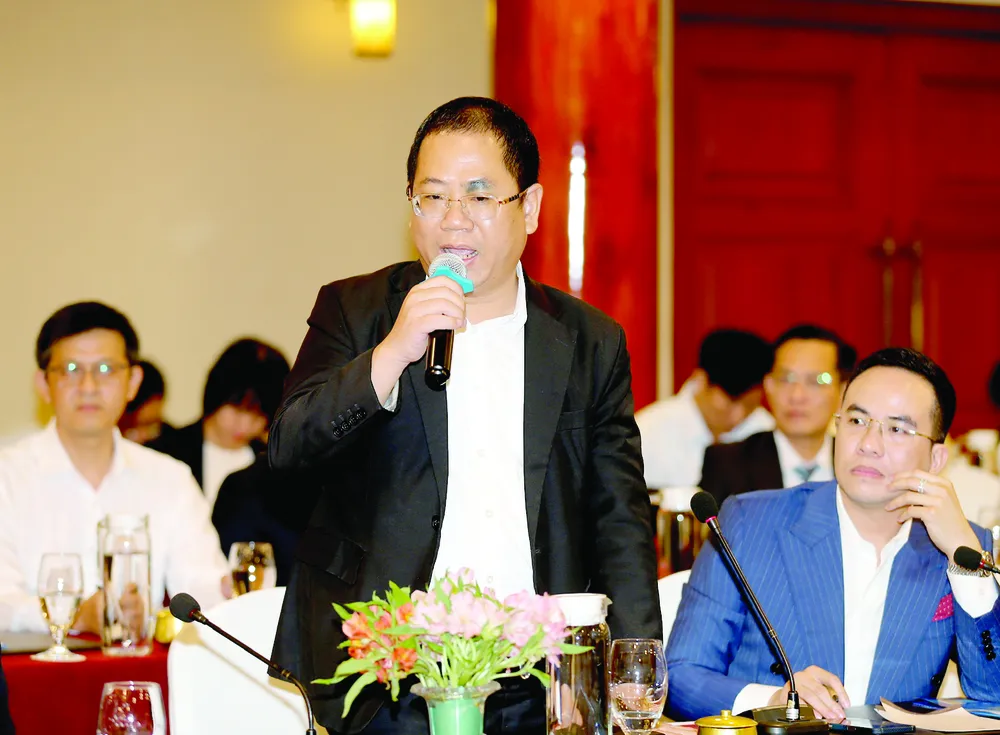
Discussing this issue, Ho Chi Minh City Party Secretary Tran Luu Quang acknowledged the value of small and medium-sized enterprises operating in the cultural sector and stated that the city would strive to research and develop support policies. However, Comrade Tran Luu Quang also frankly stated: "The city will find ways to provide the highest level of support to businesses and cultural workers, but businesses and cultural workers must also demonstrate the feasibility of their projects."
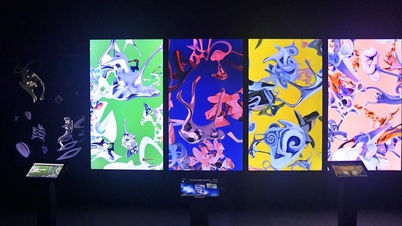
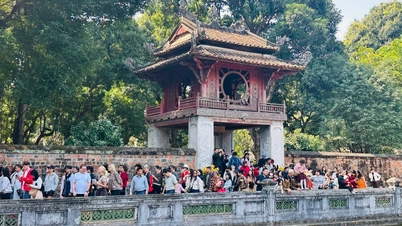
Speaking at the meeting, Mr. Hoang Quoc Viet, Chairman of the Board of Directors of Vietsoftpro Joint Stock Company, said that Ho Chi Minh City lacks digitalized cultural and heritage experience spaces. The city is vibrant at night, but museums close early, while many countries have effectively exploited night tours at museums. Even domestically, Hanoi has successfully implemented night tours at the Temple of Literature and Hoa Lo Prison, creating a strong attraction for tourists. “We are planning to invest in night tours in Con Dao, combining historical and cultural stories; and simultaneously develop the ‘Ho Chi Minh City 360’ platform for tourists to explore the city digitally, for a fee,” Mr. Hoang Quoc Viet stated.
Ho Chi Minh City Party Secretary Tran Luu Quang assessed these ideas as noteworthy and requested the businesses to promptly develop specific cost estimates, prioritizing projects in Con Dao in the immediate future. Comrade Tran Luu Quang emphasized that cooperation must ensure a harmonious balance of interests among all parties. Investment incentives in culture, tax policies, etc., will be considered by the city within the overall framework.
Building the next generation of audiences.
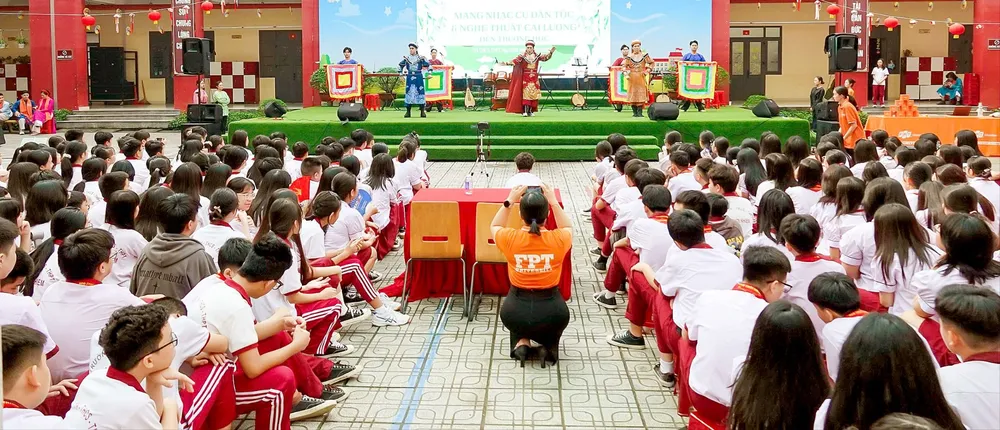
In the general landscape of contemporary art, traditional culture and art have slowed down and become somewhat marginalized. Sharing her concerns, People's Artist Hong Van (Hong Van Theatre) suggested: "We need to build a future generation of audiences, among whom will be those who continue to carry on the cultural legacy." Specifically, People's Artist Hong Van hopes that theatres will collaborate more with education, particularly reaching out to students from secondary school onwards, so that they can appreciate, understand, and love the traditional arts of their country.
Sharing the same viewpoint, Meritorious Artist Phan Quoc Kiet, Director of the Tran Huu Trang Cai Luong Theatre, shared his thoughts on the effectiveness of school theatre programs, through performances and innovative approaches to engaging students. “However, currently, school theatre performances are too few, only about 20 shows a year (funded by the Ho Chi Minh City Department of Culture and Sports at 35 million VND per show). We need to research expanding the number of performances, and especially in the context of post-merger development, we need to expand to schools in the former Ba Ria - Vung Tau and Binh Duong areas. Students need to understand and appreciate theatre to develop future talents, forming a successor generation and passing on the tradition,” said Meritorious Artist Phan Quoc Kiet.
With a passionate commitment to this issue, Ho Chi Minh City Party Secretary Tran Luu Quang emphasized: “I appreciate the efforts of the artists in their profession and in passing on their knowledge. We really need a future generation of audiences for traditional art. Currently, the city will conduct specific research on this matter, but for now, if we cannot implement it on a large scale, we will conduct a pilot program, and this must be done immediately in the first quarter or at the latest, the beginning of the second quarter. City leaders will be responsible for providing support and working together.”
View cultural investment funds as similar to venture capital funds.
Speaking at the meeting, Mr. Truong Minh Huy Vu, Director of the Ho Chi Minh City Institute for Research and Development, said that according to Resolution 98, it is possible to borrow 200 billion VND for culture, infrastructure, and cultural products, with interest subsidized by the People's Council for 7 years. However, to date, not many cultural products have received this funding. In December 2025, Resolution 98 was amended to Resolution 260, Article 7, Clause D, which introduces the concept of strategic investors, including in the fields of cultural parks, sports parks, and themed parks, with a scale of up to 6,000 billion VND. Strategic investors in these fields receive many tax incentives, and in some cases, the procedures may involve direct contracting or limited bidding.
Furthermore, we should view cultural investment funds as a form of venture capital, like investing in a film, where success or failure sometimes depends on external factors. Currently, the legal framework for international financial centers already includes mechanisms for such funds, which is very favorable for implementation.
Source: https://www.sggp.org.vn/tao-dot-pha-phat-trien-cong-nghiep-van-hoa-post837314.html
![[Photo] General Secretary and President To Lam presides over the meeting to approve the draft report on the results of the second inspection by the Politburo of the Standing Committee of the Hanoi City Party Committee.](https://vphoto.vietnam.vn/thumb/1200x675/vietnam/resource/IMAGE/2026/05/26/1779789811432_a2-bnd-4430-9620-jpg.webp)




















































Comment (0)