


Vietnam possesses abundant marine biological resources, with a high level of biodiversity in the Indo-Pacific region. Marine ecosystems record approximately 11,000-12,000 species, including many invertebrate groups such as sponges, echinoderms, and mollusks, which are rich biological resources with significant potential, containing natural compounds valuable for pharmaceuticals, materials, and marine biotechnology.
Therefore, building a DNA database for marine organisms not only supports species identification and biodiversity research but also creates a crucial data foundation for interdisciplinary research directions, having strategic significance for the long-term development of marine science and technology.
According to scientists at the Vietnam Academy of Science and Technology, marine biology research in Vietnam has achieved many positive results over the past decades, especially in the chemistry of natural compounds. However, accurate species identification remains a major challenge due to many species having similar morphology, making them difficult to distinguish using traditional methods.
Molecular biological tools, especially molecular classification based on DNA barcoding, have become effective methods for species identification and biodiversity research. Molecular classification is a method of identifying species based on specific DNA sequences or DNA barcoding of a species. The development of DNA barcoding and the creation of reference databases for marine organisms is crucial for rapid biodiversity assessment, supporting the identification of elusive species or incomplete specimens, as well as identifying organisms at all developmental stages, including larvae. This method also contributes to improving conservation efficiency, monitoring invasive species, and ensuring the authenticity of marine biological resources.
Currently, many countries around the world are implementing large-scale programs to build DNA barcode libraries for organisms globally. These databases are considered crucial biological data infrastructure, serving biodiversity research, resource management, and scientific and technological development. In line with this trend, building a DNA database for marine organisms in Vietnam will not only serve the classification and assessment of biodiversity but also create a foundation for research into natural compounds and marine gene resources.
Based on this practical need, the scientific and technological project "Research on building a DNA database for several groups of valuable marine invertebrates (sponges, echinoderms, mollusks) in Vietnam" was implemented in the period 2023-2025 at the Institute of Chemistry (Vietnam Academy of Science and Technology), led by Dr. Tran My Linh. This is one of the first systematically and comprehensively implemented studies on three groups of valuable marine invertebrates in Vietnam.
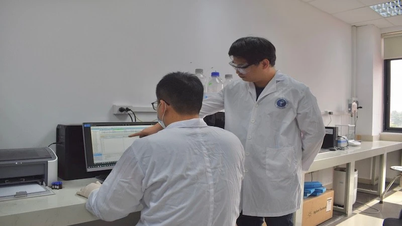
According to Dr. Tran My Linh, for the first time, a DNA barcode database has been built for 109 species belonging to the sponge, echinoderms, and mollusks groups, with sequences verified through a close combination of morphological characteristics and genetic data. All characteristic sequences have been registered in international databases such as NCBI and BOLD (Barcode of Life Database), and assigned BIN (Barcode Index Number) identifiers.
Notably, each species has at least one unique DNA sequence established, including some species for the first time with reference data on the international system. Simultaneously, the research team has built an online database at www.dnabien.vn , providing information on DNA barcodes, morphological characteristics, and sample collection locations with a bilingual Vietnamese-English interface.
A notable new aspect of the project is the expansion of research to the sequencing and transcriptional analysis of several marine species with potential applications in the field of medicine and pharmaceuticals. The research results have been published in international and domestic scientific journals, contributing to enhancing the presence of Vietnamese marine biological data in the international scientific community.
According to experts, the research results demonstrate the crucial role of basic research in forming scientific data platforms to support future technological development. While DNA barcoding is not a complex core technology, DNA data from native organisms and biobarcode libraries represent a long-term strategic data source, potentially serving as a national biodata infrastructure for biodiversity research, biological resource management, and the development of science and technology related to marine resources.
The initial results mentioned above have contributed to building a solid scientific foundation to serve the development of Vietnam's marine science and technology in the coming period.
Source: https://nhandan.vn/tao-du-lieu-dna-thuc-day-cong-nghe-sinh-hoc-bien-post959861.html
![[Image] Nearly 125,000 Hanoi students completed the Literature exam for the 10th grade entrance exam.](https://vphoto.vietnam.vn/thumb/1200x675/vietnam/resource/IMAGE/2026/05/30/1780117233041_ndo_br_thiet-ke-chua-co-ten-2-png.webp)




![[INFOGRAPHIC] Canon EOS R6: A new breakthrough in 7K Open Gate video recording.](https://vphoto.vietnam.vn/thumb/402x226/vietnam/resource/IMAGE/2026/05/30/1780114528841_info-mayanh-a-thumb-jpg.webp)







![[Photo] The General Secretary, President and Prime Minister of Singapore attend the tree planting ceremony at the Singapore Botanic Gardens.](https://vphoto.vietnam.vn/thumb/402x226/vietnam/resource/IMAGE/2026/05/30/1780122934945_vna-potal-tong-bi-thu-chu-tich-nuoc-va-thu-tuong-singapore-du-le-trong-cay-8794687-jpg.webp)



![[Photo] Admire the coral "masterpiece" amidst the million-year-old heritage of Dak Lak province.](https://vphoto.vietnam.vn/thumb/1200x675/vietnam/resource/IMAGE/2026/05/30/1780107638639_y25-jpg.webp)





























































Comment (0)