


Strategic infrastructure of the knowledge economy
As the country enters a new stage of development, General Secretary and President To Lam has pointed out that the economic growth model based on cheap labor and resource exploitation has exhausted its potential. Vietnam is compelled to shift to a development model based on knowledge, technology, and innovation, striving to transform from a country that manufactures products to a country that creates products (shifting from "Made in Vietnam" to "Made by Vietnam").
In this new model, basic science is no longer seen as a purely "academic" field, but is repositioned as a strategic infrastructure, the foundation for national competitiveness and the starting point of all technological value chains. Basic science is where fundamental knowledge is created to solve core technological problems. Without a solid foundation in basic science, these core technologies will quickly run out of room for development and lose their intrinsic resilience. Therefore, prioritizing development space and focusing resources on investing heavily in basic science is a crucial strategic step. This is not only a prerequisite for elevating the status of the national science and technology sector, but also contributes to the formation of a team of scientists with groundbreaking thinking and vision.
Regarding this philosophy, Professor Oren Harari (University of San Francisco, USA) once famously said: "The electric light bulb never came about by constantly improving candles."
In the new development model, the position and role of basic science need to be redefined. Instead of the traditional view that sees basic science as an independent academic field detached from practice, the new development model positions basic science in an organic relationship, closely linked to three pillars: strategic technology, innovation, and technological mastery.
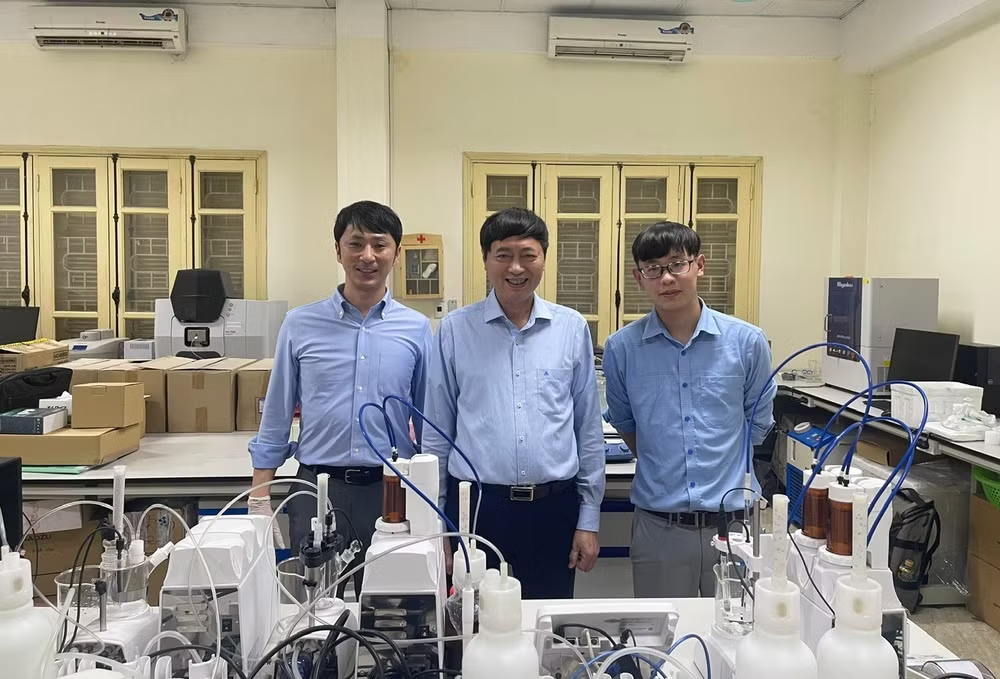
First and foremost, fundamental science is the source of strategic technology. Core technologies of the Fourth Industrial Revolution, such as artificial intelligence, semiconductor technology, quantum technology, advanced materials, next-generation biotechnology, and green energy, did not spontaneously emerge. They are the direct result of fundamental research in scientific fields such as mathematics, physics, chemistry, biology, and earth sciences. Fundamental science is defined as the source of "fundamental knowledge" with new principles and inventions. Without this fundamental knowledge, all applications of science and technology are often merely copying, processing, and are easily replaced.
Basic science is the foundation for all innovation and creativity, the source of groundbreaking technologies. It generates new scientific discoveries, serving as the core basis for businesses to develop proprietary products with high intellectual content that are difficult to replicate. Furthermore, basic science helps train high-quality human resources – individuals possessing innovative thinking, sharp critical thinking skills, and the ability to solve problems thoroughly.
Basic science also ensures mastery of technology, especially strategic technologies. A nation cannot have economic sovereignty if it is entirely dependent on imported technology. Therefore, it is necessary to improve the capacity to absorb science and technology.
It is clear that in order to transfer or receive advanced technology from abroad, domestic scientific capacity must be strong enough to understand, operate, and eventually master that technology. Without a solid foundation in basic science, we can only purchase machinery (hardware) but cannot master the technology (software/know-how).
Furthermore, strategic security must be ensured in sensitive areas such as cybersecurity, defense, and telecommunications. In this regard, technological self-reliance based on fundamental science serves as a shield protecting the nation against global geopolitical fluctuations.
Choose a breakthrough area to invest in.
Given the limited national resources (budget, high-quality human resources), investing broadly in basic science is not feasible. Vietnam needs to implement the motto "Invest with focus and priority, choose breakthrough areas." Prioritization does not mean "neglecting" other sectors, but rather concentrating resources on the most crucial areas, where breakthroughs will drive the development of the entire national technology and innovation ecosystem.
It is necessary to define the goals of research projects in the field of basic science not as creating immediately commercially viable products, but as cultivating outstanding human resources and fundamental inventions to serve as a foundation for applied science in the future. Therefore, a long-term vision (5-10-15 years) is needed, along with a strong shift from a pre-approval to a post-approval mechanism; and simultaneously creating conditions for scientists to pursue long-term, high-risk basic research in this particular field.
Regarding this matter, the Ministry of Science and Technology recently issued Decision No. 2555/QD-BKHCN approving the Program for Excellence in Basic Research in Natural Sciences for the period 2026-2035 (Program for Excellence in Basic Research - PEBR). The PEBR program is expected to create a breakthrough in investment in basic research towards long-term, focused projects, linked to the development of national strategic technologies.
State budget resources should be prioritized in the form of commissioned strategic tasks for universities and research institutes, aiming to solve key technological problems linked to the practical needs of businesses and technology corporations. In addition, mobilizing private financial resources is also extremely important. In this regard, mechanisms are needed to encourage large businesses and corporations to establish investment funds for application-oriented basic research. In this ecosystem, businesses act as an extension, helping to bring fundamental scientific knowledge from the laboratory to the market.
In Vietnam today, despite numerous government policies promoting collaboration, the gap between the business sector and the scientific community remains quite large. This situation stems from both sides: many research projects originate from the subjective proposals of scientists rather than the actual needs of the market; conversely, businesses are not enthusiastic about commissioning research from universities, often prioritizing the import of readily available foreign technologies. Recently, this situation has begun to improve, as the mechanism for selecting scientific research projects funded by the state budget has emphasized the role of businesses in formulating research topics and receiving the products from these projects.
The university's mission is to build a foundation of knowledge.
In the strategic directives of General Secretary and President To Lam, particularly at the meeting on basic scientific research and his speech at Hanoi National University in May 2026, the university system is positioned as a "central link," simultaneously addressing two key tasks: training elite human resources and creating foundational knowledge for strategic technologies.
First and foremost, it must be recognized that knowledge and advanced technologies originate from scientists and the laboratories of universities and research institutes; therefore, higher education plays a crucial role in training high-quality human resources and providing the scientific foundation for strategic technologies.
In developed countries, the scientific and technological achievements created by universities are immense. Research teams within universities make a significant contribution to the scientific landscape of a nation. The importance of policies to attract talent and invest heavily in scientific research is clearly demonstrated by the breakthroughs of American universities in the post-World War II period. Thanks to these policies, US universities have risen strongly and achieved groundbreaking developments. Currently, the United States occupies more than one-third of the positions in the ranking of the top 100 universities in the world.
Resolution 71 of the Politburo on breakthroughs in education and training development has fundamentally changed the perception of the role of the university system. Accordingly, universities should not only focus on disseminating knowledge but also be centers for generating new knowledge; simultaneously operating as national centers for research, innovation, and entrepreneurship. The output of research universities is not limited to high-quality human resources from engineers, bachelors, and PhDs, but also includes inventions, patents, and technology startups built and managed by scientists themselves.
Source: https://nhandan.vn/khoa-hoc-co-ban-nen-mong-cua-doi-moi-sang-tao-post965795.html




![[Video] Sunset at Lap An Lagoon – Where the sun sets over the fishing nets](https://vphoto.vietnam.vn/thumb/1200x675/vietnam/resource/IMAGE/2026/05/31/1780192137701_beach-landscape-sea-water-nature-grass-745871-pxhere-com.jpeg)







![[Video] Sunset at Lap An Lagoon – Where the sun sets over the fishing nets](https://vphoto.vietnam.vn/thumb/800x450/vietnam/resource/IMAGE/2026/05/31/1780192137701_beach-landscape-sea-water-nature-grass-745871-pxhere-com.jpeg)







![[Infographic] Key points from the opening remarks of General Secretary and President To Lam at the Shangri-La Dialogue](https://vphoto.vietnam.vn/thumb/402x226/vietnam/resource/IMAGE/2026/05/31/1780196272740_anh-man-hinh-2026-05-31-luc-09-55-34.png)




































![[Video] Sunset at Lap An Lagoon – Where the sun sets over the fishing nets](https://vphoto.vietnam.vn/thumb/402x226/vietnam/resource/IMAGE/2026/05/31/1780192137701_beach-landscape-sea-water-nature-grass-745871-pxhere-com.jpeg)































Comment (0)