

- The agriculture and environment sector needs breakthroughs and should play a pivotal role in the economy.
- Rice-shrimp farming: A sustainable path for ecological agriculture .
- Ninh Quoi must effectively exploit its agricultural advantages.
The effectiveness of the shrimp-rice farming model.
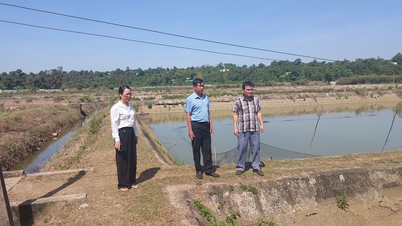
In the days leading up to the Lunar New Year of the Horse 2026, returning to the rice-shrimp farming areas in the communes of Tri Phai, Bien Bach, Thoi Binh, Nguyen Phich, U Minh... it's not difficult to see farmers enthusiastically harvesting rice, catching shrimp, pumping water, and preparing ponds for the main tiger shrimp farming season.
Although the price of freshwater prawns this year is not as high as the same period last year, Mr. Vo Minh Quan, from Nguyen Tong hamlet, Bien Bach commune, still couldn't hide his joy as his income from freshwater prawns reached tens of millions of dong. Mr. Quan said that with 1.5 hectares of freshwater prawn farming combined with rice cultivation, he harvested nearly 450 kg. Traders bought them at his home for 93,000 dong/kg, bringing in over 40 million dong, not including the more than 30 million dong from selling rice.
 This year's giant freshwater prawn harvest brought Mr. Vo Minh Quan's family over 40 million VND.
"This is a significant income, even exceeding the earnings from a whole year of extensive shrimp farming as before, while the cultivation itself doesn't require too much expense or effort," Quân shared.
Previously, when shifting the production structure from rice cultivation to shrimp farming, many localities only cultivated tiger shrimp. However, the efficiency was not high, so many farmers gradually switched to a model of producing one rice crop on shrimp farming land, combined with a crop of freshwater prawns. With the resulting efficiency, from a few thousand hectares initially, the area has now reached nearly 90,000 hectares, with many high-quality rice varieties such as ST24, ST25, Dai Thom 8... Currently, the rice crops are entering the harvesting stage, with an average yield of 5.45 tons/ha.
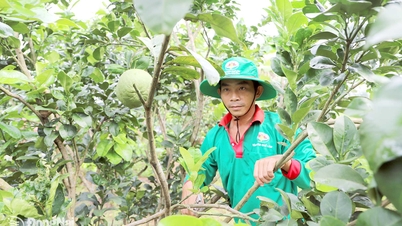
Along the T19 route in Khanh An commune, the atmosphere is bustling with activity these days as the main water chestnut harvesting season begins. The model of growing water chestnuts combined with raising freshwater fish on agricultural land is thriving, not only bringing high economic efficiency but also contributing to the conservation of natural freshwater fish resources.
 The water spinach plant is providing a high income for people living along the T19 highway.
As one of the households that has converted all 4 hectares of land to growing water spinach and raising freshwater fish for over 4 years, Mr. Nguyen Van Tong, from Hamlet 14, Khanh An Commune, shared: “Because it is a low-lying, acidic land, we can only produce one rice crop per year. Even in good years, we only get 25-30 bushels per hectare, and after deducting expenses, the income is not much. But with 4 hectares of water spinach, we can harvest more than 2 tons each month. With a selling price of about 20,000 VND, we bring in over 40 million VND. That's not including the income from freshwater fish. Due to its high efficiency, most people in Hamlets 13 and 14 along the T19 route have now switched to this model.”
Innovate production processes, increase income.
Alongside crop and livestock diversification, many households have increased their income thanks to innovative production processes. Mr. Bui Van Si, from Tac Bien hamlet, Phan Ngoc Hien commune, said: "Since participating in the certified ecological shrimp farming model of Minh Phu Social Co., Ltd., efficiency has improved significantly. In particular, with guidance on the process of raising shrimp larvae before stocking and pond renovation after each farming season, production efficiency has increased 4-5 times compared to buying larvae and stocking them directly as before. With 5 hectares of land, applying the two-stage farming model, some years we earn over 450 million VND."
 Farmers in rice-shrimp farming areas are switching to high-quality rice varieties and intercropping with freshwater prawns, bringing in higher incomes.
Becoming a member of the Ba Dinh General Agricultural Cooperative in Ben Bao hamlet, Vinh Loc commune, has significantly improved the production efficiency of Mr. Nong Van Thai's family in Lo Xe hamlet. Mr. Thai stated: "By applying the cooperative's two-stage seedling rearing process, the stocking rate reached nearly 80%, resulting in higher shrimp farming productivity. In addition, rice yield increased from 500-600 kg/acre to 800-900 kg/acre. Importantly, input costs are low, while the product prices are stable, leading to significantly higher profits compared to before."
Small changes in farmers' thinking and practices have been bringing significant economic value, contributing to environmental protection, climate change adaptation, disease control, and aligning with the current green development trend. In particular, integrated extensive farming models such as shrimp-mangrove, shrimp-rice, and shrimp-crab-fish not only create a competitive advantage but also open up avenues for experiential tourism . Activities such as forest tours by motorboat, experiencing shrimp and crab harvesting, etc., have not only increased people's income but also played a crucial role in preserving the ecosystem under the forest canopy and forest resources.
Nguyen Phu
Source: https://baocamau.vn/thay-doi-nho-gia-tri-lon-a125599.html

![[Photo] National Assembly Chairman Tran Thanh Man working with the Standing Committee of the Law and Justice Committee](https://vphoto.vietnam.vn/thumb/1200x675/vietnam/resource/IMAGE/2026/05/21/1779378929214_ndo_br_1-4610-jpg.webp)
![[Photo] General Secretary and President To Lam presides over a working session with the Central Policy and Strategy Committee on the development of the materials industry.](https://vphoto.vietnam.vn/thumb/1200x675/vietnam/resource/IMAGE/2026/05/21/1779359935432_a3-bnd-3129-1412-jpg.webp)























































Comment (0)