

The Politburo has just issued Resolution No. 09-NQ/TW on building and developing Ho Chi Minh City in the new era. According to experts, the resolution not only opens up stronger special mechanisms for Ho Chi Minh City, but also shapes a new development model for the country's largest megacity, with rapid but harmonious growth, and with the quality of life and happiness of its people at its center.
The "breakthrough of breakthroughs" mechanism
Dr. Huynh Van Sinh, Lecturer in the Department of Basic Theory ( Ho Chi Minh City Cadre Academy), believes that Resolution No. 09-NQ/TW was issued more than three years after the implementation of Resolution 31-NQ/TW of the Politburo of the 13th Party Congress, a sufficient period to accumulate practical lessons and identify bottlenecks.
The most fundamental new aspect is that Resolution No. 09-NQ/TW not only sets goals but also defines the mechanisms to achieve those goals. For the first time, the Politburo advocated for the creation of a separate, special Urban Law specifically for Ho Chi Minh City, dubbed a "breakthrough of breakthroughs," aiming to create a superior legal framework, thoroughly decentralizing power and authority, allowing the city to proactively address issues arising from practical situations that current regulations have not yet adequately addressed.
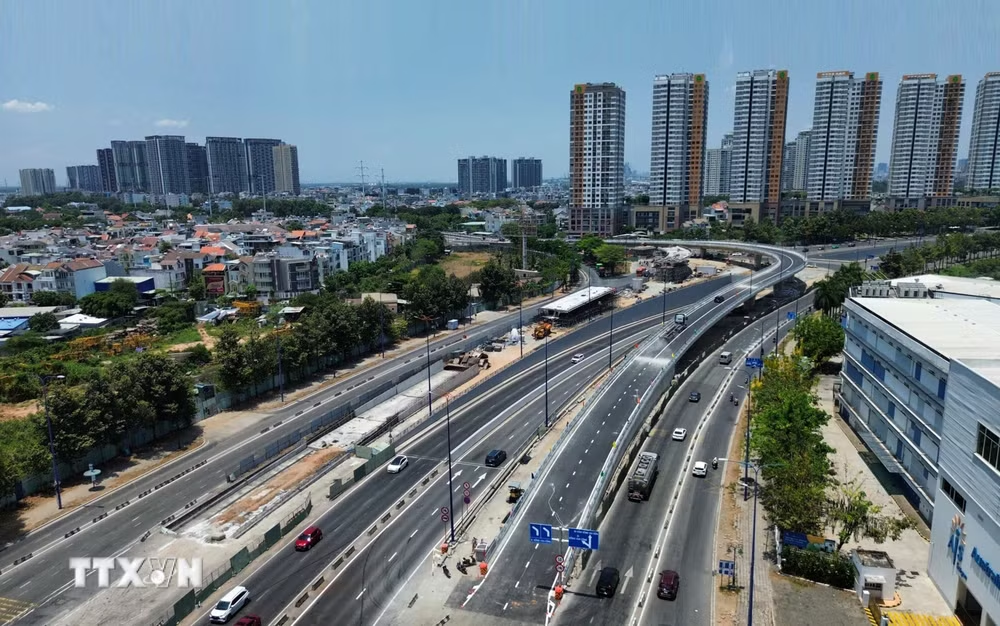
According to Dr. Huynh Van Sinh, for the Resolution to truly come to life, it is necessary to promptly enact the Law on Special Urban Areas. This is the "key" to unlocking the entire breakthrough mechanism; any delay will cause all other policies to be hampered by legal obstacles. The city must also build a team of capable and courageous officials, as the resolution requires officials to "dare to think, dare to act for the common good"; this necessitates a mechanism to protect dynamic and creative individuals and resolutely address the avoidance of responsibility.
Furthermore, the motto "Ho Chi Minh City for the whole country, the whole country for Ho Chi Minh City" should not just be a slogan but must be realized through a substantive regional coordination mechanism, mobilizing resources and sharing benefits between the city and neighboring provinces in the Southeast and Mekong Delta regions.
Sharing this perspective, Mr. Diep Van Son, former Deputy Director of the Ministry of Interior's Representative Office in Ho Chi Minh City, highly appreciated the task of drafting and promulgating the Law on Special Cities. According to Mr. Son, Ho Chi Minh City has long requested a superior mechanism for development, and this has now been concretized in the Politburo's Resolution. The city is the political center in the South, as well as the economic center, the leading engine of the Southern Key Economic Region, and plays a very important role in the urban system of our country.
Throughout its history, the city has implemented numerous initiatives and breakthroughs in institutional, economic, and administrative reform, setting a precedent for nationwide replication. These policies have been tested and proven effective in practice, thus the city deserves a special Urban Law with a long-term vision.
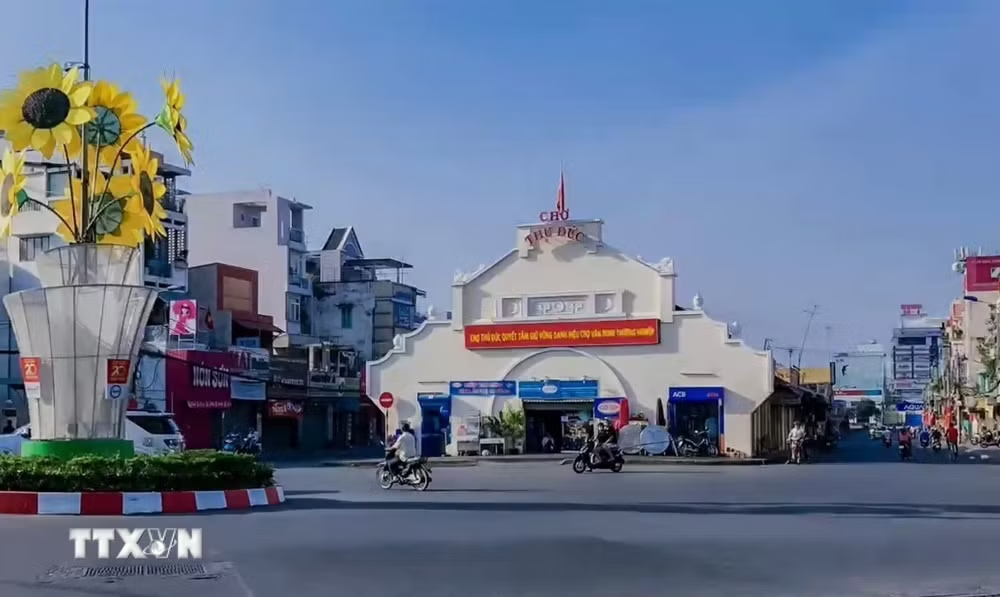
Cities like Ho Chi Minh City face challenges and have different management approaches compared to other localities. Solving these challenges for the city would open the door to solutions for cities across the country.
“Resolution 09-NQ/TW of the Politburo, recently issued, is accurate and meets the aspirations of the people of Ho Chi Minh City as well as the people of the whole country, because the development of Ho Chi Minh City is not just for the city itself, but for the whole country,” Mr. Diep Van Son shared.
Mr. Diep Van Son also emphasized that decentralization and delegation of power to the city, as stated in Resolution 09-NQ/TW, is a "civilized" approach in administration. In large cities like Ho Chi Minh City, many issues arise, and if every matter requires reporting, seeking opinions, and waiting for responses, it will cause significant delays, affecting people's lives and the development of the entire country. However, decentralization also needs a monitoring mechanism to ensure effectiveness.
According to Mr. Diep Van Son, the Resolution allows Ho Chi Minh City to proactively decide on the total number of personnel, not exceeding 20% of the number allocated by the Central Government. The city needs to take advantage of this to allocate personnel appropriately, because each facility will have different job requirements. Besides the decentralization and delegation of authority from the Central Government, the city must also study decentralization to the grassroots level and enhance the responsibility of those performing public duties.
People-centered
Resolution 09-NQ/TW sets out many important targets, including a minimum per capita GRDP of US$14,000 by 2030, US$75,000 by 2045, and US$100,000 by 2075; and a minimum GRDP growth rate of 10% per year for the first two decades. During the 2026-2030 period, the city aims to fundamentally address flooding, environmental pollution, traffic congestion, and drug-free conditions.

According to Dr. Huynh Van Sinh, the figures in the resolution reflect the grand ambitions of the Central Government and the City, and are based on scientific principles. The resolution clearly states that the extensive growth model cannot continue and must shift entirely to intensive growth, relying on science and technology, innovation, the digital economy, and the green economy.
This is not an abstract aspiration, as many major cities in Asia have set and realized similar goals when they had sufficient political will and flexible institutions. Ho Chi Minh City has the full potential to achieve this, if it thoroughly removes institutional and infrastructure bottlenecks.
One of the points that Dr. Huynh Van Sinh appreciated most in this resolution is the emphasis on human and cultural factors, clearly stating that "the satisfaction, well-being, and happiness of the people are the measure of leadership effectiveness."
This is a humanistic development philosophy, placing people at the center and as the ultimate goal. The initiative to build a "Ho Chi Minh Cultural Space" reflects the understanding that cultural identity is not a burden of modernization but a unique competitive advantage of the city on the Asian urban map.
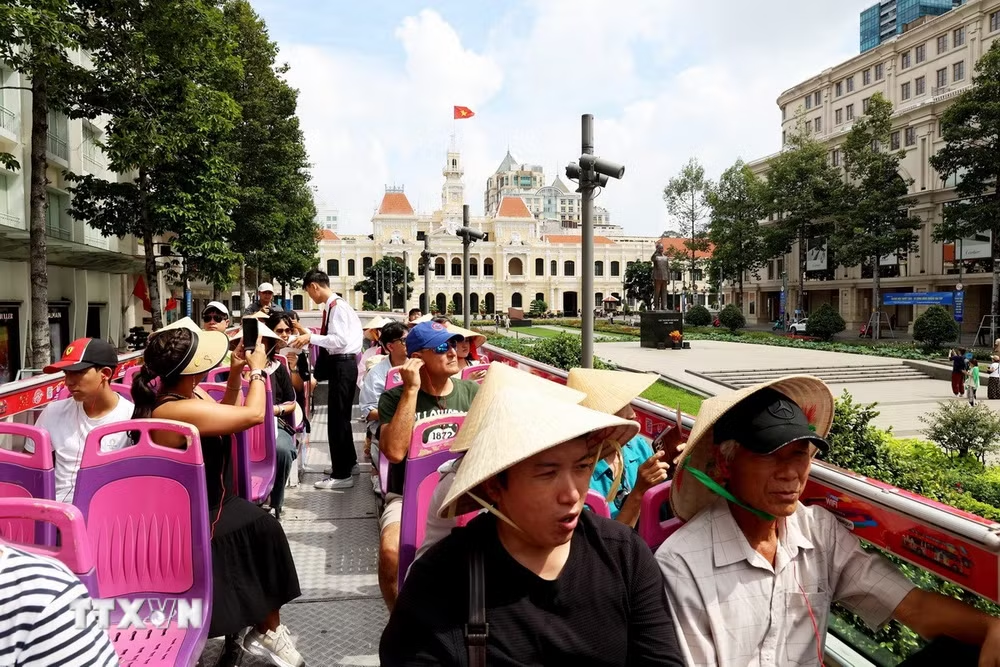
According to Dr. Huynh Van Sinh, the goal of maintaining a minimum Human Development Index (HDI) of 0.9 throughout all periods demonstrates a commitment to not sacrificing social welfare for economic growth.
An HDI (Human Development Index) of 0.9 or higher falls into the "very high human development" category according to the UNDP scale. For Ho Chi Minh City, this goal affirms that economic growth must go hand in hand with social equity and development for the benefit of the people.
To build a particularly developed, civilized, and modern city, focusing on improving the quality of life for its citizens, Dr. Huynh Van Sinh suggests that Ho Chi Minh City needs to complete its urban railway network, restructure residential spaces, and disperse the population to suburban areas following the TOD (Transit-Oriented Development) model.
The city is relocating houses along canals and renovating old apartment buildings, affecting over 20,000 houses along canals and hundreds of apartment buildings built before 1975 that are in serious disrepair. This is not just a housing issue, but also a matter of urban equity, providing worthy resettlement, and improving the quality of life for the most vulnerable population groups.
The city can develop smart satellite cities because the inner city is experiencing an overloaded population density; developing satellite cities in the former Cu Chi, Can Gio, and Binh Chanh areas; and along the Ring Road 3, the Bien Hoa-Vung Tau Expressway, National Highway 55, and National Highway 56. Designed according to a smart model with synchronized infrastructure, this will disperse the population in a controlled manner while creating new economic spaces for the Southeast urban region.
In addition, the city is implementing a comprehensive green transformation, from building materials and rooftop solar energy to urban wastewater treatment, which is a prerequisite for the city to achieve net zero emissions according to the resolution's roadmap.
The city also needs to digitize its urban governance infrastructure to improve the efficiency of its two-tiered administrative system and effectively manage a city of over 14 million people. This will also provide a data foundation for accurate and transparent urban governance decision-making.
Resolution 09-NQ/TW, with its vision extending to 2075, sets a historical mission for Ho Chi Minh City: to become a global, smart, and comprehensively developed city. The city is facing the opportunity to shape a new development model: not only an economic powerhouse, but also a livable city where citizens truly benefit from the fruits of development.
Source: https://www.vietnamplus.vn/thay-doi-tu-duy-de-kinh-te-thanh-pho-ho-chi-minh-but-pha-post1113051.vnp


![[Photo] Life on both banks of the river returns to its bustling pace on the day the Long Bien Bridge opens to traffic.](https://vphoto.vietnam.vn/thumb/1200x675/vietnam/resource/IMAGE/2026/05/28/1779949763708_cau-long-bien-minh-duy-7-3610-jpg.webp)
![[Photo] The heat at the fireworks display site on the opening night of the Da Nang International Fireworks Festival 2026](https://vphoto.vietnam.vn/thumb/1200x675/vietnam/resource/IMAGE/2026/05/27/1779889741485_ndo_br_z7872039145157-fecaba5112f39e8352544099d7ef4738-5140-jpg.webp)


































































Comment (0)