


Every year, during the summer break, many children of the Khmer ethnic minority in Hamlet 5, Vinh Tuong Commune, come to Khemmarapaphe Pagoda to learn the Khmer language. This year, the pagoda attracted about 70 students from grades 1 to 5 to study Khmer.
According to the temple's management board, to create the best conditions for the children, before the course began, the board coordinated with several Khmer ethnic teachers currently teaching at some secondary schools in the commune to plan the opening of the class.
The temple's management board is responsible for cleaning the classrooms, equipping them with blackboards, fans, and drinking water. Children from disadvantaged backgrounds will receive notebooks, books, and pens. All activities at the temple are running smoothly, demonstrating the care and attention of all levels of government and local authorities towards education in ethnic minority areas, creating a foundation for the younger generation of Khmer people to continue to nurture their pride and awareness of preserving their traditional culture.
During the teaching process, teachers use different methods depending on the class to ensure the material is easy to understand and absorb. Specifically, for first-grade students, teachers guide them step-by-step on how to write each stroke and pronounce words clearly. For third and fourth-grade students, during writing lessons, if a student doesn't understand what the teacher says in Khmer, the teacher transcribes it into Vietnamese.
Duong Thach Nhan has consistently and seriously participated in summer classes at Khemmarapaphe Pagoda for the past six summers. She shared: “During the summer, besides helping with household chores, instead of constantly glued to our phones, we should participate in summer classes, which are very beneficial. Because in these summer classes, we practice pronunciation and refine our handwriting. The teachers also impart knowledge about etiquette, culture, and the characteristic festivals of the Khmer people in Southern Vietnam. I think that, in addition to excelling in the regular school curriculum, learning the language, writing system, and culture of my people during the summer will help me equip myself with knowledge and prepare for my future dreams.”
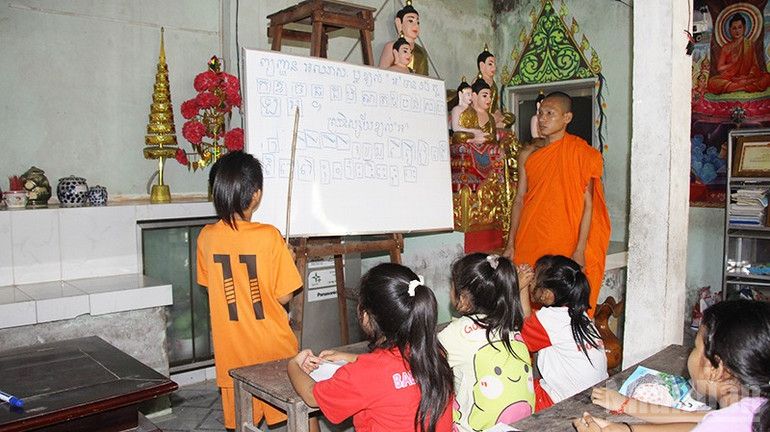
According to Mr. Duong Kim Lap, a teacher at Ly Thuong Kiet Primary School in Vinh Tuong commune, who is teaching 4th-grade Khmer language to students at Khemmarapaphe pagoda, most of the children participating in the summer class are well-behaved. They arrive very early for each lesson and listen attentively during class, thus absorbing the material very quickly.
Meanwhile, at PothiVongsa Pagoda in Hamlet 4, Xa Phien Commune, summer classes have been organized for many years, attracting hundreds of children from the Khmer ethnic community.
This summer, in the community area of the pagoda, over 120 students of various ages, categorized from grade 1 to grade 5, participate in Khmer language classes twice a day, morning and afternoon.
Mr. Duong Kim Lap, a teacher at Ly Thuong Kiet Primary School (Vinh Tuong commune, Can Tho city), said that the summer classes at the pagoda are divided into two sessions, morning and afternoon, from Monday to Friday each week. Due to circumstances, it is not mandatory for all teachers to teach regularly; they take turns. Sometimes, two or three teachers teach one class, and they take turns teaching the children whenever they have free time. The important thing is to help the children learn to read and write their ethnic language, and at the same time, help them understand more about the traditions and customs of their ethnic group.
Summer courses usually end at the end of August. Currently, the temples are coordinating with relevant authorities to conduct assessments to evaluate results, rank students' academic performance, and present gifts to commend, encourage, and motivate students to perform better in subsequent summer classes.
The important thing is to help the children learn to read and write in their own ethnic language. At the same time, we need to help them better understand the traditions and customs of their ethnic group.
Mr. Duong Kim Lap, a teacher at Ly Thuong Kiet Primary School (Vinh Tuong commune, Can Tho city)
This is where children in the villages learn to read and write their first letters.
In addition to learning to speak and write their "mother tongue," the children are also taught by teachers and monks in the temple about traditional customs and practices, and how to behave ethically within the family and community.
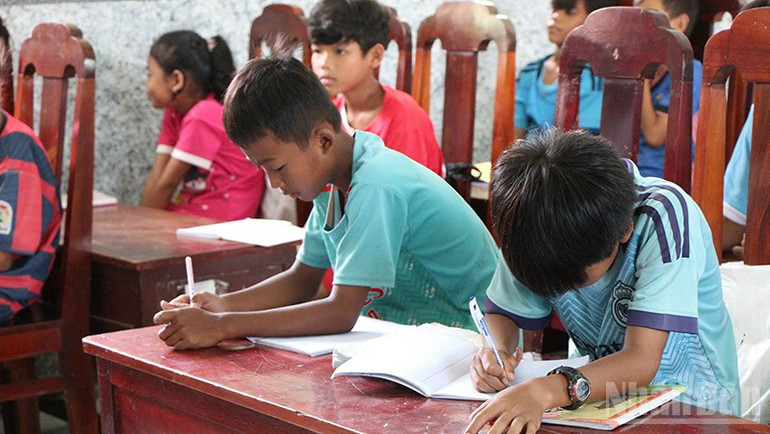
Thi Thanh Thao (15 years old) from Hamlet 4, Xa Phien Commune shared: “At school, we learn a lot of useful knowledge. Summer classes at the pagoda like this are also very meaningful. We get to practice the spoken and written language of our ethnic group. I dream of becoming a teacher in the future, standing in front of the class to impart knowledge to young children, teaching them about good and beneficial things for society and our village…”
For the Khmer people, the pagoda is not only a place of religious activity but also a place that connects the community's culture. Maintaining Khmer language classes during the summer not only helps preserve and promote the spoken and written Khmer language through generations but also contributes to building a united and developing community.
Source: https://nhandan.vn/thiet-thuc-tu-nhung-lop-hoc-he-danh-cho-dong-bao-khmer-post899665.html
![[Image] Pleasant weather helps students enter the 10th grade entrance exam with confidence.](https://vphoto.vietnam.vn/thumb/1200x675/vietnam/resource/IMAGE/2026/05/29/1780034401612_ngay-1-thi-lop-10-minh-duy-8-5009-jpg.webp)
![[Photo] Ba Lang An Lighthouse - the "eye of the sea" amidst the "rock museum" of Quang Ngai province.](https://vphoto.vietnam.vn/thumb/1200x675/vietnam/resource/IMAGE/2026/05/29/1780038698840_anh-man-hinh-2026-05-29-luc-14-10-42.png)




























































Comment (0)