

The Prime Minister stated that at the 11th Central Committee meeting, the draft documents to be submitted to the 14th Party Congress were supplemented and refined in a way that is revolutionary, action-oriented, highly feasible, concise, and succinct.
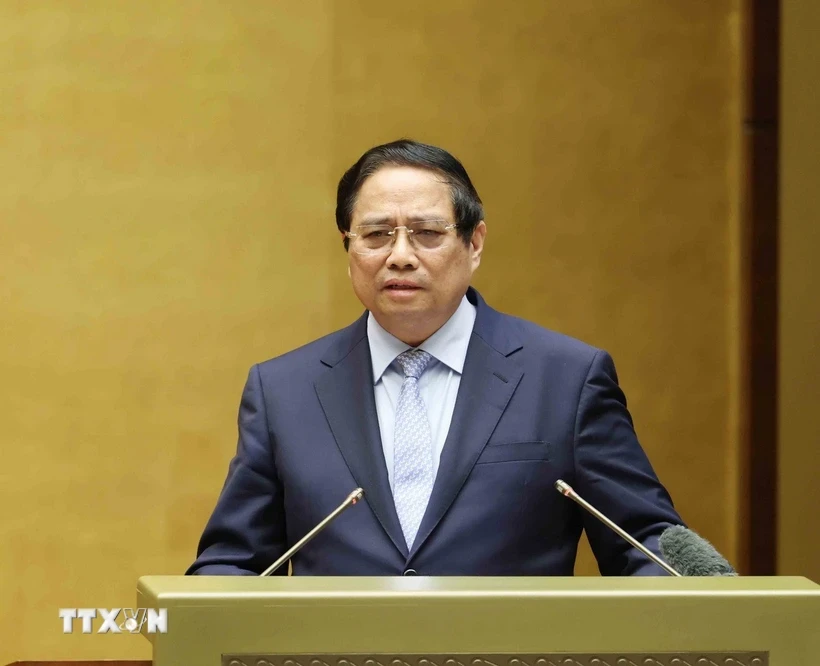
On the morning of April 16th, at the National Conference on the Implementation of the Resolution of the 11th Central Committee Meeting, 13th term, organized by the Politburo and the Secretariat of the Central Committee of the Party, Politburo member and Prime Minister Pham Minh Chinh delivered a presentation on Topic 1, clearly stating that at the 11th Central Committee Meeting, the draft documents to be submitted to the 14th Party Congress were supplemented and refined in a way that is revolutionary, action-oriented, highly feasible, concise, focused, and at the same time ensures the high level of generalization of the Party Congress documents.
The Prime Minister conveyed the first topic, outlining the core contents and new points in the draft documents to be submitted to the 14th National Congress of the Party, including: the Report summarizing some theoretical and practical issues on the socialist-oriented reform process in Vietnam over the past 40 years; the draft Report summarizing Party building work and the implementation of the Party Charter to be submitted to the 14th National Congress of the Party; the draft Political Report; and the draft Report on the 5-year implementation of the 10-year socio-economic development strategy 2021-2030 and the directions and tasks for socio-economic development in the 5 years 2026-2030.
Demonstrating the Party's wisdom, perceptiveness, and flexibility.
Prime Minister Pham Minh Chinh stated that from the 10th to the 11th Central Committee Meeting of the 13th Party Congress, the global situation has evolved rapidly, unpredictably, and is difficult to foresee. We have undertaken many actions in line with the evolving global and domestic situations, including: implementing a "revolution in organizational restructuring"; making breakthroughs in science, technology, innovation, and digital transformation; promoting international integration in the new context; accelerating the achievement of an 8% growth target in 2025, creating momentum and strength to achieve double-digit growth in the following years to strive for two centenary goals; and identifying the development of the private sector as the most important driving force in Vietnam's economic development.
At the 11th Central Committee Conference, 538 opinions were contributed to finalize the draft documents. Following the directives of General Secretary To Lam, the political reports were developed to be concise, succinct, feasible, and to demonstrate stronger determination and fighting spirit. In addition to updating and supplementing the situation, the political reports were shortened by 30%-40%, and in some cases even 50%, compared to previous versions.
"The timely inclusion of new content in the political reports submitted to the Party Congress demonstrates the wisdom, sensitivity, and flexibility of the Party, based on closely adhering to reality, respecting reality, and using reality as a yardstick," the Prime Minister affirmed.
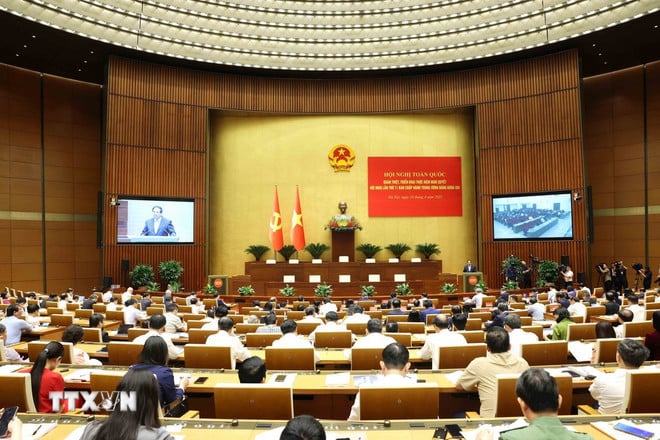
Highlighting the new points in the draft Report summarizing some theoretical and practical issues on the socialist-oriented reform process in Vietnam over the past 40 years, the Prime Minister stated that the report has added content analyzing the context and situation; affirming the completion of Vietnam's path to socialism based on three main pillars: socialist democracy; socialist rule of law; and a socialist-oriented market economy. Throughout this process, people are at the center and as the subject, without sacrificing the environment, civilization, fairness, and social progress for the sake of purely rapid growth, but it must be sustainable.
The Prime Minister introduced the contents regarding the development of the Party's theoretical understanding and achievements over 40 years of reform; lessons learned; and especially the outstanding results in socio-economic development. He stated that the draft report affirms that, after 40 years of implementing the reform process, the Party has gradually formed and perfected the theory of the reform line in Vietnam, which is Marxism-Leninism, Ho Chi Minh Thought combined with the culture of over 4,000 years of Vietnam's glorious history, creatively applied in the Vietnamese context and the global context.
"This is the application, supplementation, and creative development of Marxism-Leninism and Ho Chi Minh Thought in the specific conditions of Vietnam in the new era; it is the creative development of the theory of socialism and the path to socialism in Vietnam, in accordance with objective laws, stemming from the country's reality and the trends of the times; inheriting the fine traditions of the nation, selectively absorbing the essence, cultural values, and development achievements of humanity," the Prime Minister emphasized.
By 2030, GDP per capita is expected to nearly double what it is today.
Introducing the new points in the draft political report, the Prime Minister stated that, based on the addition of elements of self-reliance, self-confidence, and strong progress in the era of national development, and the revisions to ensure it is concise, clear, and has a strong call to action, the Central Committee unanimously agreed on the theme for the 14th National Congress as: “Under the glorious banner of the Party, working together with determination to successfully achieve the national development goals by 2030; self-reliance, self-confidence, and strong progress in the era of national development for peace, independence, democracy, prosperity, civilization, happiness, and steadily advancing towards socialism.”
The political report analyzes, supplements, and emphasizes new points regarding the context and situation; it also adds outstanding results and assesses the achievements of the 5-year implementation of the Resolution of the 13th National Congress. The economy has grown at a relatively high rate, averaging 6.2% per year, placing it among the high-growth economies in the region and the world. Significant progress has been made in the development of science, technology, innovation, and digital transformation.
The Human Development Index (HDI) has improved. Vietnam has implemented free tuition for kindergarten and primary and secondary school students. Government agencies and localities are working to eliminate temporary and dilapidated housing by 2025; and to build one million apartments for low-income earners and workers. The capacity for forecasting and warning of natural disasters and adapting to climate change has been enhanced.
The defense and security industries have been invested in and developed, achieving breakthroughs and ensuring dual-use capabilities and modernization. Vietnam actively and effectively participates in United Nations peacekeeping operations; and has elevated and deepened its comprehensive strategic partnerships with major countries.
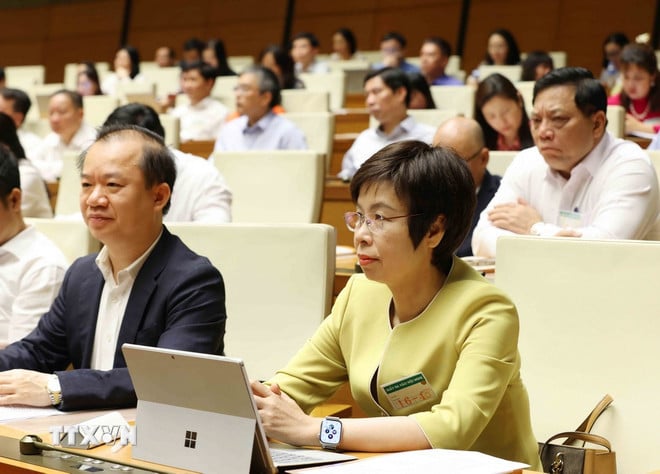
The country is undertaking a revolution in restructuring the overall model and organizational apparatus of the political system towards a streamlined, efficient, effective, and effective model, ensuring the synchronicity and unity of the entire political system from the central to local levels.
Along with supplementing the assessment of lessons learned and forecasting the context and situation, the Central Committee's political report added and emphasized the viewpoint: Ensuring development for stability and stability for rapid and sustainable national development; promoting the comprehensive construction and improvement of institutions for rapid and sustainable development; promptly and decisively removing bottlenecks and obstacles; unlocking and unleashing all resources and promoting all driving forces. This is coupled with a strong breakthrough in science, technology, innovation, and national digital transformation; attracting and utilizing talent, and promoting the development of new productive forces.
Regarding development goals, the following aspects should be added and emphasized: maintaining a peaceful and stable environment; achieving rapid and sustainable development based on science and technology, innovation, and digital transformation; self-reliance and confidence; and making strong progress in the new era of national development; and comprehensively improving and enhancing the lives of the people.
Specifically, the report outlines key targets for the five-year period 2026-2030, reviewing and adjusting some indicators, including striving to achieve an average annual growth rate of gross domestic product (GDP) of 10% or more for the period 2026-2030; GDP per capita reaching approximately US$8,500 by 2030; a social labor productivity growth rate of approximately 8.5% per year; and total social investment averaging around 40% of GDP over the five-year period.
The Prime Minister outlined 12 key tasks and solutions in the draft Political Report concerning: perfecting the system; restructuring the economy, establishing a new growth model, promoting industrialization and modernization; developing Vietnamese culture and people comprehensively; building a modern national education system; breakthroughs in science and technology development, innovation and digital transformation; managing sustainable social development; ensuring social progress and equity; resources, environment, and climate change; foreign affairs and international integration; perfecting the socialist rule of law in Vietnam...
The private sector is one of the most important drivers of the economy.
Regarding the new points in the draft Report on the 5-year implementation of the 10-year socio-economic development strategy 2021-2030 and the direction and tasks for socio-economic development in the 5 years 2026-2030," the Prime Minister stated that the socio-economic development results for the 5 years 2021-2025, supplemented and emphasized the following contents: in the last two years of the term, there was a focus on decisive direction, issuing many decisions, creating many historical milestones, especially implementing the revolution in reorganizing the political system's apparatus towards a streamlined, strong, efficient, effective, and effective system; merging some provincial-level administrative units; implementing a two-tiered local government model; ensuring macroeconomic stability, controlling inflation, and promoting growth; and public debt, government debt, and foreign debt were well controlled.
The stakeholders focused on reviewing and improving institutions and laws, removing difficulties and obstacles for production and business; promoting administrative reform, especially reducing administrative procedures, decentralization, and delegation of power; strongly promoting science and technology, innovation, and digital transformation; focusing on resolving difficulties and obstacles for long-standing stalled projects; accelerating the construction and implementation of expressways, high-speed railways, urban railways, and nuclear power plants; and emphasizing the role, importance, and synchronized implementation of solutions for the development of the private economy.
In addition, the units will implement tuition fee exemption for students from public preschool to high school; focus on completing the basic goal of eliminating temporary and dilapidated houses by 2025; pay attention to investing in the development of social housing, actively implementing the Project to invest in the construction of at least 1 million social housing units; and establish a "National Social Housing Fund." Economic growth in 2024 is projected to reach 7.09%, and is expected to reach 8% or higher in 2025, placing Vietnam among the high-growth countries in the region and the world.
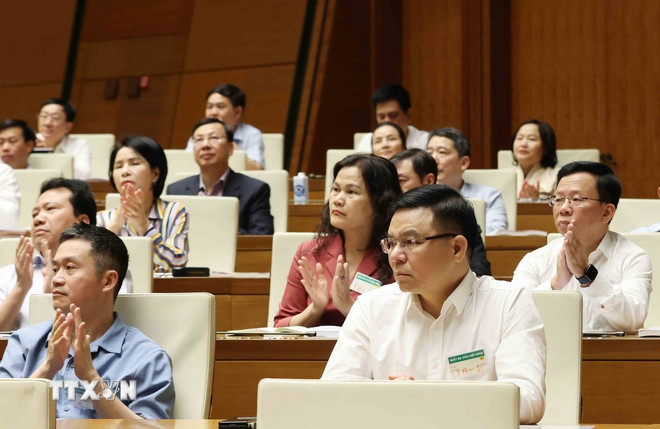
Regarding the forecast of the context, perspectives, and development goals for the 2026-2030 period, the draft socio-economic report outlines 11 main groups of tasks and solutions; including some new content on: perfecting institutions and mobilizing resources; promoting industrialization and modernization, restructuring the economy, and establishing a new growth model; developing the private economy, clearly identifying the private sector as the most important driving force of the economy; and decisively implementing breakthroughs in science, technology, innovation, and digital transformation.
Building a national education system and developing high-quality human resources; developing infrastructure systems, developing regions, localities, urban areas, and rural areas; developing culture and society, improving people's lives; managing resources, protecting the environment, and responding to climate change; ensuring national defense, security, and foreign relations...
Perfecting the theory of Party building to truly be "moral and civilized"
Introducing the new points in the draft report summarizing the work of Party building, Prime Minister Pham Minh Chinh said that the Central Committee unanimously agreed to add assessments and emphasize some outstanding results. In particular, it affirmed that the work of Party building during the 13th Party Congress term was truly placed in a "key" position by the Central Committee, the Politburo, the Secretariat, and Party committees and organizations at all levels...
The implementation of the 10 tasks on Party building, the 3 key tasks and 3 breakthrough solutions set forth by the 13th National Congress, especially a number of revolutionary policies and tasks, has been focused on by the Central Committee, the Politburo, the Secretariat, led by the General Secretary, with a very new, decisive, effective, comprehensive, synchronized, and profound organizational method, achieving very important results and creating a foundation for our country to firmly enter a new era, an era of striving for strong, prosperous development.
Building upon the results of seven years of implementing Resolution 18, the recent historic revolution in streamlining the organizational structure of the political system demonstrates that this policy is very correct, very effective, and has full scientific, political, legal, and practical grounds, which have been supported and highly appreciated by cadres, Party members, the people, and international public opinion. The Central Committee, the Politburo, and the Secretariat have reformed their thinking and comprehensively and synchronously issued many policies and resolutions. The correct, wise, and skillful leadership of the Party is the decisive factor in the country's achievements and successes in recent years, and the success of the reform process.
According to Prime Minister Pham Minh Chinh, the guidelines emphasize: Practical experience has confirmed that the Party's leadership is the decisive factor in all revolutionary victories, and Party building is a key task. Therefore, in the new era, with very high new demands, special attention must be paid to improving the effectiveness and efficiency of the Party's leadership and governance, and defining the Party's political mission of leading the country in the new era of development.
The Central Committee unanimously agreed on 10 groups of tasks and solutions to be implemented during the 14th National Congress term; including updating and supplementing the content of tasks to concretize the Central Committee's important orientations on: promoting the summation of practical experience and theoretical research; researching and further perfecting the theory of Party building on ethics, building a Party that is truly "ethical and civilized" in the new situation; perfecting and implementing the new organizational structure of the political system; paying attention to and creating a pool of female cadres, young cadres, cadres from ethnic minorities, and scientific and technical cadres; controlling power, preventing and combating corruption and negative phenomena; strongly reforming the content and methods of operation of the Fatherland Front, political-social organizations and mass associations...
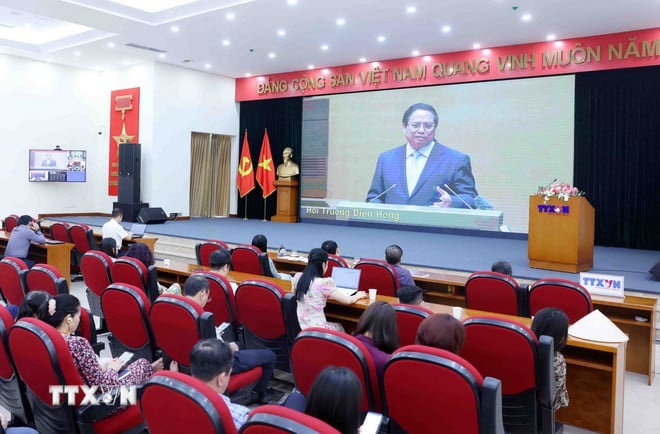
The Prime Minister stated that to accomplish these tasks, the Central Committee agreed on three breakthrough solutions to be implemented during the 14th Party Congress term, especially enhancing the capacity for self-renewal and self-improvement to strengthen the effectiveness and efficiency of the Party's leadership and governance, consolidating and strengthening the people's trust; and effectively implementing the new model of the political system's organizational structure, ensuring smooth operation and meeting the requirements and tasks of national development in the new era.
Based on the contents that have been disseminated, Prime Minister Pham Minh Chinh requested leaders of Party organizations at all levels to thoroughly study and refine the documents for their respective Party Congresses; at the same time, the Subcommittees should continue to research, update, supplement, and incorporate the opinions of Party congresses at all levels to submit to the upcoming Central Committee meeting.
Source
![[Photo] Prime Minister Pham Minh Chinh attends the Conference on the Implementation of Tasks for 2026 of the Industry and Trade Sector](/_next/image?url=https%3A%2F%2Fvphoto.vietnam.vn%2Fthumb%2F1200x675%2Fvietnam%2Fresource%2FIMAGE%2F2025%2F12%2F19%2F1766159500458_ndo_br_shared31-jpg.webp&w=3840&q=75)

































































Comment (0)