

 |
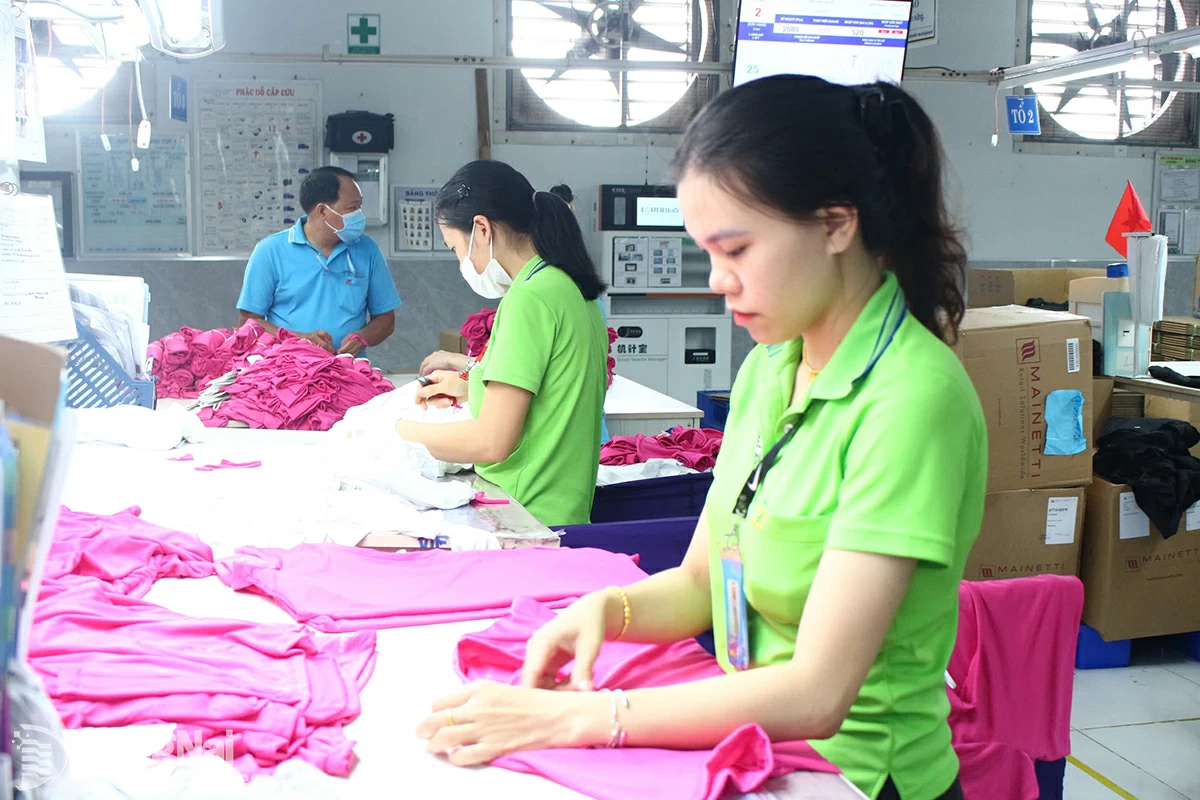
| Garment manufacturing at Dong Tien Joint Stock Company (Amata Industrial Park, Long Binh Ward), one of the country's well-known domestic garment companies. (Illustrative photo: Nguyen Hoa) |
According to economic experts, despite impressive growth, the textile and footwear industries are facing difficulties and challenges as tax policies and requirements regarding origin and raw materials in major markets such as the United States and the European Union (EU) are becoming increasingly stringent for imported goods, including those originating from Vietnam.
Key industries seek sustainable development paths.
According to statistics from the Vietnam Textile and Garment Association, in the first six months of 2025, the export turnover of the textile and garment industry reached nearly 22 billion USD, an increase of 10.6% compared to the same period in 2024.
In recent years, over 40% of Vietnam's textile and garment products have been exported to the US market. Therefore, US tariff policies will have a direct impact on textile and garment businesses. To proactively respond to market fluctuations, the industry has focused on training human resources and applying high technology (AI, robotics, etc.) in design and new product development.
At the conference between the Prime Minister and Vietnamese representative agencies abroad on the economic and diplomatic situation in the first six months of 2025 on July 22nd, Mr. Truong Van Cam, Vice Chairman and General Secretary of the Vietnam Textile and Garment Association, stated that the Vietnamese textile and garment industry currently exports products to 130 markets worldwide. However, products are still concentrated in a few main markets such as the US, EU, Japan (over 10%), South Korea and China (over 8%), and have not yet exploited many other potential markets.
According to Mr. Cam, the current "bottleneck" in the textile and garment industry is the production of fabrics and accessories. The industry is striving to attract domestic and foreign investment in this sector to proactively secure the supply of raw materials and accessories, as well as meet the origin standards stipulated in the free trade agreements (FTAs) that Vietnam has signed and benefit from in terms of tariffs.
For the footwear industry, according to statistics from the Vietnam Leather and Footwear Association (LEFASO), in the first six months of 2025, the export turnover of the leather and footwear industry reached 14 billion USD, an increase of 12% compared to the same period in 2024. The main export markets are the United States and the EU.
Sharing her thoughts on the challenges facing the footwear industry, Vice President of LEFASO Phan Thi Thanh Xuan stated that the current "bottleneck" for Vietnam's footwear industry is the issue of raw materials and components. Vietnam is still dependent on imported raw materials and components or on customer specifications through a contract manufacturing model for foreign partners. To address this problem, the footwear industry is seeking to achieve self-sufficiency in the production of raw materials and components within Vietnam. This would allow Vietnamese businesses to attract orders and create momentum for future growth.
Encouraging sustainable development solutions.
Currently, LEFASO, the Vietnam Textile and Garment Association, and the Vietnam Wood Association are proposing the establishment of an Innovation Center for the development of raw materials and accessories for the Vietnamese fashion industry (referred to as the Innovation Center). Accordingly, the Innovation Center will address many issues, diversify supply sources; and promote innovation in product design and business models.
According to Ms. Phan Thi Thanh Xuan, Vietnam's raw materials currently come not only from China, but also from many other countries around the world (Uzbekistan (leather materials), but they haven't yet found a way to access Vietnam). Therefore, the Innovation Center will act as a bridge connecting these departments.
In Dong Nai, textiles and footwear are key industrial production sectors. In the first six months of 2025, economic growth in the garment and footwear sectors is projected to reach 8-10% compared to the same period in 2024. Most garment and footwear businesses in Dong Nai are contract manufacturers for foreign partners and are heavily dependent on raw materials and product markets.
Mr. Tran Van Hung, Finance Director of Bowker Vietnam Co., Ltd. (Ho Chi Minh City), and Vice President of the Dong Nai Provincial Accounting Association, shared that Dong Nai has many businesses in the textile and garment sector. The majority of these businesses are garment processing companies, producing goods according to orders from foreign partners and still having to import raw materials. If they could secure a domestic source of raw materials, businesses would significantly reduce various costs…
Mr. Hung believes that building a sustainable textile and garment industry requires the involvement of the Government and relevant ministries and agencies. There must be mechanisms and policies to support and promote garment businesses in market development, supply chain management, and communication strategies to promote their brands…
Regarding the proposal from the footwear and textile industries to establish an Innovation Center, Prime Minister Pham Minh Chinh requested that these industries, as well as several other export-oriented economic sectors nationwide, develop strategies for researching and developing designs, packaging, and raw materials. He emphasized the need to minimize reliance on domestic suppliers while maximizing the utilization of domestic raw material supply capabilities.
The Prime Minister emphasized that the Government fully agrees with and supports the development of research centers in key economic sectors to achieve sustainable development strategies, aiming for product diversification and market diversification…
Ngoc Lien
Source: https://baodongnai.com.vn/kinh-te/202507/tim-huong-di-ben-vung-cho-nganh-giay-da-va-det-may-54e2103/
![[Photo] Secretary of the National Assembly Party Committee, Chairman of the National Assembly presides over the meeting of the Standing Committee and Executive Committee of the National Assembly Party Committee.](https://vphoto.vietnam.vn/thumb/1200x675/vietnam/resource/IMAGE/2026/06/03/1780480353201_ndo_br_bnd-2585-jpg.webp)


![[Photo] First session of the 14th Congress of the Vietnam Trade Union](https://vphoto.vietnam.vn/thumb/1200x675/vietnam/resource/IMAGE/2026/06/03/1780465947883_ndo_br_img-3852-jpg.webp)
![[Photo] General Secretary and President To Lam presides over a meeting with the Central Organizing Committee.](https://vphoto.vietnam.vn/thumb/1200x675/vietnam/resource/IMAGE/2026/06/03/1780482764658_a1-bnd-4741-3342-jpg.webp)









































![[Video] Sunset at Lap An Lagoon – Where the sun sets over the fishing nets](https://vphoto.vietnam.vn/thumb/1200x675/vietnam/resource/IMAGE/2026/05/31/1780192137701_beach-landscape-sea-water-nature-grass-745871-pxhere-com.jpeg)


























Comment (0)