Borrowers hit their loan limit right at the bank's doorstep.
As the year draws to a close, the seemingly familiar need of many families to borrow money for buying a house suddenly becomes a difficult journey. " I took my application to three places, and all three said they had reached their 'room' (credit limit), and they couldn't disburse the funds by the end of the year," one borrower lamented, sharing their struggle to find funding.
For a long time, many people hoped that the period leading up to Tet (Lunar New Year) would be a time of preferential rates, but the reality is quite the opposite: banks are tightening regulations, applications are being scrutinized closely, and credit quotas are gradually closing.
Another borrower said they used the HouseNow app (a real estate platform) to check their loan status and then contacted a consultant at a state-owned bank. Although the bank still had available credit, the consultant frankly warned them that "banks control cash flow very tightly at the end of the year," limits were being imposed, and the closer it got to the end of the fiscal year, the more difficult it would be to disburse funds.
The above facts indicate that while credit demand remains high, banks find themselves in a familiar yet strange situation at the end of each year: strong growth but difficulty lending because they have reached their lending limit.
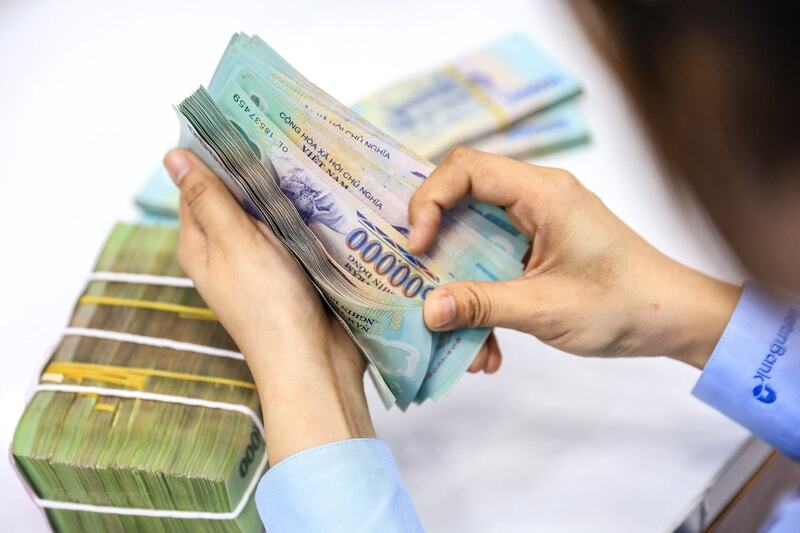
By the end of November 2025, credit across the entire system had increased by approximately 16%. Photo: Duy Minh
The discrepancy between actual borrowing demand and disbursement capacity stems not only from "limited lending capacity," but also from the overall market entering an unprecedented acceleration phase. According to a newly published analysis report by Rong Viet Securities (VDSC), by the end of November 2025, credit across the entire system had increased by approximately 16%, the highest level in the past ten years.
According to the report, many banks had nearly or completely used up their annual growth limits by the end of the third quarter, creating significant pressure during the peak months, which are expected to be the period of strongest disbursement.
In this context, the State Bank of Vietnam has not yet adjusted its credit growth targets upwards for October and November, as is customary in previous years. Since the relaxation of credit limits at the end of July 2025, the regulatory body has maintained a cautious stance.
VDSC believes that this move demonstrates a determination to control interest rates, limit pressure on the exchange rate, and maintain system liquidity amidst numerous challenges facing the financial market.
Experts from this organization also believe that, while not ruling out the possibility of the State Bank of Vietnam loosening its lending limits after the US Federal Reserve (Fed) cuts interest rates at its December meeting, it is highly likely that the regulatory body will maintain a cautious stance until the end of the year. The analysis group predicts that banks in their watchlist will seek to optimize their allocated credit limits, bringing full-year credit growth to approximately 18.2%.
From the beginning of 2025, the State Bank of Vietnam assigned all credit growth targets to credit institutions based on a general growth rate of approximately 16%, and then further adjusted the limit upwards on July 31, 2025. Notably, this increase was implemented according to the principle of transparency and proactiveness from the State Bank of Vietnam, without requiring any proposals from the banks.
At the press conference announcing the results of banking operations in the third quarter of 2025, Mr. Pham Chi Quang, Director of the Monetary Policy Department of the State Bank of Vietnam, emphasized that the State Bank of Vietnam has continuously adjusted credit limits, especially prioritizing credit institutions with strong financial capacity and high credit ratings.
With the current growth rate, Mr. Quang believes that credit growth across the entire banking sector could reach 19-20% by the end of the year, a very high level compared to recent years. However, he also warned that rapid growth always comes with risks regarding the quality of outstanding loans; therefore, the State Bank of Vietnam is closely monitoring and regularly warning credit institutions about allocating credit to risky sectors.
The roadmap to abolish credit limits: a bottleneck or a turning point for reform?
The recent issue of credit growth limits is not just a technical matter for the banking sector, but is becoming a policy topic of particular interest to the National Assembly. During the discussion on December 3rd, Representative Nguyen Thi Viet Nga, Deputy Head of the Hai Phong delegation, suggested that the State Bank of Vietnam should develop a clear roadmap to move towards abolishing credit growth limits.
According to her, although the State Bank of Vietnam has improved the method of allocating credit limits this year based on the safety level of each bank, the credit "quota" mechanism still essentially exists. She raised the issue: "After many years of being asked to abolish quotas, there is still no specific timeframe, no alternative management solution, while this is the most controversial tool in the financial system."
The delegates also suggested that, while it is not yet possible to immediately abolish the credit limit, the State Bank of Vietnam should limit mid-year adjustments to ensure stability, and at the same time expand the number of credit institutions that can independently increase credit growth within safe limits. The credit limit mechanism has existed for more than a decade as a tool to control credit quality, inflation, and money supply. However, in the context of an economy aiming for double-digit GDP growth, a development model heavily reliant on bank credit may encounter a "glass ceiling" if the credit limit remains rigidly applied.
According to analysts, the removal of the credit growth quota mechanism is an irreversible trend, especially since the Prime Minister has requested the State Bank of Vietnam to study a pilot program to abolish credit growth targets from 2026. Some banks have also prepared for this scenario and appear quite confident.
Ms. Bui Thi Thu Thuy, Senior Director of Corporate Finance Management at Techcombank, believes that the resilience of the Vietnamese banking system has significantly improved after the 2012-2014 crisis. A series of restructuring measures, tightened lending regulations, centralized risk control, the application of Basel II, and the ongoing transition to Basel III have raised the level of risk management to a new level. In addition, the mandatory mergers and transfers of weak banks have significantly reduced systemic risk.
With that foundation, Ms. Thuy affirmed that removing the credit limit would not cause any systemic negative impact. At the same time, Techcombank stated that they have the necessary foundation to seize opportunities in the current environment without a credit limit.
However, experts also acknowledge that removing credit limits is not a "magic bullet" that will immediately create room for growth. The important thing is that the monitoring framework after removing the limits must be sufficiently strict to avoid a repeat of the overheated credit growth and escalating bad debts seen in previous periods.
In requesting the State Bank of Vietnam to promptly develop a roadmap for removing credit limits, the Prime Minister emphasized that the State Bank needs to develop a set of transparent standards and criteria to assess healthy banks, ensuring sufficient governance capacity and credit quality when granting them greater autonomy.
Source: https://congthuong.vn/tin-dung-but-pha-nhieu-ngan-hang-can-room-tin-dung-cuoi-nam-433535.html



![[Photo] General Secretary and President To Lam presides over a meeting with the Central Organizing Committee.](https://vphoto.vietnam.vn/thumb/1200x675/vietnam/resource/IMAGE/2026/06/03/1780482764658_a1-bnd-4741-3342-jpg.webp)
![[Photo] First session of the 14th Congress of the Vietnam Trade Union](https://vphoto.vietnam.vn/thumb/1200x675/vietnam/resource/IMAGE/2026/06/03/1780465947883_ndo_br_img-3852-jpg.webp)

![[Photo] Secretary of the National Assembly Party Committee, Chairman of the National Assembly presides over the meeting of the Standing Committee and Executive Committee of the National Assembly Party Committee.](https://vphoto.vietnam.vn/thumb/1200x675/vietnam/resource/IMAGE/2026/06/03/1780480353201_ndo_br_bnd-2585-jpg.webp)






















































![[Video] Sunset at Lap An Lagoon – Where the sun sets over the fishing nets](https://vphoto.vietnam.vn/thumb/1200x675/vietnam/resource/IMAGE/2026/05/31/1780192137701_beach-landscape-sea-water-nature-grass-745871-pxhere-com.jpeg)












































Comment (0)