

In 2024, the real estate market received a series of good news as amended laws such as the Law on Land, Housing, Real Estate Business, and the Law on Credit Institutions 2024 were passed by the National Assembly and came into effect 5 months earlier (from August 1, 2024, instead of January 1, 2025), institutionalizing many new policies and guidelines of the Party and State on housing management and development.
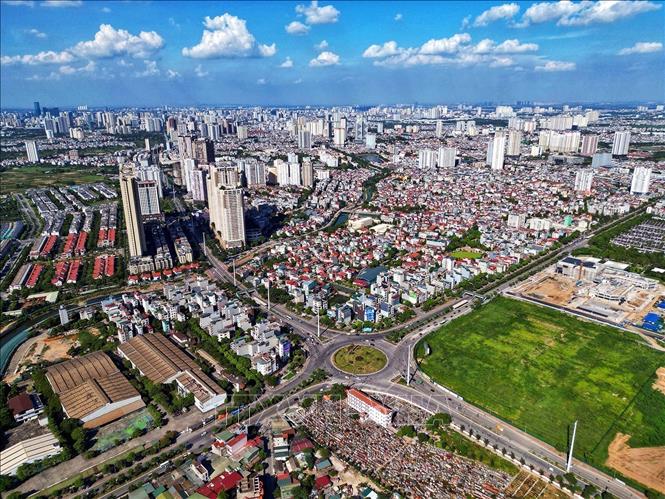
Although the implementation of the new law in the third quarter still faced some challenges, especially regarding land price regulations in some localities, the efforts to resolve market issues in the past period are undeniable. Many localities such as Ho Chi Minh City, Binh Dinh, and Binh Duong have made significant progress in addressing legal issues.
For example, Ho Chi Minh City has completed the removal of legal obstacles for 8 real estate projects such as The Metropole Thu Thiem, Celadon City, Metro Star, Lotte Eco Smart City Thu Thiem... These are all large-scale projects with total investment capital reaching thousands of billions of VND, offering diverse supply. This creates confidence for a strong market recovery in the last months of 2024 and provides momentum for 2025.
Regarding supply, transactions, and prices, the real estate market is showing positive signs. According to estimates by Vietcap Securities Joint Stock Company, the real estate market in Hanoi and Ho Chi Minh City recorded 23,900 primary apartment transactions in the past three quarters, a 28% increase compared to the total transactions for the whole year of 2023. New supply also grew by 11%, reaching 20,900 units. Hanoi currently dominates with 85% of total transactions and 91% of new supply in these two major markets.
Alongside this, real estate prices continue to rise, especially in the apartment segment, and show signs of spreading to other segments. In Hanoi, high-end apartments recorded the strongest price increase, ranging from 20-35% compared to the same period in 2023; while in Ho Chi Minh City, the price increase fluctuated from 15-20%.
Secondary market prices have moved away from deep discounts, instead showing a price difference of 10-20%. Rental prices have also increased by 10-20%. These figures reflect strong demand and the market's ability to maintain stable prices. Simultaneously, this trend reinforces confidence that the real estate market will continue to develop positively, providing a basis for businesses to expect good absorption for projects scheduled for launch in 2025.
Mr. Nguyen Van Dinh, Vice Chairman of the Vietnam Real Estate Association (VNREA) and Chairman of the Vietnam Association of Real Estate Brokers (VARS), predicted that 2025 will mark a significant milestone as market supply begins to be eased, but not completely. Projects that fully meet legal requirements and developer capabilities will be prioritized, helping to balance supply and demand in the market.
The VARS chairman also commented: This will be a promising year with stable growth in the industrial and commercial real estate segments. Despite experiencing many fluctuations, these two segments have maintained considerable stability, especially in industrial real estate, where demand for manufacturing areas, factories, and logistics remains high. At the same time, the commercial real estate market has shown positive signs in the last two quarters.
However, according to Mr. Dinh, residential real estate, especially the apartment segment, will still be the main driving force of the market in 2025, particularly given the current high demand for affordable apartments while supply is severely scarce. This segment not only meets the practical needs of middle-income households but also attracts the attention of investors seeking highly liquid real estate products.
Dr. Can Van Luc, Chief Economist of BIDV, analyzed: The current real estate market has seen many positive changes compared to the past. Specifically, the macroeconomic situation has gradually stabilized, inflation is controlled at a reasonable level, and interest rates in Vietnam remain low. Indicators such as budget deficit, public debt, foreign debt, and government debt repayment obligations are all within the limits permitted by the National Assembly.
Legal issues have also been gradually addressed, and institutional improvements have been emphasized, with many important laws passed and in effect, along with new decrees and policies. Planning at all levels is also being improved… These are important "supportive" factors, creating a solid foundation to help the real estate market enter a new phase and achieve a more sustainable recovery in the future.
According to Mr. Luc, the current domestic and international context still presents many risks and challenges to the recovery of the real estate market. Specifically, the global economy is slowing down, the disbursement of public investment is slow and lacks breakthroughs, and is uneven. Real estate businesses also face many difficulties; real estate prices remain high and are increasing rapidly in some segments… Therefore, real estate businesses need to be determined to restructure, focus on strong areas, and control risks related to cash flow, interest rates, and debt maturity to overcome the current financial difficulties.
From a macroeconomic perspective, Dr. Nguyen Minh Phong, an economic expert, commented: Recently, the Government and various ministries, sectors, and localities have been very determined to remove difficulties for businesses and projects. Furthermore, the macroeconomic situation has also seen positive changes, creating momentum for the real estate market. Historical real estate cycles show that when the economy transitions from a recovery phase to a growth phase, the real estate market usually becomes vibrant again with increased prices and transactions.
"With optimistic forecasts for Vietnam's economic growth, we can fully expect that in the last quarter of 2024 and the first half of 2025, the real estate market in general will continue its recovery trend on sustainable foundations," this expert shared.
With the government continuing to boost public investment, rapid urbanization is also contributing to a large demand for housing, business, and real estate investment. Overall, the real estate market is showing optimistic signs and is expected to continue developing in 2025.
According to VNA
Source: https://doanhnghiepvn.vn/kinh-te/tin-hieu-phuc-hoi-manh-cua-thi-truong-bat-dong-san/20241214083357110
![[Image] Hanoi Police officially crowned champions of V-League 2025/2026](https://vphoto.vietnam.vn/thumb/1200x675/vietnam/resource/IMAGE/2026/05/31/1780244769054_ndo_br_039d561b692be875b13a-jpg.webp)































![[Photo] The General Secretary, President and his wife begin their state visit to the Philippines.](https://vphoto.vietnam.vn/thumb/1200x675/vietnam/resource/IMAGE/2026/05/31/1780230559452_anh-man-hinh-2026-05-31-luc-19-28-11.png)




































































Comment (0)